
Butter biscuit baker
You’re mainly looking for a suitable beater and control when mixing your butter biscuit recipe, rather than a machine for light sponge batter.


Start by choosing the attachment that suits the method in your butter biscuit recipe. KitchenAid recommends the flat beater for biscuit mixtures and also describes using the dough hook to work pieces of cold butter into flour. Then compare your usual batch size, the dimensions and the cleaning involved. A larger bowl or higher wattage alone doesn’t prove that a small batch will mix better.
You’re mainly looking for a suitable beater and control when mixing your butter biscuit recipe, rather than a machine for light sponge batter.
You regularly make more than one batch for a picnic, so you’re comparing the bowl capacity with the stated dough capacity for a similar recipe.
You want a stand mixer that you can set up and put away without choosing solely on the basis of bowl capacity or motor power.
Start with your recipe method, then compare your usual batch size with the space available in your kitchen. Also check which attachments are included and how to clean them.
| What to consider | What should you check? | Who is this important for? |
|---|---|---|
| Attachment for your recipe | Read the recipe method and check which beater and dough hook come with the exact machine. | When I make butter biscuit dough, I want an attachment that suits the method in my recipe. Around 39% of consumers give choosing the right tool for the recipe top priority. |
| Batch size | Compare the quantity in your usual recipe with the stated capacity for a similar mixture; bowl capacity alone doesn’t tell you this. | When making multiple batches, I want to know whether my usual recipe will fit in one go. Batch size comes first for around 23% of consumers. |
| Worktop space and storage | Measure the available width, depth and height, allowing room to operate the head or bowl. | If my kitchen has limited worktop or cupboard space, the machine’s overall dimensions matter as well as the bowl. Around 23% of consumers prioritise the space available. |
| Cleaning and aftercare | Check the cleaning instructions and what’s included; also look at the difference between the manufacturer’s warranty and your statutory rights. | I want to know which parts I’ll need to clean, whether I’ll need to scrape the bowl during mixing and who to contact if something goes wrong. Cleaning and aftercare are the main priority for around 15% of consumers. |
The method for working with butter determines which attachment you need; terms for different bakes don’t automatically refer to the same mixture.
Start with the steps in your recipe and check what the beater and dough hook supplied with the exact model are designed to do.
Choosing the wrong attachment could mean having to buy a suitable one separately.
Manufacturers give capacity figures for different mixtures. These don’t tell you how much butter biscuit dough will fit in the same bowl.
Only compare capacity figures for similar mixtures, and use the quantity in your own recipe as your starting point.
Kenwood says the standard K-beater shouldn’t touch the sides of the bowl. You may need to scrape the sides with a spatula while mixing.
Check that a flexi beater is suitable for your exact model before buying one.
A compatible flexi beater may be sold separately.
A manufacturer’s warranty is separate from your statutory rights with the seller if a product doesn’t meet the standards you’re entitled to expect.
Check your statutory rights first, then compare the terms of any additional warranty.
An additional warranty product may cost extra.
KitchenAid describes different attachments for different methods of making biscuit dough.
The Go KZM35.000GY and kMix KMX750ABK offer different bowl sizes to compare with your batch size and available kitchen space.
The MUMS2VM00 is listed with a 3.8 l bowl and a patisserie set comprising a whisk, beater and dough hook.
Smeg lists stand mixers and flat beaters for individual models.
This Joybuy selection includes stand mixers with different bowl sizes and mixing attachments. Compare the included parts with your recipe, and check that the dimensions and capacity suit your kitchen and batch sizes.
 No image available
The included beater and dough hook give you two attachments to compare with the method in your recipe.
5 l bowl; 10 speeds; tilt head; whisk and beater included.
 No image available
The product description lists a flat beater and dough hook for you to compare with the method in your recipe.
6.5 QT bowl; 8 speeds; tilt head; flat beater, dough hook and whisk included.
 No image available
The product description lists the K-Beater for biscuit batter; compare that use with the method in your recipe.
6.70 l bowl; K-Beater, whisk and dough hook included; dimensions 34.50 × 28 × 38.50 cm.
 No image available
The stated dimensions help you work out whether the machine will fit on your worktop or in your storage space.
4 l bowl; dough capacity up to 1.4 kg; six speeds and pulse function; dimensions 33.5 × 18 × 30 cm. The dough capacity isn’t a separate measurement for butter biscuit dough.
The description lists a K-Beater and dough hook.
 No image available
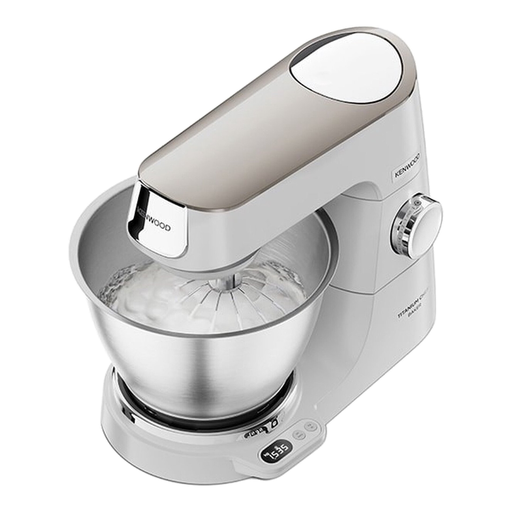
The built-in scales can weigh ingredients directly into the bowl; consider whether this feature suits the way you bake.
Built-in scales; digitally controlled 1200 W motor; LightLift head.
Start by checking the method in your recipe. KitchenAid recommends the flat beater for biscuit mixtures and also describes using the dough hook to work pieces of cold butter into flour. A wire whisk isn’t automatically the right choice, so follow the instructions for your model too.
No. Kenwood says the standard K-beater shouldn’t touch the sides of the bowl, as this could damage the bowl or attachment. Scrape the sides with a spatula while mixing if needed, and check separately whether a flexi beater is available for your model.
No, there’s no general two-year limit on statutory guarantees in the Netherlands. According to ACM ConsuWijzer, a product should do what you’re entitled to expect when used normally. If it develops a fault too soon, the seller is responsible for providing an appropriate solution at no cost. The manufacturer’s warranty is separate.
For a standard online purchase, ACM ConsuWijzer says you generally have a statutory cooling-off period of up to 14 days after delivery. There are exceptions and rules about unpacking and trying out the product, so check these before using the machine extensively.