
Baker making one large batch for the neighbourhood
Would prefer to knead the pre-calculated brioche dough all at once, so checks the stated dough capacity of the exact model.


First, work out how much dough your recipe makes and compare it with the stated dough capacity of the exact model; bowl capacity and dough capacity are not the same thing. If you want to make one large batch, look for a model with a suitable dough limit. A more compact model may be enough if you can plan to make several batches. When kneading and adding butter, follow both your recipe and the machine’s operating limits.
Would prefer to knead the pre-calculated brioche dough all at once, so checks the stated dough capacity of the exact model.
Wants to add butter gradually and follow the recipe steps and machine instructions while kneading.
Can make several batches if needed and weighs up the space the mixer takes against how often it will be used and its purchase price.
| What to consider | What should you check? | Who will find this important? |
|---|---|---|
| Dough capacity | Calculate the total dough weight for your recipe and compare it with the limit for the exact model and type of dough. Don’t compare kilograms of dough with kilograms of flour. | For a neighbourhood gathering, I’d prefer to knead the calculated amount of dough all at once, rather than having to plan several rounds. That’s why around 36% of consumers give batch capacity their top priority. |
| Dough handling | Check whether a dough hook is included and whether the manual allows the required speed and running time for your batch. | When I make brioche, I want to be able to add butter step by step and follow the machine instructions, even if I have to make smaller batches. Around 29% of consumers prioritise control over the dough. |
| Space and usage | Measure your worktop and storage space, and check the dimensions of the exact model. Allow extra kneading time if you’re making several batches. | I only bake occasionally and want to be able to put the mixer away after use; making several batches fits into my plans. Around 21% of consumers consider space and cost most important. |
| Cleaning and reuse | Check which bowls and attachments are included with the model and the cleaning instructions for each part. | After the gathering, I want to know how much cleaning the bowl and attachments will need, and whether I’ll use them again later. Around 14% of consumers prioritise cleaning and reuse. |
Bowl capacity in litres and weight in kilograms of dough or flour are different measurements. A large bowl alone doesn’t tell you how much brioche dough the manufacturer says the model can knead.
First calculate the amount for your recipe, then check the dough limit and manual for the exact model.
If the batch exceeds the applicable limit, you may need to knead it in an extra round, so allow time for that.
Consumentenbond says its reported test used a light white bread mix and did not test heavier dough. So the test doesn’t provide a direct result for brioche dough.
Use test results only for the task that was actually tested, and assess brioche separately based on your recipe, the capacity and the machine instructions.
The Kenwood KVL65 listing on Joybuy isn’t the KVL85.124SI that was assessed. Another KitchenAid listing we found describes a blender, not an Artisan stand mixer.
Before buying, check the full model number, product type, attachments and specifications.
A different model or product category may mean it isn’t suited to your recipe or planned use.
The Titanium Chef Baker XL KVL85.124SI is worth comparing if you’re looking for a larger batch capacity and two bowls.
The MUMS2VM00 is a more compact Series 2 model to compare if you want to balance batch size against the space available.
The Artisan 5KSM175PS is worth comparing if you’re weighing up smaller batches and the included mixing accessories.
The Assistent Original AKM6230 is an alternative to consider if your recipe calculation calls for a larger batch.
These Joybuy products are stand mixers with a dough hook or a stated dough capacity to consider when choosing a mixer for brioche. For each model, check the specifications and operating limits for the exact version.
 Image unavailable
Worth considering if you want to knead brioche dough and the stated dough limit suits your recipe.
The product description specifies a maximum of 1,7 kg of dough, a dough hook and several speed settings.
 Image unavailable
Consider this model if a 5 l bowl and adjustable speeds suit the way you bake.
The product name specifies a 5 l bowl, 10 speeds and a tilt-head design. The product description mentions a dough hook and a 400 W motor.
 Image unavailable
Worth comparing if a 6 l bowl suits your needs and worktop space.
The product name specifies 6 speeds, while the product description mentions a dough hook and a 450 W motor. According to the operating warning, the mixer must not run continuously for more than 6 minutes without a rest.
 Image unavailable
Worth considering if a larger bowl and included dough hook suit your baking plans.
The product details specify a 6,7 l bowl and a dough hook. Before using it for your recipe, check the applicable dough limit in the documentation for this model.
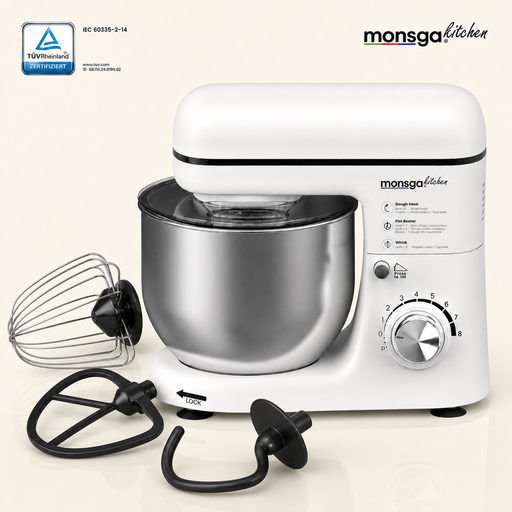 Image unavailable
Worth comparing if you’re looking for a tilt-head design and a dough hook for home baking.
The product name specifies a 5,0 l bowl and 8 speeds. The product description mentions a non-stick-coated dough hook.
Add together the weight of the ingredients in your chosen recipe for the number of portions you want to make. Compare the result with the dough limit for the exact model and type of dough; bowl capacity in litres and flour weight in kilograms aren’t the same as dough weight in kilograms.
Follow one complete brioche recipe and stick to the machine manual. A recipe from KitchenAid Nederland adds softened butter a spoonful at a time after an initial kneading stage; Heel Holland Bakt describes adding butter in cubes at a low speed. These recipe steps aren’t a universal setting for every mixer.
No. Check the cleaning instructions for each model and part. Bosch lists dishwasher-safe accessories for the MUMS2VM00; follow the instructions for the bowl, whisk and dough hook supplied with your model.
For online consumer purchases, you generally have a statutory 14-day cooling-off period after delivery, with some exceptions. If a product is faulty, the seller is responsible for the statutory guarantee; the Netherlands Authority for Consumers and Markets explains that this may include free repair or replacement.
Applicable safety rules apply to electrical appliances; Business.gov.nl describes, among other things, CE marking and the EU Declaration of Conformity. The Netherlands Food and Consumer Product Safety Authority states that materials intended to come into contact with food must comply with Dutch and European rules. These general rules alone don’t establish whether a specific product on offer complies.