
Brioche baker with limited worktop space
You want to know whether your usual batch is within the mixer’s capacity, without giving up more worktop space than necessary.


For brioche, first check the maximum amount of flour and total enriched dough weight permitted for the exact model. Then measure the space where you’ll put it, as well as the room needed to use the bowl. Kenwood states that the Go KZM35.000GY can handle up to 700 g of flour or 1.5 kg of enriched dough in total, subject to conditions on speed, kneading time and rest. Bosch gives flour and general dough limits for the MUMS2VM00, but no separate limit for enriched dough.
You want to know whether your usual batch is within the mixer’s capacity, without giving up more worktop space than necessary.
You need worktop space while preparing your ingredients, so you’re keeping an eye on the appliance’s dimensions and the space needed to reach the bowl.
You sometimes make a small brioche and sometimes a larger batch of dough, so you compare the flour and dough limits for the exact model rather than looking at bowl capacity alone.
| What to consider | What to check before buying | Who is this important to? |
|---|---|---|
| Suitable for enriched dough | Compare the flour quantity and total dough weight with the instructions for the exact model. For the Go KZM35.000GY, Kenwood states a maximum of 700 g of flour or 1.5 kg of enriched dough in total, at speeds 1–2 for 5–10 minutes; the brand recommends resting the mixer for at least 15 minutes between heavy loads. | I want to knead my brioche batch without exceeding the permitted capacity. Around 36% of consumers put suitability for enriched dough first. |
| Worktop and storage space | Measure the space where the mixer will sit, as well as the room needed to use the bowl. Kenwood lists the Go as 33.5 × 18 × 30 cm; Bosch gives the dimensions of the MUMS2VM00 as 266 × 266 × 277 mm (h × w × d). | I need to be able to put the mixer away after use and reach the bowl easily while kneading. Around 29% of consumers prioritise worktop and storage space. |
| Batch size | For your usual recipe, note both the flour weight and the total dough weight, then compare each separately with the model’s specifications. Bowl capacity in litres, flour in kilograms and total dough in kilograms are not interchangeable. | I don’t always make the same quantity, so I want the limit to suit both my smallest and larger recipes. Around 21% of consumers prioritise their preferred batch size. |
| Cleaning and attachments | Check which dough hook is included, how the parts should be cleaned and whether your existing accessories are compatible with the model range. For the Go, Kenwood recommends putting the bowl in the dishwasher and washing the K-beater, whisk and dough hook by hand; Go attachments are not interchangeable with Chef attachments. | I don’t want any surprises with cleaning or accessories after kneading. Around 14% of consumers prioritise ease of use, maintenance and attachments. |
The bowl’s capacity doesn’t tell you how much enriched dough you can knead in a particular model. The permitted flour quantity and total dough weight may have separate limits.
Compare both weights in your recipe with the instructions for the exact model, and take the recommended kneading time and rest breaks into account too.
The Go KZM35.000GY is an option if you have a small worktop and want an explicitly stated capacity for enriched dough.
The Serie 2 MUMS2VM00 is a compact option if you want to mix and whisk as well as knead.
The 5KSM3311X is worth comparing for smaller recipes where access to the bowl is important.
This selection includes stand mixers whose product information mentions kneading dough. Check the permitted amount of enriched dough and the space each model takes up during use.
 No image available
The stated bowl capacity and tilt-head may be useful if you’re looking for a stand mixer that gives you access to the bowl; bowl capacity doesn’t determine how much brioche dough you can knead.
The product name lists a 5.5 l bowl, 11 speeds and a 4.5-inch LED touchscreen.
According to the product description, the bowl and accessories are not dishwasher-safe.
 No image available
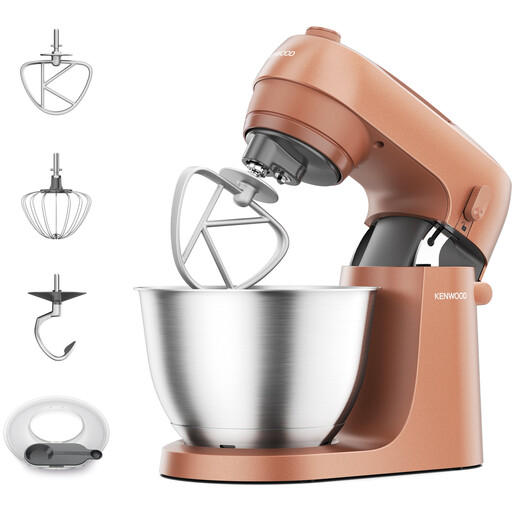
This version may suit you if you’re looking for a Kenwood Go with a dough hook. Check the instructions for this exact version before using it to knead enriched dough.
The product information lists a dough hook, whisk and K-beater. Kenwood Go attachments are not interchangeable with Chef attachments.
 No image available
According to the product information, this version has a tilt-head and dough hook. Check the model-specific instructions for your enriched dough recipe.
The product name lists a 5.0 l bowl and 8 speeds. The usage tips recommend a low to medium speed for kneading dough.
 No image available
The product information lists a dough hook and tilt-head. Measure the available space and check the dough limit for the exact version before choosing a brioche batch size.
The stated dimensions are 35.4 × 22.5 × 29.6 cm. The product name lists a 5 l bowl and 10 speeds.
 No image available
This version may be worth considering if you’re looking for a larger bowl, but bowl capacity doesn’t tell you how much enriched dough you can knead.
The stated dimensions are 40.7 × 26.8 × 33.2 cm. The product name lists a 6 l bowl and 6 speeds.
The product description warns against using the mixer continuously for more than 6 minutes without a rest.
No. The Consumers’ Association (Consumentenbond) distinguishes stand mixers, which can be used for longer kneading with a dough hook, from food processors, which are mainly used for slicing, grating and chopping and can at most knead light dough briefly.
Follow your recipe and the speed and capacity instructions for your mixer. In a KitchenAid brioche recipe, softened butter is added gradually once the dough has come together; this recipe instruction isn’t a general setting for other mixers.
Kenwood says to switch off the mixer and unplug it first. The bowl is dishwasher-safe; for the K-beater, whisk and dough hook, the brand recommends washing by hand.
No, you don’t need extra cover to have statutory rights. According to the Dutch Government, you have a legal guarantee when you buy a product, and the seller must provide a solution if it’s faulty. The Netherlands doesn’t have a fixed statutory guarantee period; if you’re considering extra cover, check what additional rights it actually offers.
According to the Netherlands Food and Consumer Product Safety Authority, CE marking is mandatory for electrical products covered by the applicable regulations. The marking is the manufacturer’s declaration that the product complies with those regulations; it isn’t proof that a specific mixer’s brioche performance has been independently tested.