
Baking for a crowd
You want to keep the number of batches to a minimum. Compare the dough capacity of the exact model with your recipe, and remember to allow enough time and space for proving.


Start by working out the total amount of dough per batch, then compare it with the dough capacity of the exact model. The bowl capacity alone won’t tell you how much dough the mixer can handle. An all-round mixer may suit you if you’re making smaller batches and also want to prepare batter or cream, while a model with a higher stated dough capacity may be worth considering for larger batches. For brioche, also follow the kneading instructions for your specific model and allow time and space for proving and, if needed, chilling.
You want to keep the number of batches to a minimum. Compare the dough capacity of the exact model with your recipe, and remember to allow enough time and space for proving.
You make dough with butter and egg and want to follow the instructions for your mixer. Don’t assume that a speed given in a recipe is a general rule for the machine.
You want to make batter or cream as well as dough. Compare the attachments supplied, the bowl and the storage space you’ll need for everything.
First, work out the total weight of dough in your recipe and decide how much you want to knead at a time. Then check the instructions and attachments for the exact model, and consider whether you’ll use the mixer for other baking too.
| What to consider | What should you check? | Who is this important for? |
|---|---|---|
| Amount per batch | Compare the total weight of dough in your recipe with the dough capacity of the exact model. Only compare flour limits with the weight of the flour. | If I want to knead as few separate batches as possible for a party, I look at the capacity for the type of dough in my recipe. Around 36% of consumers focus mainly on batch size. |
| Kneading instructions | Check the manual for the permitted quantity, speed and kneading time for your model. | If I’m making enriched dough, I want to know how to knead it using the instructions for my own mixer. Around 29% of consumers prioritise this approach. |
| Other party baking | Check which dough hook, whisk and mixing beater are included, and whether additional attachments are compatible with the model. | If I want to make batter or cream as well as brioche, I compare the attachments supplied. Around 21% of consumers are mainly looking for versatility. |
| Space and use | Measure the available worktop and storage space, and think about how many batches you expect to make. | If my kitchen is short on space or I only use the mixer occasionally, I want it to suit my kitchen and plans. Around 14% of consumers prioritise space and expected use. |
Bosch lists a 3.9 l bowl capacity, a maximum of 2.7 kg of cake batter and a maximum of 1.9 kg of yeast dough for the MUM5X720. These figures don’t apply to the same type of mixture.
Compare your recipe with the limit for the relevant type of dough, using the same unit of weight.
If the dough capacity is lower than your planned batch size, you may need to knead it in more batches.
KitchenAid’s general kneading FAQ and its brioche recipes don’t always specify the same speed or kneading time.
Use the manual for your exact mixer to check its limits, and follow your chosen recipe for the method.
A stated maximum dough capacity doesn’t tell you how much time or space you’ll need for the other steps in your recipe.
As well as kneading, allow time and space for proving, chilling and baking, following the recipe you’re using.
A large batch may also need plenty of space for the next proving and chilling stages.
According to Bosch, the MUM5X720 combines an integrated scale with a 3.9 l bowl.
According to Kenwood, the Chef XL KVL4100S is a planetary mixer with a 6.7 l bowl.
According to the manufacturer, the Assistent Original AKM6230 uses a rotating bowl and, in the version described, comes with a dough roller and dough hook.
According to KitchenAid, the tilt-head Artisan 5KSM175PS is designed for a range of mixing and whisking tasks; the version described comes with various attachments.
This selection focuses on stand mixers with a dough hook for making dough; some models are also listed with attachments for mixing or whisking. Always check the capacity and instructions for the exact model against your recipe.
 No image available
The product description lists a dough hook for making dough, as well as functions for mixing and whisking.
The title specifies a 5.5 l bowl and 11 speeds. No dough capacity is listed in the product information here, so check whether the permitted quantity is suitable for your recipe.
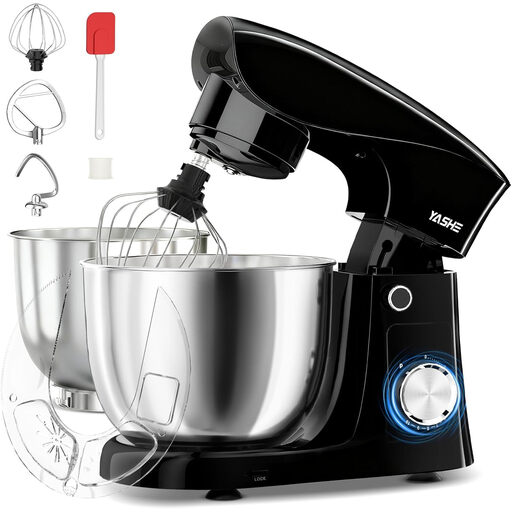 No image available
The product information lists a dough hook and says the mixer can knead bread and yeast dough; check the manual for the permitted quantity.
The title specifies a tilt-head design. The description lists two stainless steel bowls, with capacities of 4.5 and 5 l.
 No image available
The description mentions bread and yeast dough and a dough hook, as well as a mixing beater and whisk for other baking.
The title specifies 10 speeds and 600 W. The product description states a maximum operating time of 30 minutes; make sure you observe this limit.
 No image available
The product description lists attachments for kneading, mixing and whisking, including a dough hook for making dough.
The title specifies a 6 l bowl and 450 W. The product description warns against using the mixer continuously for more than 6 minutes without a break.
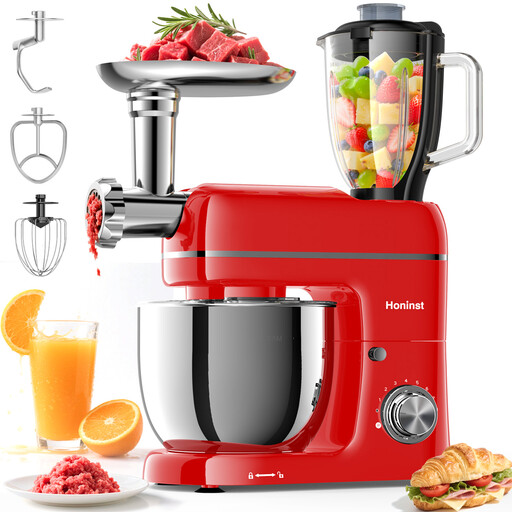 No image available
The title lists a dough hook for making dough, as well as a blender and meat grinder for other kitchen tasks.
The title specifies a 6.5 QT bowl and 8 speeds. Check the manual for the permitted dough quantity for the exact version.
No. Compare the weight of your full recipe with the relevant dough capacity of the exact model. Compare a flour limit with the weight of the flour, not the total weight of the dough.
Use the manual for your exact mixer to check its limits. KitchenAid’s general kneading FAQ recommends speed 2 and a limited kneading time for yeast dough, while KitchenAid recipes also specify other speeds or longer times. So don’t treat a recipe as a universal instruction for using your mixer.
Not necessarily: a KitchenAid brioche recipe describes proving the dough after kneading, then chilling it for at least 8 hours. Follow the timings in the recipe you choose and allow enough space for proving and chilling.
No. According to the Dutch Government, the Netherlands has no fixed statutory guarantee period: you’re entitled to a product that works as it should for as long as you could reasonably expect. If something goes wrong, contact the seller. A manufacturer’s guarantee or an extended guarantee you’ve bought is separate from your statutory rights.
For a standard online consumer purchase, you generally have a statutory cooling-off period of up to 14 days after delivery. ACM ConsuWijzer outlines the exceptions; also check the seller’s returns policy.