What should you look for when buying?
First, note the quantity and type of dough in your recipe. Then compare the stated limit on a like-for-like basis, and only after that consider workspace, accessories and how you’ll use the mixer after the school fair.
| What to consider |
What should you check? |
Who is this important for? |
| Dough per batch |
Compare dough weight with dough weight, or flour weight with flour weight. Check whether a separate limit applies to firm bread dough. |
If I want to make lots of loaves without an unnecessary number of kneading sessions, I look for a suitable batch limit. Around 36% of consumers prioritise the amount of dough per batch. |
| Several kneading sessions |
Check the manual for the exact model for quantity, speed, operating time and any required rest period. |
If I split the preparation into batches, I want to know how much time and space between sessions to allow for. Around 29% of consumers prioritise batch planning. |
| Space and future use |
Measure the available worktop and storage space, and check which dough hook, whisk or beater comes with that version. |
If the mixer will stay on the worktop or in the cupboard after the fair, space and its suitability for other baking matter too. Around 21% of consumers prioritise this combination. |
| Aftercare and what’s included |
Check the accessories and warranty terms for the exact model and seller. |
If I also want to know what comes with that version and who to contact if something goes wrong, I factor aftercare into my choice. Around 14% of consumers prioritise both the purchase and aftercare. |
Stand mixers on Joybuy
These product picks are aimed at kneading bread dough, with batch planning in mind and attachments that may also come in handy for other baking.
 No image available
AUCMA stand mixer, 5 l, 10 speeds, black
An option if you want to knead bread dough and also use attachments for mixing and whisking.
The product name lists a 5 l bowl, 10 speeds, a dough hook, whisk and beater.
Joybuy
 No image available
AUCMA stand mixer, 6 l, 6 speeds, black
An option if you want to knead bread dough and also use whisking and mixing attachments.
The product name lists a 6 l bowl, 6 speeds, a dough hook, whisk and beater. The stated instructions allow a maximum of 6 minutes of continuous use; allow for the required rest period.
Joybuy
 No image available
Bear Intelligent Dough Maker, 5 l, maximum 2.5 kg of dough
An option if you want a stated maximum dough quantity to help plan your batches.
The product name lists a capacity of up to 2.5 kg of dough and kneading and resting functions. Stick to the stated limit per batch.
Joybuy
 No image available
Kenwood Chef XL KVL4110 stand mixer, silver
An option if you want to use a dough hook to knead dough.
This version is listed as the Kenwood Chef XL KVL4110 in silver. Before planning a batch, check the applicable dough limit and instructions for this version.
Joybuy
 No image available
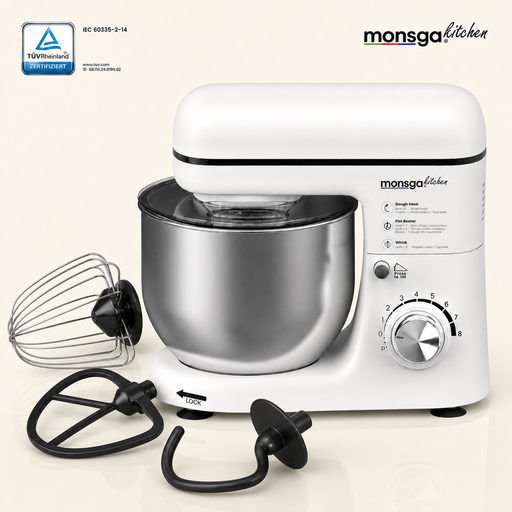
MONSGA SM100 stand mixer, 5.0 l, 8 speeds
An option if you’re looking for a stand mixer with a dough hook and also want to use mixing and whisking attachments.
The product name lists a 5.0 l bowl, 8 speeds, a dough hook and 1000W peak power.
Joybuy
Frequently asked questions
Can I use the mixing bowl capacity to work out the size of my bread batch?
No. Use the stated maximum quantity of dough or flour for the exact model, and compare it with your recipe on the same weight basis. Bosch specifies a maximum of 1.9 kg of yeast dough for the MUM58200, while KitchenAid gives a maximum of 1 kg of flour for the 5KSM125; these figures aren’t directly comparable.
Does the mixer need to rest between consecutive bread batches?
Follow the instructions for the exact model. For example, Kenwood recommends a rest of at least 15 minutes between heavy loads for the Kenwood GO; this instruction doesn’t automatically apply to the Chef XL or other mixers.
Do I still have rights if something goes wrong after the manufacturer’s warranty expires?
You may do: ACM ConsuWijzer explains that statutory guarantees in the Netherlands don’t have a fixed two-year term. With normal use, the period depends on what you could reasonably expect from the product. The seller is your point of contact, and the circumstances of the fault are also relevant.
Which rules apply if we sell homemade bread at school?
According to the Netherlands Food and Consumer Product Safety Authority, food sold at an event must be prepared, stored and sold safely and hygienically, including when sold by a private individual. Tell buyers about any allergens present; the way you provide this information differs for prepacked and unpackaged products. The NVWA says that anyone who prepares and sells food several times a year must have a food safety plan, but this information alone doesn’t mean that a plan is required for a single school fair.


