
Vandaag of morgen in huis

Kwaliteit gegarandeerd

Welkomstaanbiedingen ontgrendelen: GRATIS bezorging | Tot 80% korting | Gratis 30 dagen JoyPlus-proefperiode
Download de app
A stand mixer with a bowl can make preparing bread dough, cake batter, whipped cream and sauces easier. But a high wattage or a 6-litre bowl won’t automatically be right for every kitchen. If you look only at the product title or an impressive wattage figure, you could end up with a mixer that takes up too much space, isn’t stable on the worktop or is less useful than you expected.
This guide helps you compare a stand mixer, kitchen mixer or electric mixer based on verifiable features. That way, you can choose a food mixer to suit your recipes, worktop and how often you use it.
A high wattage sounds appealing, but it doesn’t tell you on its own how well a mixer with a dough hook can handle heavy dough. The motor design, overload protection, drive system and maximum dough quantity all play a part, too. Some sellers list peak power, even though the rated power is lower.
So check:
A stand mixer for bread and cakes shouldn’t be left running indefinitely with heavy yeast dough. Always follow the instructions for use.
You can’t fill a 6-litre bowl right to the top with ingredients. You need to leave room for mixing, rising and expansion. So the practical capacity may be lower than the figure on the packaging.
A 5-litre stand mixer is often enough for smaller households and standard cake or pizza recipes. A 6-litre stand mixer is better suited to larger batches, but it also takes up more space on the worktop. Check the external dimensions, as well as how much space you need to open the tilt-head.
Noise claims are only useful if it’s clear how and at what distance the sound was measured. A mixer rated at 60 to 75 dB may sound different in practice, depending on the surface it’s on, the speed setting and the type of dough.
A stable base, suction cups and vibration damping matter just as much. Check whether the manufacturer specifies a measuring distance, too. For example, according to its own product information, AUCMA lists a noise level measured within 1 metre for some models. This is a brand claim, not a universal comparison with all other mixers.
A stainless steel bowl is sturdy, doesn’t absorb odours and is generally easy to clean. Check that it’s made from stainless steel suitable for food contact, as stated for several models with a 304 or SUS304 bowl.
Also look out for:
A mixer with several speeds gives you more control when gently mixing, whisking and kneading. A pulse function is useful for short bursts of power, but it doesn’t replace a longer programme for heavy dough.
The basic set usually includes:
Check whether the accessories are dishwasher-safe. For some models, only the bowl and whisk are dishwasher-safe; the dough hook or flat beater must then be washed by hand.
A tilt-head makes it easier to change the bowl and accessories. A lock prevents the head from lifting during use. Anti-slip feet or suction cups help stop the mixer moving on smooth worktops.
Important safety features include:
Always use the mixer on a flat, dry surface. Switch it off and unplug it before changing the whisk, beater or dough hook.
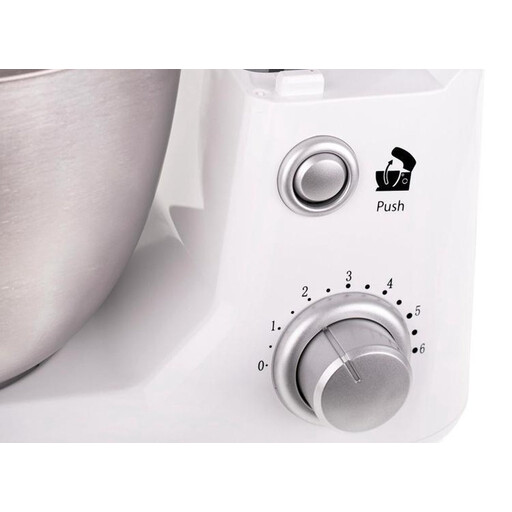
Why it suits this profile: This model has a 4-litre bowl, six speeds and three basic accessories. It’s a good match for smaller households and beginner home bakers who mainly make cakes, whipped cream and lighter doughs.
The product information gives specific details about bowl capacity, speeds, splash protection and suction cups. It also distinguishes between a rated power of 500 W and a maximum power of 1000 W, so you don’t have to interpret the figures as a single value.
4-litre stainless steel bowl, six speeds, planetary mixing action, whisk, beater and dough hook.

Why it suits this profile: The Bosch is designed for regular baking, with planetary mixing action and a baking set. The product description lists a 3.8-litre bowl and a capacity of 1.7 kg of dough or 2.4 kg of batter.
The stated maximum quantities give you a clearer idea of what you can actually process than wattage alone. However, the supplied product title and description list different power ratings and bowl sizes; check the current product specifications before buying.
3D planetary mixing technology, supplied whisk, beater and dough hook; accessories are dishwasher-safe according to the description.
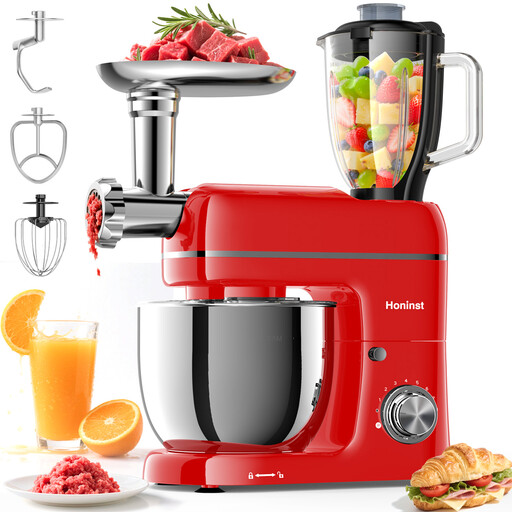
Why it suits this profile: If you want to grind meat or make smoothies and sauces as well as mix and knead, the product information says this model comes with extra accessories. The bowl has a capacity of 6 QT, and the mixer has eight speeds plus a pulse function.
The product description mentions a safety lock on the tilt-head and a maximum motor power of 1300 W. Use the extra functions only with approved accessories, and stick to the maximum quantities in the manual.
6 QT stainless steel bowl, eight speeds with pulse function, blender and meat grinder accessories, tilt-head with safety switch.
We’ve put together a complete, up-to-date list of products that meet these strict selection criteria and the applicable European safety regulations.
For a small household and everyday cake or pizza recipes, 4 to 5 litres can be a practical choice. For families or making several loaves in a row, 6 to 6.5 litres gives you more room. Always check the recommended dough quantity, not just the bowl’s total capacity.
That depends on the motor, dough hook, construction and permitted quantity. For yeast dough, use a low to medium speed in most cases, and don’t exceed the maximum quantity. Let the appliance cool down if the manual specifies a rest period.
Energy use depends on the power rating and how long you use the mixer. A 600 W mixer running for ten minutes theoretically uses about 0.1 kWh. Actual consumption may be lower or higher depending on the load on the motor. Using the right speed for a short preparation will usually help limit electricity use.
