
Vandaag of morgen in huis

Kwaliteit gegarandeerd

Welkomstaanbiedingen ontgrendelen: GRATIS bezorging | Tot 80% korting | Gratis 30 dagen JoyPlus-proefperiode
Download de app
A stand mixer with bowl can knead bread dough, mix cake batter and whip cream without you having to hold the mixer constantly. However, not every model is suitable for the same recipes. A large bowl, high wattage or a wide range of accessories does not tell you enough on its own.
As a Joybuy Product Recommendation Officer, I therefore focus mainly on verifiable product information: capacity, motor power, speed settings, accessories, maintenance and safety features. This helps you avoid buying a stand mixer that turns out to be too small, too noisy or difficult to clean after preparing a few heavy doughs.
A 6-litre bowl is not automatically suitable for filling completely. The maximum capacity depends on the recipe. Bread dough puts a lot of strain on the motor while kneading, whereas cake batter and whipped cream are less demanding.
So pay attention to the difference between:
For example, the Monsga SM100 is described as having a maximum bowl capacity of 6 litres, but a recommended usable capacity of 5 litres. That is more relevant than simply looking at the largest number on the packaging.
The motor power of an electric mixer is not always directly comparable. Some brands state peak power, while others quote nominal power. The Monsga SM100, for example, lists 1000 watts peak power and 600 watts nominal power. The AUCMA ASM1559 has a motor power of 450 watts.
So also consider:
Higher wattage does not automatically mean that a stand mixer is better suited to your bread- and cake-making needs.
A mixer with a dough hook, whisk and beater covers the basic requirements:
A multifunctional stand mixer with a blender or mincer can be useful, but it generally takes up more space and may leave you with extra parts to clean. Also check whether the accessories are dishwasher-safe and whether replacement parts are available.
For a family or regular home baker, a bowl of around 5 to 6.5 litres is practical. A stainless-steel bowl is sturdy, does not absorb many odours and is generally easy to clean. Check whether the bowl has a handle and whether it fits properly beneath the tilting head.
A larger bowl is not always more convenient for small quantities. With a small batch of batter, the whisk or beater may not reach the bottom as effectively. So look at the shape of the bowl and the stated planetary mixing action.
A stand mixer with adjustable speed gives you more control than a model with only a few settings. Low speeds are useful for gently incorporating flour into a mixture. Medium speeds are suitable for cake batter, while high speeds are ideal for whipped cream or egg whites.
Six to ten settings are sufficient for most household recipes. A pulse function can be useful for short, powerful bursts, but it does not replace a suitable low speed for kneading dough.
Noise claims should always be considered in their measurement context. Honinst states less than 60 dB, while Monsga gives a noise level of 75 dB. These figures are only genuinely comparable when measured at the same distance and under the same load.
Other useful features include:
Always follow the instructions when working with heavy dough. The Honinst information, for example, advises against kneading heavy yeast dough continuously for more than 10 minutes, after which the machine should be allowed to cool for at least 15 minutes. The AUCMA information specifies a maximum continuous operating time of 6 minutes. Guidance like this is more important than a general claim that a stand mixer is powerful.

Why it suits this profile: The combination of a 6-litre bowl, six speeds and three basic accessories is ideal for beginner home bakers who want to make bread, cake and pizza without extra features taking up valuable space.
The specifications state that it has a 450W copper DC motor, overheat protection and a recommended maximum operating time. This makes its limits with heavy dough clearer than a marketing claim about power alone.
6L stainless-steel bowl, dough hook, whisk, beater, pulse function and non-slip suction feet.
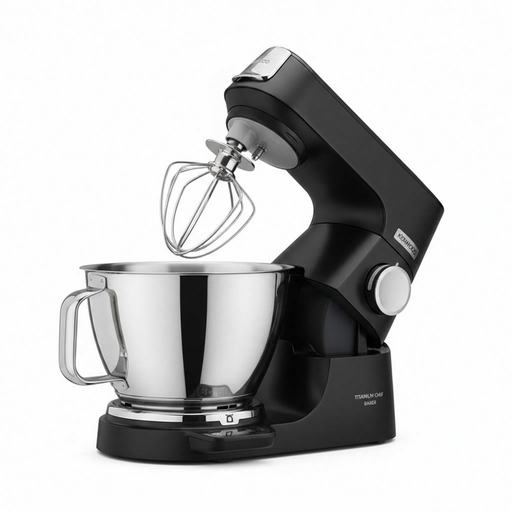
Why it suits this profile: If you bake frequently and want to work precisely, you get features that go beyond standard mixing, including built-in scales, a DuoBowl and a 1200W motor.
The capacity is 5 litres and the machine has integrated scales. This means you do not have to assess capacity and measuring cups based on vague marketing terms.
1200W motor, built-in scales, extra bowl, LightLift head and dishwasher-safe accessories according to the product information.
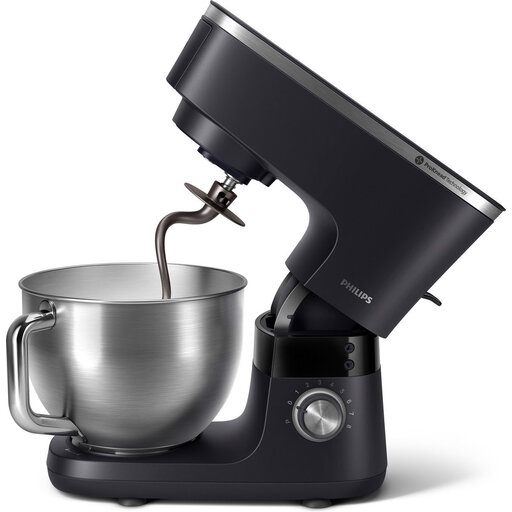
Why it suits this profile: This model is suitable for households that want to blend and mince as well as knead and whisk. The 5.5-litre bowl keeps the size practical for regular family use.
The product information clearly lists a 1.5-litre blender, a mincer, eight speeds and a timer. This allows you to decide in advance whether you will genuinely use the extra functions.
1000W power, 5.5L bowl, blender, mincer, eight speeds, splash protection and automatic shut-off via the timer.
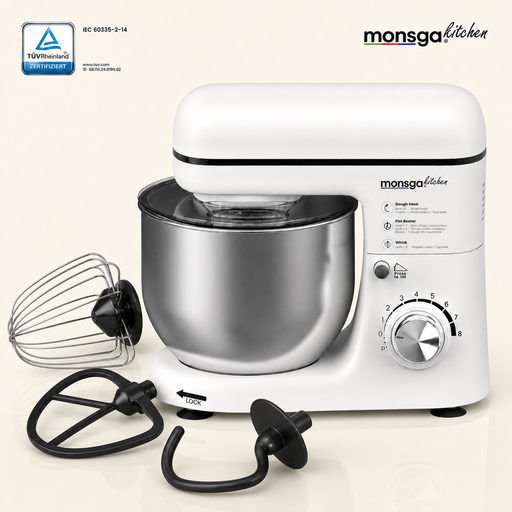
Why it suits this profile: The combination of a stainless-steel bowl, eight settings and three baking accessories is designed for cakes, biscuits, bread dough and whipped cream.
The product data distinguishes between 1000W peak power and 600W nominal power. It also states a recommended bowl capacity of 5 litres and overload protection.
8 speeds, tilting head, splash guard, stainless-steel bowl and dishwasher-safe accessories according to the description.
We have put together a complete, up-to-date list of products that fully meet these strict selection criteria and the applicable European safety regulations.
For everyday family use, a bowl of around 5 to 6 litres is often practical. If you mainly make small quantities of cake batter or whipped cream, you may need less. Always check the recommended usable capacity and maximum dough quantity in the instructions.
Yes, a stand mixer with a dough hook is designed for this, but the quantity and operating time vary from model to model. Start at a low speed, do not exceed the maximum capacity and allow the motor to cool down according to the manufacturer's instructions.
Consumption depends on the nominal power and operating time. A 1000-watt machine theoretically uses a maximum of 1 kWh in one hour, but actual consumption is lower when mixing for shorter periods. The wattage shown on the packaging is therefore not a direct prediction of the cost per recipe.
