
Vandaag of morgen in huis

Kwaliteit gegarandeerd

Welkomstaanbiedingen ontgrendelen: GRATIS bezorging | Tot 80% korting | Gratis 30 dagen JoyPlus-proefperiode
Download de app
A stand mixer with a bowl can knead bread dough, mix cake batter and whip cream without you having to hold the mixer the whole time. However, a high wattage or a large bowl doesn’t tell you everything. A machine may look powerful on paper, but prove awkward to use in practice because of an unstable base, a limited dough capacity or accessories that are difficult to clean.
For home bakers, keen cooks and families, these three pitfalls are particularly important.
A higher wattage doesn’t automatically mean a stand mixer can handle every heavy bread dough without a problem. Manufacturers may quote different figures, such as peak power or rated power. The Monsga SM100, for example, is listed with 1000 W peak power, while its stated rated power is 600 W.
So, check these details too:
For bread and pizza dough, you’ll usually want to use a low to medium setting and follow the instructions. A motor that is regularly overloaded may wear out more quickly.
A 5 or 6-litre bowl doesn’t have the same usable capacity as 5 or 6 litres. Ingredients need room to mix properly without spilling over the sides. The Monsga SM100, for example, is listed with a 6-litre capacity and a recommended working capacity of 5 litres.
When comparing a 5-litre stand mixer or a 6-litre stand mixer, check:
A large bowl is especially practical for families and for making several loaves or cakes. For small quantities, though, an overly spacious bowl may mix less efficiently.
Ten speeds sound appealing, but for everyday baking, the right accessories and a useful low-speed setting are just as important. A mixer with a dough hook is suitable for yeasted dough, a flat beater for cake batter and sauces, and a mixer with a whisk for egg whites or cream.
Before you buy, check whether the set includes:
A hand mixer is often lighter and takes up less space. A stand mixer with a fixed bowl is more convenient if you regularly make heavy dough or want to weigh out other ingredients while mixing.
A bowl made from food-grade stainless steel, such as 304 stainless steel, is durable, doesn’t absorb many odours and is generally easy to clean. Do check whether the bowl is dishwasher-safe, though; this isn’t automatically the case for every part.
For most households, 5 litres is a practical middle ground. If you often bake for a family, you could consider a 6-litre or 6.5 QT model. Bear the machine’s dimensions in mind, too. A stand mixer with a tilt-head also needs enough clearance above it.
A mixer that moves across the worktop is unsafe and impractical. Non-slip feet, suction cups and a sturdy housing help keep it in place. According to the product description, AUCMA uses four suction cups and a vibration-absorbing design. The brand lists a maximum noise level of 75 dB for the 5L model.
Noise ratings are useful for comparison, but always check how they were measured. A quoted figure doesn’t guarantee that every mixing task will be equally quiet. Heavy dough may cause more vibration than light cake batter.
Choose a model with a tilt-head, a locking mechanism and protection against overheating. Some models switch off the motor when the head is raised. This feature is listed, for example, on the Monsga and Honinst models.
Always unplug the machine before you:
Never immerse the motor housing in water. Also check the recommended maximum running time. The AUCMA 6L, for example, is listed as needing a break after no more than 6 minutes of continuous operation.

Why it suits this profile: This model is a straightforward starting point if you want to make cakes, pizza, bread and pastries with a fixed bowl and three basic accessories.
The stated 5L stainless steel bowl, splash guard, tilt-head and non-slip suction cups make its practical features clearer than a wattage claim alone.
According to the product description: 10 speeds plus a pulse setting, a 400W motor, whisk, dough hook and beater.

Why it suits this profile: A good fit if you’re looking for a larger bowl, several speed settings and features that make cleaning easier.
The product details distinguish between 1000W peak power and 600W rated power, and list 5L as the recommended working capacity for the 6L bowl.
According to the product description: 8 speeds, planetary mixing action, stainless steel bowl, splash guard and dishwasher-safe accessories.
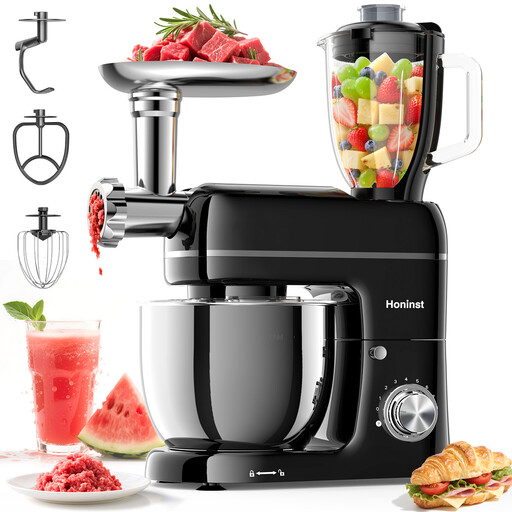
Why it suits this profile: A good choice for households that want to use a mincer and blender as well as mix and knead.
Be sure to check the maximum quantities first: the brand describes the appliance as intended for normal household use with approved accessories.
According to the product description: 1300W maximum power, a 6 QT bowl, 8 speeds, pulse function, blender and mincer.
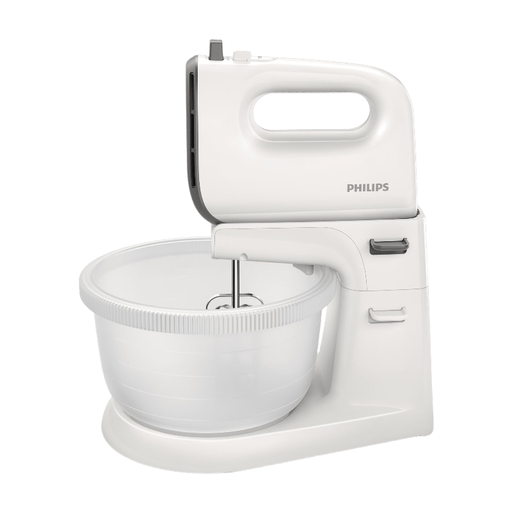
Why it suits this profile: This electric mixer with an automatically rotating bowl takes up less space than a heavy stand mixer and is designed for cake batter and light dough.
The fixed 3L bowl and automatic rotation make its capacity clear. For large quantities or heavy bread dough, a stand mixer with a larger bowl is a more suitable choice.
According to the product details: 450W power, 6 speeds, 3L bowl, two beaters and two dough hooks.
We’ve put together a complete, up-to-date list of products that meet these strict selection criteria and the applicable European safety regulations.
Yes. A stand mixer with a dough hook can knead bread or pizza dough, as long as you stick to the maximum quantity and recommended running time. Use a low to medium speed, and let the motor cool down between batches if the instructions recommend it.
For everyday household use, a bowl of around 5 litres is often practical. A 6-litre stand mixer offers more room for larger batches, but takes up more space too. As well as the bowl capacity, check the recommended working capacity.
Energy use depends on the power rating and how long you use the mixer for. A 400W mixer running for a short time may use less electricity than a higher-powered model used for longer. So, don’t compare wattages alone: consider your own baking time and how often you’ll use it.
