
Vandaag of morgen in huis

Kwaliteit gegarandeerd

Welkomstaanbiedingen ontgrendelen: GRATIS bezorging | Tot 80% korting | Gratis 30 dagen JoyPlus-proefperiode
Download de app
A stand mixer with a bowl can make preparing batter, cream and bread dough much easier. However, a high wattage or a large bowl doesn’t guarantee that an appliance is right for your kitchen. Home bakers and families in particular can fall into three common buying traps: unclear capacity claims, attachments that aren’t suitable for every task, and noise levels that only become noticeable once the machine is in use.
This guide helps you compare a kitchen mixer, stand mixer or mixer with a bowl using specifications you can check. That way, you can choose a model to suit your recipes, kitchen space and how often you’ll use it.
Manufacturers often state the bowl’s total capacity, for example 5 or 6 litres. That isn’t the same as the maximum amount of flour or dough you can safely process. A bowl may look spacious, while the motor and drive aren’t designed for heavy batches.
So always check:
For example, the Bosch MUMS2AW00 has a stated bowl capacity of 3.8 litres, with a maximum capacity of 1.7 kg of dough and 2.4 kg of batter. This gives you more practical information than the number of litres alone.
A power rating of 1000 watts sounds appealing, but manufacturers may present peak and rated power differently. The Monsga SM100, for example, is listed with 1000 watts peak power, alongside 600 watts rated power. So don’t compare wattage alone: also consider the intended use, maximum dough quantity and construction.
For a stand mixer for bread dough, a suitable dough hook, low speeds, stable feet and clear overload protection are more important than a high number on the box.
A quiet kitchen mixer is a subjective promise if no decibel rating is provided. The Monsga SM100 has a stated maximum noise level of 75 dB. The AUCMA ASM1559 lists 68–72 dB at one metre. No noise level is given for the Bosch MUMS2AW00.
Also look out for vibration. Suction cups or non-slip feet can help prevent the machine from moving on the worktop, but always place it on a flat, sturdy surface.
A stainless steel bowl is practical for everyday use and can usually be cleaned easily. Check whether the bowl has a handle, whether it’s dishwasher-safe and how much capacity you really need.
A larger bowl also takes up more space. So measure the space on your worktop and the clearance beneath your kitchen cupboards.
A versatile stand mixer with a dough hook usually comes with three basic attachments:
A splash guard helps prevent splattering, while a tilting motor head makes it easier to change the bowl and attachments. Do check whether replacement attachments are available. The Kenwood Chef XL is listed as having more than 20 optional attachments, according to the product information, but they aren’t all included as standard.
A stand mixer with multiple speeds gives you more control. Start at a low speed with heavy dough and only increase it if the recipe allows. A pulse setting is useful for short, powerful bursts of mixing.
Also look for:
According to the product information for various models, you should remove the attachments and unplug the appliance before cleaning or changing parts. Don’t use the machine beyond its maximum capacity.

Why it suits this user: The 3.8-litre bowl and included baking attachments are well suited to smaller households and beginner bakers making cake batter, cream and smaller quantities of dough.
The product information gives specific limits: a maximum of 1.7 kg of dough and 2.4 kg of batter. The stated motor power is 700 watts, rather than an unspecified peak power rating alone.
3D planetary mixing action, whisk, beater and dough hook; the attachments are dishwasher-safe according to the product description.

Why it suits this user: This model is designed for people who bake regularly and value a generous bowl, metal construction and built-in scales.
The product page lists 1200 watts, a 7-litre bowl and automatic speed control. Do check the space available before buying: the appliance is 40 cm high.
Stainless steel construction, built-in scales and a 2-year manufacturer’s warranty according to the product information.

Why it suits this user: The stainless steel bowl, eight speeds and dough hook make this model suitable for households that regularly make bread, cakes and other bakes.
The product description distinguishes between a maximum bowl capacity of 6 litres and a recommended working capacity of 5 litres. It also lists 75 dB, overload protection and four suction cups.
Eight speeds, tilting motor head, whisk, beater, dough hook and splash guard; the stated rated motor power is 600 watts.
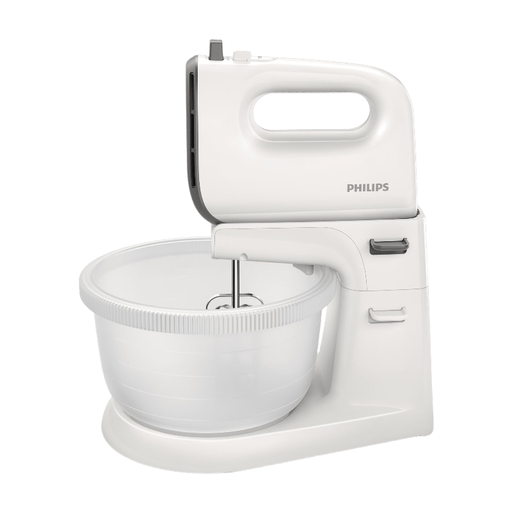
Why it suits this user: If you don’t want a large stand mixer taking up space, this electric kitchen mixer offers a more compact option, with a 3-litre bowl that rotates automatically.
The product specifications list 450 watts, six speeds and a bowl capacity of 3 litres, making it clearer which batch sizes the model is designed for.
Automatically rotating bowl, six speeds, two beaters and two dough hooks; according to the product information, it comes with a 2-year manufacturer’s warranty.
We’ve put together a complete, up-to-date list of products that meet these strict selection criteria and the applicable European safety regulations.
For a small household or occasional baking, 3 to 4 litres may be enough. For families, bread dough and making several batches in a row, 5 to 6 litres is more practical. Always check the maximum dough capacity; bowl capacity alone doesn’t give you the full picture.
Yes, if the model has a suitable dough hook and the manufacturer lists bread dough as a suitable use. Use a low to medium speed, don’t exceed the maximum quantity and allow for any recommended rest period. A larger motor isn’t automatically suitable for unlimited or prolonged kneading.
Consumption depends on the power rating and how long you use the appliance. A 1000-watt appliance would theoretically use a maximum of 1 kWh in an hour, but stand mixers usually run for shorter periods and aren’t constantly operating at maximum power. To work out the actual cost, multiply the energy used in kWh by your current electricity tariff.
