
Baker with a small cupboard
You want to make biscuit dough in a stand mixer regularly, but need to put the appliance away afterwards. That’s why both its external dimensions and the space needed to reach the bowl matter.


First, choose a stand mixer that fits in your cupboard and leaves enough room to reach the bowl while you’re using it. Then compare the mixing attachment and the stated capacity with your recipe: the bowl’s capacity alone doesn’t tell you how much firm dough the machine can handle. A food processor is worth considering if chopping and slicing matter just as much as baking; the Dutch Consumers’ Association distinguishes stand mixers as specialist appliances for mixing and kneading.
You want to make biscuit dough in a stand mixer regularly, but need to put the appliance away afterwards. That’s why both its external dimensions and the space needed to reach the bowl matter.
You want to know whether your recipe is within the stated limits. Bowl capacity alone won’t tell you; Bosch and Kenwood provide quantities specific to their products.
You’re weighing up mixing biscuit dough against chopping and slicing, while also considering how much space separate attachments will take up. The Dutch Consumers’ Association describes stand mixers and food processors as appliances for different kitchen tasks.
Best for: regular mixing or kneading with a bowl and mixing attachment.
Bear in mind: compact external dimensions don’t necessarily tell you the dough limit or how much room you need to use the bowl.
Best for: chopping, slicing and grating matter just as much as occasionally mixing a light dough.
Bear in mind: according to the Dutch Consumers’ Association, a stand mixer is more geared towards mixing and kneading, so don’t choose a food processor based on cupboard width alone.
| What to consider | What to check before buying | Who should consider this? |
|---|---|---|
| Storage and worktop space | Measure your cupboard and the space on your worktop. Bosch lists the MUMS2EW00 as measuring 266 × 266 × 277 mm; also allow room to reach and remove the bowl. | If I have limited cupboard space, I also want to be able to reach the bowl easily while mixing. Around 40% of consumers put storage first. |
| Suitability for biscuit dough | Check the mixing attachment and instructions for the exact model and recipe. KitchenAid says its flat beater is suitable for biscuits; this doesn’t automatically apply to every model version. | If you mainly want to know whether the mixing attachment suits your biscuit recipe, don’t skip the manual. Around 31% of consumers put suitability for their dough first. |
| Batch size and dough limit | Compare your recipe with the stated quantity of flour or dough for the model. Bosch lists a maximum of 0.8 kg of flour and 2.4 kg of dough for the MUMS2EW00; Kenwood states that the Go can handle 0.5 kg of flour for cake making. | If I make larger batches, I want to know whether my recipe is within the model’s limit, even if that means using more space. Around 15% of consumers put batch size first. |
| Other kitchen tasks | Decide whether mixing and kneading or chopping and slicing is the main task. Remember to include any attachments when estimating the storage space available. | Versatility matters if you want to do several kitchen tasks with as few appliances as possible. Around 14% of consumers put this first. |
Bowl capacity, maximum flour weight and maximum dough weight are different measurements. A larger bowl doesn’t automatically tell you how much firm dough you can mix.
Compare your recipe with the correct limit stated by the manufacturer for the exact model, and allow for whichever applicable limit is lowest.
A mixer with a tilting head also needs room for you to reach the bowl and mixing attachment. KitchenAid describes how to use mixers with a tilting head.
Measure both the storage space and the work area, and check that you can reach the bowl before choosing a model.
The Dutch Consumers’ Association says its bread dough test used a light white bread mix; heavier dough wasn’t included in the test.
Use test results only for the preparation that was actually tested, and consult the manual for the exact model to check whether it suits your recipe.
For the MUMS2EW00, Bosch provides the model dimensions, bowl capacity and quantity limits.
The Go KZM35.000GY is a stand mixer; the Prospero+ KHC29.A0SI is a different range with expandable functions.
KitchenAid describes mixers with a tilting head and provides separate guidance on mixing attachments.
These products are designed for mixing or kneading dough in a bowl. For each version, check that the included mixing attachments and stated quantities suit your biscuit recipe and available storage space.
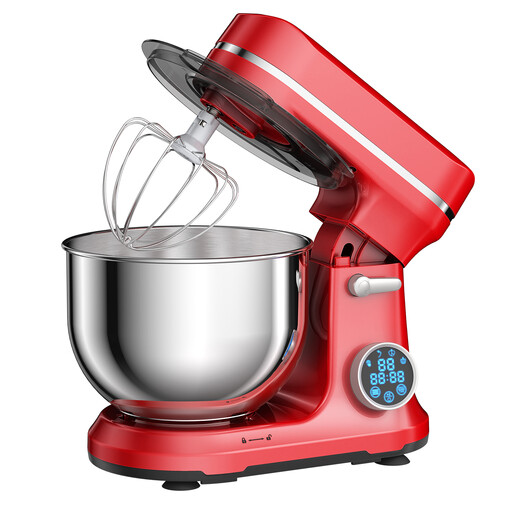 No image available
The product information mentions thick biscuit dough; check the model instructions and recipe limit for your preparation.
The product name lists a 5-litre bowl, a planetary mixing system, a 1200 W motor and 11 speeds.
 No image available
The tilting head can make it easier to reach the bowl; also measure the space needed to raise the head.
The product name lists a 5-litre bowl, 10 speeds, a 400 W motor, a dough hook, whisk and beater.
 No image available
The product name mentions automatic kneading; check that the mixing function and instructions suit your biscuit recipe.
The product name states a maximum dough quantity of 2.5 kg. Stick to this limit and check the manual for this version.
 No image available
One to compare if you’re looking for a stand mixer. Check which attachments are included with this version and how much dough it can handle.
 No image available
The product name lists a dough hook; check that the included attachments are suitable for the biscuits you want to make.
The product name lists a 5-litre stainless steel bowl, a peak power of 1000 W and 8 speeds.
Follow your recipe and the manual for your exact mixer. KitchenAid recommends the flat beater for cakes and biscuits; having a dough hook included doesn’t in itself mean it’s suitable for every biscuit recipe.
It could be a good fit if chopping and slicing are your priorities. For regularly mixing and kneading baking dough, the Dutch Consumers’ Association describes a stand mixer as the more specialised choice.
No. Use the stated flour or dough limit for the exact model. Bowl capacity and the maximum quantity of flour or dough are different measurements, so compare the relevant limit with your recipe.
Electrical equipment placed on the market in the Netherlands must meet the relevant European requirements. The Dutch Government’s Ondernemersplein explains CE marking and the EU Declaration of Conformity; check the information for the exact model, and don’t assume that a web listing means the individual product has undergone a safety test.
In the Netherlands, the seller is responsible for resolving the issue if a product doesn’t meet reasonable expectations; there is no fixed statutory guarantee period covering all products. For a standard online purchase, you generally have up to 14 days after delivery to change your mind, subject to legal exceptions. The Dutch Government explains your rights if there’s a problem with a product, while ACM ConsuWijzer provides information about the cooling-off period.