
Student on a tight budget
You want to make biscuit dough without paying for features you’re unlikely to use again. Check which beater is included and the price of the exact model.


Start by choosing a mixer that comes with the beater or flat beater you need, then decide how much dough you want to make at a time and how much space you have. A larger bowl can be handy for making several batches, but its capacity in litres doesn’t tell you how much firm biscuit dough it can hold. Compare the manual for the exact model with your recipe, and factor in cleaning and storage too.
You want to make biscuit dough without paying for features you’re unlikely to use again. Check which beater is included and the price of the exact model.
You want to make the amount of dough needed for the potluck in as few batches as possible. Compare your recipe size with the stated processing limits for the specific model.
You have limited storage space and want to know whether the mixer will not only fit, but can also stay on the worktop while you use it.
For biscuit dough for a student potluck, four questions can help narrow down your options: what’s included, how much dough you’ll make at a time, where you’ll put the mixer and how you’ll clean the parts.
| What to consider | What to check | Who this matters to |
|---|---|---|
| Purchase and accessories | Compare the model and check whether it comes with a beater or flat beater. | If I’m mainly buying the mixer for this potluck, I don’t want to pay for features I won’t use or have to hunt for a beater I need later. Around 31% of consumers prioritise the purchase cost and included accessories. |
| Dough per batch | Compare the amount in your recipe with the manual; plan to make several batches if needed. | If I’m baking for a group, I want to know whether my recipe will fit in one go, without assuming that the bowl’s capacity in litres guarantees a certain amount of biscuit dough. Around 31% of consumers prioritise the amount they can make per batch. |
| Space for use and storage | Measure the space available and compare it with the dimensions of the exact model. | In a small kitchen, I want to be able to store the mixer after use and have enough room to use it while mixing. Around 23% of consumers prioritise limited kitchen space. |
| Cleaning | Check the cleaning instructions for the bowl and each attachment. | After baking, I want to know how to clean the parts I’ve used; a dishwasher-safe bowl doesn’t automatically mean that all the attachments are dishwasher-safe too. Around 15% of consumers focus on cleaning. |
Manufacturers may state the capacity or processing limits for other types of dough or batter. These figures don’t necessarily apply to your biscuit recipe.
Compare the amount in your recipe with the manual for the exact mixer, and make several batches if needed.
If your recipe doesn’t fit in one go, you may need to mix more batches and wash up more often.
Wattage alone doesn’t show how a mixer will perform with your biscuit dough, and it isn’t a like-for-like dough test.
Start with the attachment you need, the amount per batch and the space available; don’t use wattage as your only deciding factor.
An optional warranty doesn’t replace the seller’s responsibility if a product doesn’t meet the standard you’re entitled to expect.
If you’re considering an extended warranty, check what extra cover it provides. If a product is faulty, contact the seller; the Dutch government explains that there is no fixed statutory warranty period in the Netherlands.
MUM Series 2 models could suit you if you’re looking for a mixer with a baking set.
The Kenwood Go KZM35.000GY is worth considering if you’re keeping an eye on the mixer’s height; according to Kenwood, the kMix KMX750ARD has a 5-litre bowl.
The Kitchen Chef Plus 5.5L is worth a look if you’re after a larger bowl and an included beater.
The Artisan 5KSM125EER is worth comparing if you plan to use your mixer regularly for different types of baking after the potluck too.
These Joybuy products are stand mixers with listed accessories and bowl capacities to include in your comparison for biscuit dough and potluck portions.
 Image unavailable
The listed beater makes this worth considering if you’re looking for a mixer for biscuit dough.
The product title lists a 5 L bowl, 10 speeds and 600 W of power. Listed accessories include a dough hook, beater, whisk and splash guard.
 Image unavailable
The listed bowl capacity may be useful when comparing mixers for different types of baking; match the quantity to your recipe and the manual.
The product title lists a 4.5 L bowl, six speeds plus a pulse function and 1300 W. The description mentions a beater, dough hooks and a whisk.
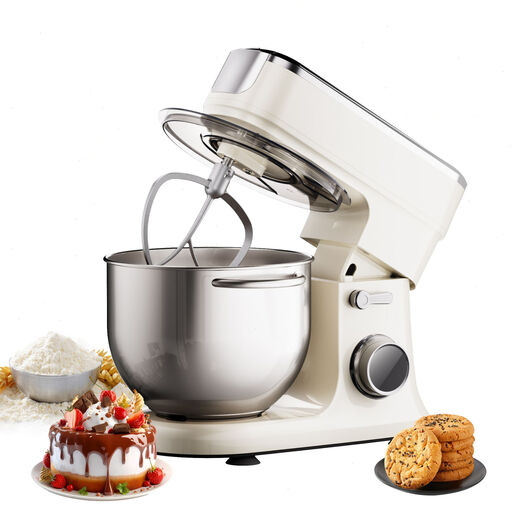 Image unavailable
The 7 L bowl may be worth comparing if you’re baking for a group; check the stated processing limits for your biscuit dough.
The product title lists a 1200 W motor, an OLED touchscreen and adjustable speeds. It describes the product as easy to clean and dishwasher-safe.
 Image unavailable
The listed beater makes this model worth considering if you’re looking for a mixer for biscuit dough.
The product title lists a 5 L bowl, 10 speeds and a tilt-head design. Listed accessories include a dough hook, whisk and beater; the stated motor power is 400 W.
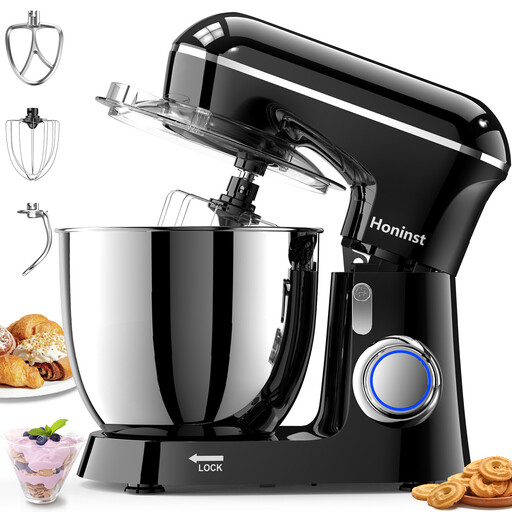 Image unavailable
The product description mentions biscuits; check the quantity your recipe calls for and the manual for this model.
The product title lists a 6.5 QT bowl, 10 speeds and a tilt-head design. Listed accessories include a dough hook, whisk and beater.
Choose a mixer supplied with a beater, K-beater or flat beater, and follow your recipe and the manual for your model. Bourgini describes the beater for the Kitchen Chef Plus 5.5L as suitable for light doughs; the KitchenAid and Kenwood models mentioned come with a beater and a K-beater respectively.
Wash your hands and kitchen utensils after contact with raw egg, and keep ready-to-eat food away from them. Check the cleaning instructions for each mixer part too: a dishwasher-safe bowl doesn’t automatically mean every attachment can go in the dishwasher.
The Dutch Nutrition Centre advises against tasting raw dough, as raw egg and flour can contain harmful bacteria. Bake the biscuits before serving, especially if young children, pregnant people, older people or anyone with a weakened immune system will be eating them.
Ask which ingredients someone needs to avoid and check the ingredients in the recipe. Cereals containing gluten, egg, milk and nuts are examples of allergens that need to be clearly identified; using a different mixer won’t automatically make a recipe suitable for someone with an allergy.
No, you don’t need to buy an extended warranty to be entitled to a product that meets expectations. According to the Dutch government, there is no fixed statutory warranty period in the Netherlands; if a product is faulty, the seller must provide a solution.
No. The European Commission explains that the manufacturer applies the mark when applicable EU rules require it; there is no central EU body that issues a general permit or certificate for this purpose. The mark doesn’t compare how well mixers mix biscuit dough.