
Baker making small batches of biscuits
You often make enough dough for a few lunchboxes and mainly want the right mixing attachment and a machine that’s easy to handle.


Choose a stand mixer with a flat beater or another attachment that the manufacturer recommends for biscuit dough; having a dough hook alone doesn’t mean it’s suitable. Match the bowl capacity and the space you need on your worktop or for storage to the size of your batches, and check which attachments are included and the product information for the exact version.
You often make enough dough for a few lunchboxes and mainly want the right mixing attachment and a machine that’s easy to handle.
You make larger or repeated batches and want to compare bowl capacity and weighing ingredients carefully.
You want to think about cleaning and where to store the mixer after baking.
Start with the mixing attachment for biscuit dough, then compare the bowl and features with the batch sizes you actually make.
| What to consider | What to look for | Who is this important for? |
|---|---|---|
| Mixing biscuit dough | Check which mixing attachment the manufacturer recommends for biscuit dough and what’s included with the exact version. | If I make small batches for lunchboxes, I want the included attachment to be suitable for biscuit dough. Around 42% of consumers give top priority to having the right mixing attachment. |
| Batch sizes and weighing | Check the bowl capacity and, if you often make the same recipe, whether built-in scales suit the way you work. | When I bake for several days, I want to weigh out batches and know how much the bowl can hold. Around 25% of consumers prioritise batch size or weighing. |
| Cleaning and storage | Check the dimensions and cleaning instructions for each part. | With limited kitchen space, I want to know where the mixer can go and how to clean the bowl and attachments. Around 17% of consumers prioritise space and ease of storage. |
| What’s included and after-sales service | Compare the included attachments and check who to contact if the mixer develops a fault. | If I want to know exactly what’s included and what service is available, I check the package contents and the seller. Around 16% of consumers make this their main consideration. |
Manufacturers distinguish between attachments for biscuits and dough hooks for tasks such as kneading yeast dough. So the machine’s name or the fact that it comes with a dough hook doesn’t tell you whether it has the right attachment for your recipe.
Check the product information and the contents of the box for the exact version.
If the mixing attachment you need isn’t included, you may have to buy a suitable one separately.
The stated capacity for cake batter or yeast dough isn’t a test result for spiced biscuit dough.
Only compare capacity figures when the type of dough and the basis of measurement match; don’t use the stated bowl capacity as proof of how much a particular recipe it can handle.
Kenwood states that accessories from the Chef range can’t be used with the Go.
Check compatibility against the full model code before choosing an extra attachment.
An attachment that doesn’t fit your mixer will go unused.
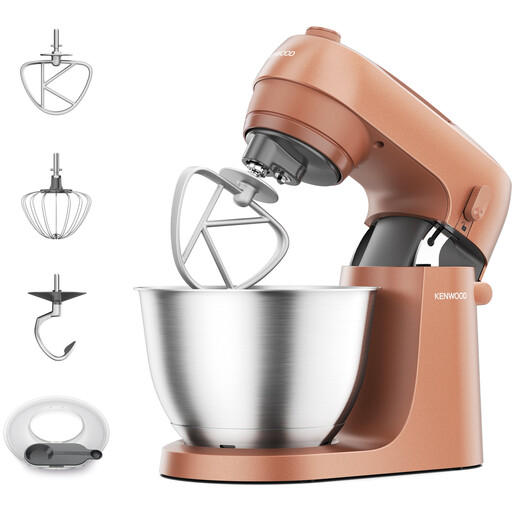
The Kenwood Go KZM35.000RD is a compact stand mixer to compare if you make smaller batches and are looking for a K-beater.
The Bosch MUM5X720 is an option to compare if you want to weigh ingredients as you mix.
The Artisan 5KSM125EER is a mid-sized option to compare if you make other bakes as well as biscuits.
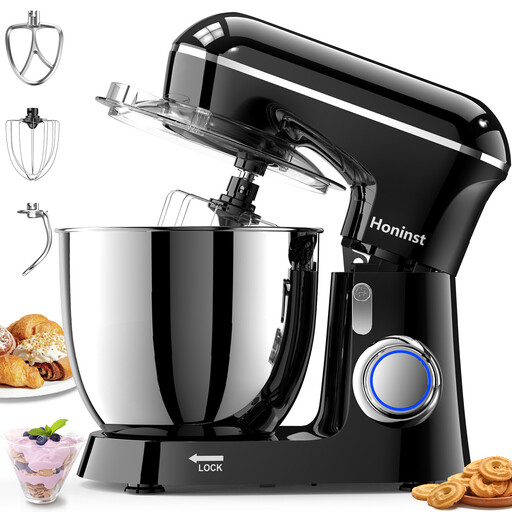
These models are suited to home baking: a Kenwood Go for anyone looking for a compact mixer, and a Honinst stand mixer with several speeds and different mixing attachments.
 No image available
Worth considering if you’re looking for a mixer with several speeds and different attachments for home baking.
The product description lists a 6.5 QT stainless steel bowl, 10 speeds, a whisk, dough hook and beater.
 No image available
A compact option to consider if you’re looking for a K-beater for smaller batches and have limited kitchen space.
The product description lists a 4 L bowl, K-beater, whisk and dough hook. The stated dimensions are 33,5 × 18 × 30 cm. Kenwood says Chef accessories won’t fit the Go; check compatibility for each attachment.
Not necessarily: KitchenAid recommends the flat beater for biscuit batter, while Philips distinguishes between the beater for biscuits and the dough hook for tasks such as kneading yeast dough. Follow the instructions for your machine and recipe.
No, the stated bowl capacity on its own doesn’t prove how much of your recipe it can handle. Only compare capacity figures when the type of dough and the basis of measurement match.
It depends on the part and the version. Kenwood recommends putting the Go bowl in the dishwasher and hand-washing the K-beater, whisk and dough hook; check the manual for your model.
The Netherlands Nutrition Centre advises against tasting raw batter or dough and notes that young children are particularly susceptible to food-borne illness. Bake the biscuits before putting them in a lunchbox, and wash your hands after handling raw dough.
According to the NVWA, CE marking is compulsory for electrical products. Parts intended to come into contact with food are also subject to the relevant Dutch and European rules on food contact materials. Check the product information for the exact version: general requirements alone don’t confirm that a specific item complies.