
Baker with limited worktop space
You want a stand mixer for biscuit dough, but need to be able to fit it into a small kitchen, use it and put it away.


Start with the space you have, the amount of dough you make and the beater supplied; bowl capacity alone won’t tell you how much of your recipe the mixer can handle. Manufacturer information about dimensions, accessories and quantities can help you compare models, but it isn’t a like-for-like test with your spiced biscuit dough.
You want a stand mixer for biscuit dough, but need to be able to fit it into a small kitchen, use it and put it away.
Sometimes you make a small batch and sometimes more dough. The usable amount for your recipe matters more than the bowl’s capacity in litres alone.
You want to know which supplied accessory to use for biscuit dough, and how much cleaning and accessory handling is involved.
First, measure the space where the mixer will go and the clearance you need to use it. Then compare the batch size and accessory with your recipe and the instructions for the exact model.
| What to consider | What to look for when buying | Who is this important for? |
|---|---|---|
| Fitting and using the mixer | Compare the dimensions of the exact model with the space you have available. Allow room for the bowl, beater and, if applicable, a tilting head. | If you have limited worktop space or little clearance beneath a cupboard, you’ll also need to be able to use and store the mixer; space is the top buying priority for around 36% of consumers in this breakdown. |
| Quantity and consistency | Compare your recipe and batch size with the manufacturer’s limits for the exact model; don’t treat bowl capacity as the maximum amount of dough it can handle. | If you make batches of different sizes or dense dough, you’ll want to know whether your recipe falls within the model’s instructions; dough quantity is the top buying priority for around 29% of consumers. |
| Beater and ease of use | Check which accessories are included with the exact model, and follow the instructions for the accessory and speed setting. | If you mainly want mixing and cleaning to be straightforward, the right accessory for your recipe and what comes in the box matter; this is the top buying priority for around 21% of consumers. |
| Purchase and aftercare | Compare the included accessories and read the terms of any additional warranty before deciding whether to buy it. | If you want to know what support is available if something goes wrong, and what’s included with the model, aftercare comes first; this is the top buying priority for around 14% of consumers. |
Manufacturers set limits using different criteria. A maximum dough weight and a number of standard-sized biscuits aren’t directly comparable measures.
Compare the ingredients and total batch size in your recipe with the limits and instructions for the exact model. Don’t treat quantities given for other types of dough as a test with spiced biscuit dough.
A mixer may fit in its usual spot but need extra clearance to tilt the head and access the bowl.
Measure both the space available and the clearance needed to use the mixer and remove the bowl and beater.
According to the Dutch Government, the seller remains responsible for putting things right if a product is faulty.
Compare any additional cover with your existing rights and read the terms before choosing it.
The Go range is worth comparing if a relatively low-profile mixer and front-mounted controls are important to you; the model described here is KZM35.000GY.
The MUM Serie 2 MUMS2ER01 is worth comparing if the stated appliance dimensions and patisserie set are important to you.
The tilt-head mixer with a 3.3-litre bowl is an option to compare for smaller batches and limited space; the model mentioned is 5KSM3311X.
This Joybuy selection includes stand mixers with product information about biscuits, dough or the mixing accessories supplied. Compare the stated dimensions and quantities with your own recipe and the space in your kitchen.
 Image unavailable
The product description mentions biscuits and dough; the 5.5-litre bowl is a specification to consider when comparing batch sizes for your recipe.
The product name lists 11 speeds and a 4.5-inch LED touchscreen.
 Image unavailable
The product description lists presets for biscuits, dough and batter; check the model instructions for your recipe.
The product name lists a 5.5-litre bowl, 11 speeds and five preset programmes.
 Image unavailable
The product information lists a beater for batter and a dough hook for dough; compare the accessories with the steps in your recipe.
Listed specifications include a 6-litre bowl, six speeds, a 450 W motor and dimensions of 40,7 × 26,8 × 33,2 cm. The head tilts.
 Image unavailable
The K-beater is one of the supplied accessories you can compare with the method for making your biscuit dough.
The product information lists a 4-litre bowl, six speeds plus pulse, a K-beater, whisk and dough hook, and a maximum dough capacity of 1,4 kg. The stated dimensions are 33,5 × 18 × 30 cm; the controls are on the front.
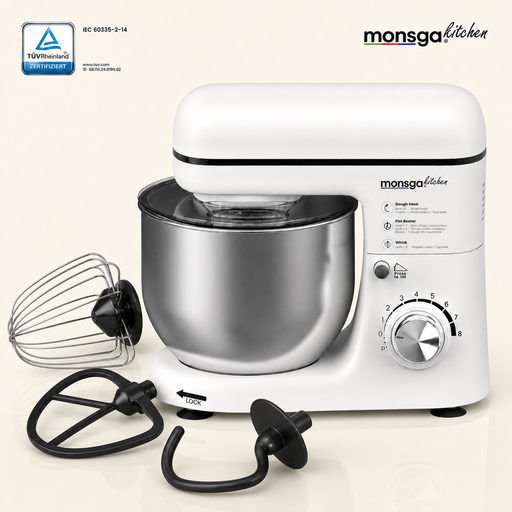 Image unavailable
The product information lists a flat beater for biscuits; check the manual for guidance on using it with your recipe.
The product name lists a 5.0-litre bowl and eight speeds. The description mentions a tilting head and dishwasher-safe accessories.
No. KitchenAid describes the flat beater as suitable for biscuit batter, while the Consumers’ Association mainly discusses the dough hook for kneading bread dough for a long time. Follow the instructions for your recipe and exact mixer; dough thickness and preparation methods can vary.
Don’t just measure the stated appliance height; also check how much clearance you need to move the head and remove the bowl and beater. KitchenAid notes that access to the bowl varies depending on the head or bowl design.
According to the Dutch Government, the seller must put things right if a product is faulty. The Netherlands has no fixed statutory warranty period; what you can reasonably expect depends on factors including the product and how it is used. Paying for an additional warranty doesn’t replace this right.
According to the Dutch Government, online purchases from a business often come with a 14-day cooling-off period. Check the terms of the specific purchase; buying online from a private seller, for example, is a different situation.
Check the CE marking and safety information on the specific appliance and its packaging. The Netherlands Food and Consumer Product Safety Authority classifies kitchen appliances as electrical equipment and explains when CE marking is mandatory; this doesn’t establish whether an individual model carries the marking.