
A lunch baker making one batch
You want to know whether your usual bagel recipe is within the stand mixer’s flour limit. The KitchenAid Netherlands recipe we looked at uses 550 g of flour.


Start with your recipe: compare both the amount of flour and the total dough weight with the stated capacity for the exact model, and don’t treat bowl capacity as kneading capacity. For a recipe using around 550 g of flour, a smaller stand mixer may be worth looking into; for larger lunch batches, the stated limits and the number of kneading rounds you’ll need are what matter. A mixer combines the dough, but it won’t take care of proving, shaping, boiling or baking.
You want to know whether your usual bagel recipe is within the stand mixer’s flour limit. The KitchenAid Netherlands recipe we looked at uses 550 g of flour.
You want to find out whether you can knead more dough at once or whether it’s better to make several batches. Manufacturers sometimes state limits by flour weight and sometimes by dough weight.
You often make firm dough, so you want to look beyond batch size and check the permitted load, attachments and cleaning instructions too.
A good fit if: your bagel recipe uses around 550 g of flour and you also want to mix or whisk.
Bear in mind: a flour limit doesn’t guarantee that every recipe or kneading time will be suitable; check the instructions for the exact model variant.
A good fit if: you need to make a larger batch than the example recipe and can compare the model’s flour and dough limits.
Bear in mind: a maximum stated in kilograms of flour isn’t directly comparable with a maximum stated in kilograms of dough.
A good fit if: you regularly make large quantities of dough and want to consider a different working method with a rotating bowl.
Bear in mind: check that the controls and attachments suit the way you work; a manufacturer’s maximum isn’t an independent test with bagel dough.
KitchenAid Netherlands and Kenwood state limits including flour weight, while Bosch and Ankarsrum give dough weights. So only compare maximums stated in the same unit, and follow the instructions for the exact model.
| What to consider | What should you check? | Who should pay particular attention? |
|---|---|---|
| Firm dough | Check the dough hook, the maximum quantity and the kneading instructions for the exact model. | If I’m kneading firm bagel dough, I want to stay within the limit for this exact model and know whether I need to split the batch. Around 27% of consumers prioritise dough load. |
| Batch size | Compare flour weight with a flour limit, and total dough weight with a dough limit. | For a shared lunch, I want to know how much dough I can make per kneading round so I can plan accordingly. Around 27% of consumers prioritise batch size. |
| Planning | Work backwards from lunchtime, allowing for every step in your recipe and any extra kneading rounds. | If lunch starts at a set time, I also want to allow time for proving, shaping, boiling and baking. Around 20% of consumers prioritise predictable preparation. |
| Space and cleaning | Measure the available space, including room to lift the head, and check the cleaning instructions for each attachment. | If I have limited worktop space, I want to know where the machine can go and what I’ll need to clean after kneading. Around 13% of consumers focus mainly on placement and cleaning. |
| Purchase and aftercare | Check which attachments are included and who the seller is; read any additional warranty terms separately. | If I don’t use the machine often, I want to weigh up the purchase and after-sales support before choosing a larger model. Around 13% of consumers prioritise purchase and aftercare. |
Bowl capacity in litres, a maximum in kilograms of flour and a maximum in kilograms of dough each describe different things. A large bowl alone won’t tell you how much firm dough you can knead.
Note both the flour quantity and the total dough weight in your recipe, then compare them with the relevant capacity and usage instructions for the exact model.
Proving, shaping, boiling and baking are still part of making bagels after the dough has been mixed. Extra batches can also add to your preparation time.
Work backwards from your preferred lunchtime and allow for every recipe step and kneading round. The KitchenAid recipe we looked at gives a total time of 2 hours and 10 minutes; your own recipe may differ.
According to the Dutch government, there is no fixed time limit for statutory guarantees in the Netherlands. If a product is faulty, the seller is your point of contact; any manufacturer’s warranty is in addition to this.
Keep your proof of purchase and read any additional manufacturer’s warranty terms as a supplement, not a replacement for your statutory rights.
The Artisan 5KSM125 series is worth looking into for a modest bagel batch, as well as mixing and whisking.
The MUM58L20 is a planetary stand mixer to compare if you’re considering a larger batch of yeasted dough.
The Chef XL KVL4100S is worth comparing if you’re considering a larger planetary mixer with a dough hook.
The Assistent Original AKM6230 is an alternative worth looking into if you regularly make large quantities of dough and are considering a machine with a rotating bowl.
These Joybuy products are stand mixers for preparing dough. Compare the stated bowl capacity and speeds with the instructions and dough limits for the exact model variant.
 No image available
For anyone considering a larger bowl; check the model instructions to see whether it can handle the amount of firm bagel dough you plan to make.
Bowl: 5.5 l. 11 speeds.
 No image available
Worth including in your comparison if you’re considering a larger batch of dough; check which attachments and quantities apply to this model variant.
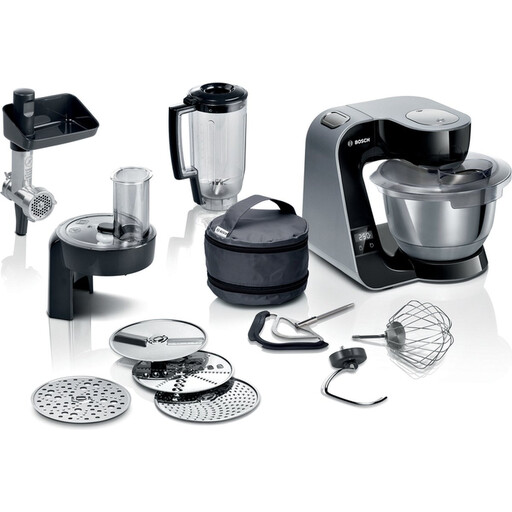 No image available
For anyone looking for a planetary stand mixer for preparing dough; check the included attachments and the dough limit for the exact model variant.
Power according to the product name: 1000 W.
 No image available
The product title mentions a dough hook and bread dough; check the maximum quantity of firm dough and the instructions for the model.
Bowl: 5 l. 10 speeds. Power according to the product name: 400 W.
 No image available
The product title mentions a dough hook and bread dough; check the maximum quantity of firm dough and the instructions for the model.
Bowl: 6 l. 6 speeds. Power according to the product name: 450 W.
No. The KitchenAid Netherlands bagel recipe we looked at includes other ingredients as well as 550 g of flour, including water and yeast. Compare a flour limit with the amount of flour, and a dough limit with the weight of all the dough ingredients; don’t use bowl capacity in litres as a substitute for either.
Allow time for the rest of the preparation too. The KitchenAid Netherlands recipe we looked at gives a total time of 2 hours and 10 minutes, including steps after mixing such as proving, shaping, boiling and baking. Your own recipe and the number of batches may take longer.
Compare the ingredients in your own recipe with the limit for the exact model variant. Use a maximum in kilograms of flour for flour only, and a maximum in kilograms of dough for the total dough weight only. Follow the manufacturer’s kneading instructions.
Follow the cleaning instructions for the exact model variant and each individual attachment. For example, the Joybuy listing for the KitchenAid 5KSM125EMH says that the whisk is not dishwasher-safe, while the dough hook, flat beater and bowl are. Don’t automatically apply this guidance to other models.
According to the Dutch government, there is no fixed time limit for statutory guarantees; what you can expect depends, among other things, on the product and normal use. If a product is faulty, the seller is your point of contact. Any manufacturer’s warranty is in addition to this.