
Baker with limited worktop space
You want to make batter without a mixer that is awkward to position or store. Measure the width, depth and height of the space, and allow room to operate the mixer head.


Start by measuring your worktop space, the clearance needed for storage and the room required to operate the mixer head. Then compare the bowl and attachments with the amount of apple cake batter you make. A compact model can be practical in a small kitchen, while a larger bowl may suit you if you often make bigger batches. Before buying, also check the safety information and CE marking for the specific product.
You want to make batter without a mixer that is awkward to position or store. Measure the width, depth and height of the space, and allow room to operate the mixer head.
You want a suitable beater or whisk and a bowl that fits the amount of batter you usually make, without letting attachments you won’t use influence your choice.
You’re weighing up a bowl for smaller batches against the capacity you need when you often make more batter at once.
| What to consider | What should you check? | Who is this important for? |
|---|---|---|
| Positioning and storage | Measure the width, depth and height, and check separately how much room you need to open the mixer head. | If I have limited worktop space, I also want to be able to reach the bowl while mixing. Around 31% of consumers prioritise positioning and storage. |
| Attachments for batter | Check whether the model includes a beater and, if you need one, a whisk. | For my apple cake batter, I want the right attachments to hand without factoring in features I won’t use. Around 31% of consumers give mixing batter top priority. |
| Bowl capacity and batch size | Compare your recipe with the capacity information for the specific model; don’t estimate the maximum amount from the number of litres alone. | If I sometimes make more batter at once, I want to know whether the bowl and stated capacity are suitable. Around 23% of consumers start by considering the batch size they need. |
| Cleaning and storage | Check the cleaning instructions for each part and think about where you’ll store the attachments. | When I choose a mixer for the occasional cake, the number of parts I’ll need to clean and store matters too. Around 15% of consumers consider this first. |
CE marking is compulsory for electrical consumer products, according to the Netherlands Food and Consumer Product Safety Authority. Check the marking and relevant product information for the item you’re buying; information about a model alone does not confirm this for every individual product.
The mixer may fit in its space, but there might not be enough room to open the head, remove the bowl or add ingredients.
Measure the operating clearance as well, where you plan to use the mixer.
The power rating alone won’t tell you whether the attachments and usage limits are right for your recipe.
Compare the included beater or whisk and the capacity for that particular model. Only rely on independent test results if you can access them.
Parts you don’t use take up space and add to the cleaning. The Dutch Consumers’ Association warns that attachments aren’t always dishwasher-safe.
Check the cleaning instructions for each part and see which attachments you actually need.
Extra attachments may need more storage and cleaning space.
The Go range includes the KZM35.000GY, a stand mixer that Kenwood positions as suitable for limited space.
The MUM Serie 2 range includes the MUMS2EW00, which has a 3,8-litre bowl.
KitchenAid describes the 5KSM3311X as its smallest tilt-head mixer.
This selection includes stand mixers for batter with a range of bowl capacities. Compare the stated dimensions and capacity with your worktop, storage space and the amount of apple cake batter you make. Also check the CE marking on the specific product.
 No image available
The product description lists a beater for batter and lighter mixtures, which is useful if you mainly want to use the mixer for cake batter.
The product name specifies a 5.5-litre bowl and planetary mixing action. Check whether the bowl capacity suits your recipe and whether the dimensions fit on your worktop.
 No image available
The product description lists a mixing beater for batter and a whisk for whisking; check whether these attachments suit your recipe.
The product name specifies a 5-litre bowl, 10 speeds and a 400 W motor. The stated dimensions are 35,4 × 22,5 × 29,6 cm.
 No image available
The product description lists a mixing beater for batter; compare the bowl capacity with the amount you usually make at a time.
The product name specifies a 6-litre bowl, 6 speeds and a 450 W DC motor. The stated dimensions are 40,7 × 26,8 × 33,2 cm, so measure the available space carefully.
 No image available
The K-beater and whisk are useful if you want to use the mixer for both mixing and whisking.
The stated dimensions are 33,5 × 18 × 30 cm and the bowl capacity is 4 litres. Kenwood lists a cake capacity of 1,8 kg for this model; this manufacturer’s figure doesn’t automatically apply to other recipes.
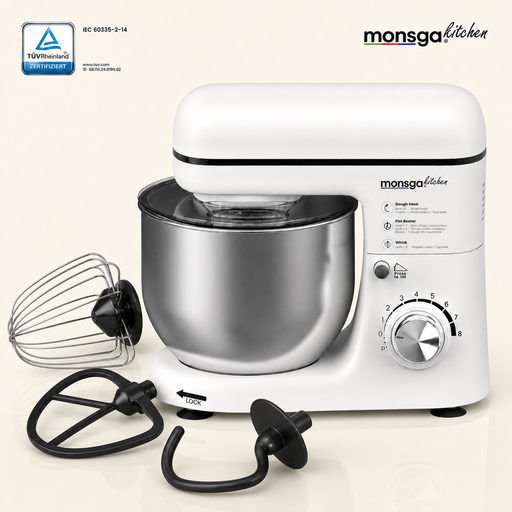 No image available
The product name lists a beater and whisk; check the instructions for using them with your recipe.
The product name specifies a 5,0-litre bowl, 1000 W peak power and 8 speeds. Check the dimensions and CE marking on the specific product before deciding.
Not necessarily. The Dutch Consumers’ Association describes food mixers as designed for mixing and whisking when baking, while food processors are mainly for slicing, grating and chopping. Choose based on the task you do most; a food processor is most relevant if preparing ingredients by chopping is your priority.
Compare the appliance height with the available space, and check that there’s also room to tilt the head and remove the bowl. The stated height alone won’t tell you how much operating clearance you need.
It depends on the part and model. Bosch says the MUMS2EW00 accessories are dishwasher-safe; follow the relevant instructions for other parts. The Dutch Consumers’ Association points out that attachments aren’t always suitable for the dishwasher.
The Dutch government says that a 14-day cancellation period applies to many online purchases, although exceptions may apply. There is no fixed statutory guarantee period in the Netherlands, so check the Dutch government’s guidance on your rights if a product is faulty.
Yes. The Netherlands Food and Consumer Product Safety Authority says CE marking is compulsory for electrical consumer products. Check the marking on the specific product; a general reference to the model doesn’t confirm that every individual item has been checked.