What should you look for when buying?
Smaller batches and limited workspace
Choose this if: you stay within the stated dough limit for each batch and available space is important. Bosch lists a 3.8-litre bowl and a maximum dough capacity of 2.0 kg for the MUMS2VM00.
Bear in mind: the stated dough quantity is not a specific limit for your almond roll recipe.
Larger batches, depending on the type of dough
Choose this if: your recipe and batch size fall within a stated limit for yeast or bread dough. Bosch lists a maximum of 1.9 kg of yeast dough for the MUM5X720; Smeg lists a maximum of 2.1 kg of bread or pizza dough for the SMF05BLEU at a minimum hydration of 55%.
Bear in mind: these manufacturer limits use different definitions of dough and are not directly comparable.
Kneading dough as well as other workshop tasks
Choose this if: you want to mix or whisk as well as knead. The KitchenAid Artisan 5KSM175PSEFL is described as coming with a dough hook, flat beaters, a whisk and two bowls.
Bear in mind: the manufacturer does not give a directly comparable maximum quantity for your dough for this model. Check before planning a large batch.
Chef XL for different types of dough
Choose this if: you know the flour weight for each batch and a 6.7-litre bowl suits your workspace. Kenwood gives separate maximum quantities for different types of dough.
Bear in mind: Kenwood’s maximum quantities are given as flour weight, not total dough weight, so they are not a general limit for almond rolls.
Start by choosing according to your recipe and the quantity you need for each batch. Attachments, cleaning and available workspace then determine how practical a model will be. Parts that come into contact with food must also comply with the relevant European and Dutch food-contact materials regulations; this alone does not confirm that a specific model complies.
| What to consider |
What to check before buying |
Who is this important for? |
| Dough per workshop batch |
Note the flour weight and total dough weight, then compare them with the manufacturer’s limit for the same type of dough. |
I want to make enough dough for each batch without treating bowl capacity as a dough limit. Around 36% of consumers prioritise the amount of dough per batch. |
| Attachment for your recipe |
Compare the recipe with the supplied dough hook, flat beater and whisk, and check what’s in the box for the exact model. |
If I’m carrying out different workshop tasks, I don’t want to assume every model comes with the same attachments. Around 29% of consumers prioritise having the right attachments. |
| Cleaning between preparations |
Check the cleaning instructions for the bowl and attachments, and plan how to keep preparations separate. |
When equipment is shared, I want to clean it carefully between preparations and take allergens into account. Around 21% of consumers prioritise cleaning. |
| Workspace and storage |
Compare the appliance’s dimensions with the space available, and allow room to open the head. |
If I have limited worktop or storage space, I want to know whether the machine will fit. Around 14% of consumers prioritise available space. |
The Consumers’ Association describes a dough hook for kneading bread dough over an extended period. Manufacturers also set their own limits for different types of dough; don’t treat these as interchangeable measures for every recipe.
Stand mixers at Joybuy
These Joybuy product picks focus on kneading dough and, for some models, on several stages of baking. Compare the listed attachments and bowl capacity with the type and quantity of dough you need for each workshop batch.
 No image available
HAUSWIRT M5 Max stand mixer, 5.5 litres
The product information mentions kneading bread dough and firm dough. Check the applicable quantity for your recipe before planning a batch.
The title lists a 5.5-litre bowl and 11 speeds.
Joybuy
 No image available
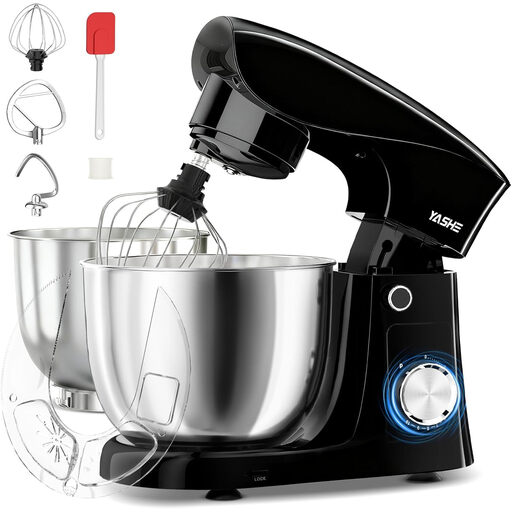
YASHE SM-2548A stand mixer with two bowls
The dough hook is useful for kneading, while two bowls may come in handy for consecutive workshop tasks. Check the cleaning instructions for each part.
The product information lists 4.5- and 5-litre bowls and a tilt-head design.
Joybuy
 No image available
Stand mixer, 5 litres, 10 speeds
The listed dough hook and flat beater are useful for preparing dough and mixing. Check that the included accessories suit your workshop recipe.
The title lists a 5-litre bowl, 600 W, a dough hook, flat beater, whisk and splash guard. The product description states a maximum operating time of 30 minutes.
Joybuy
 No image available
Dough mixer, 4.5 litres, 6 speeds plus pulse function
The product description lists dough hooks, a whisk and a beater. Check which parts you’ll need for the preparations you have planned.
The title lists a 4.5-litre stainless steel bowl and 1300 W.
Joybuy
 No image available
Bosch MUM 54251
The product information gives separate quantities for kneaded dough and yeast dough. Compare the limit for the type of dough in your recipe.
The product information lists a 3.9-litre bowl, a maximum of 2.7 kg of kneaded dough and a maximum of 1.9 kg of yeast dough. It is stated as intended for domestic use only; check that this suits the way you plan to run your workshop.
Joybuy
Frequently asked questions
Is a dough hook always the right attachment for almond rolls?
You can’t tell from the name of the bake alone. First check what type of dough the recipe calls for: the Consumers’ Association describes a dough hook for kneading bread dough over an extended period, while a stand mixer may also come with mixing and whisking attachments.
How do you prepare the machine for consecutive workshop batches?
For each batch, stick to the stated quantity for the relevant type of dough. Check the instructions for the bowl and attachments supplied with the exact model; a second bowl doesn’t replace cleaning or the need to consider allergens.
Does consumer law also apply if you buy the mixer for your business?
Don’t assume it does. According to Business.gov.nl, different rules apply when a business makes a purchase than when a consumer buys something. Check the business terms before buying, and distinguish between your statutory rights as a private buyer and any additional manufacturer’s warranty.
What rules should you bear in mind when offering rolls to workshop participants?
Parts that come into contact with food must comply with the applicable food-contact rules, including Regulation (EC) No 1935/2004 and the Dutch rules for packaging and consumer articles. If you offer food to consumers as a business, the NVWA says you must provide information about allergens present, including nuts. Food safety rules also apply to sales; whether you need to take any additional steps depends, among other things, on the nature and frequency of the sales.


