
Workshop leader making one large batch
You mix batter for several participants at once and compare the stated cake capacity with the total recipe weight.


Choose a stand mixer to suit the weight of your recipe per batch, and pick a suitable flat beater or whisk. Bowl capacity alone won’t tell you how much cake batter a model can handle. A mixer with a higher stated cake capacity can be practical for one large batch, while smaller individual batches may suit a compact model with attachments that are easy to swap and clean. Check the specifications for the exact version. If anyone has an almond allergy, also consider your workshop procedures and allergen information.
You mix batter for several participants at once and compare the stated cake capacity with the total recipe weight.
You make smaller batches one after another, so you consider the available workspace, ease of use and how easy it is to change attachments.
You want to whisk egg whites as well as mix cake batter, for example, so you check which specific attachments are included with the model.
A good fit if: participants mix individually, you have limited workspace and the recipe is within the stated cake capacity. Kenwood lists a 4 L bowl and a cake capacity of 1.8 kg for the Go KZM35.000GY.
Bear in mind: with a lower stated cake capacity, you may need to make several batches in succession for multiple participants.
A good fit if: your calculated recipe weight calls for a larger batch. Kenwood lists a 6.7 L bowl and a cake capacity of 5 kg for the Chef XL KVL4100S.
Bear in mind: make sure you have enough workspace and check that the model will also suit your smallest recipe. These capacities are manufacturer specifications, not the results of an independent mixing test with almond cake batter.
A good fit if: your recipe works as a medium-sized batch and you want to weigh up bowl and attachment options. Bosch lists a maximum of 2.7 kg of cake batter for the MUM58L20. The KitchenAid Artisan 5KSM175PSECA has a 4.7 L bowl, an extra 3 L bowl, and standard and flexible flat beaters.
Bear in mind: KitchenAid’s product information doesn’t give a directly comparable cake capacity in kilograms. So don’t compare the models on bowl capacity alone.
First, calculate the recipe weight per batch. Then consider the beater, the space on your worktop and how you’ll clean the mixer between batches.
| What to consider | What should you check? | Who is this important to? |
|---|---|---|
| Batter capacity per batch | Calculate the total recipe weight for each batch and compare it with the stated cake capacity for the exact model. | If I’m mixing one batch for a whole group, I want the recipe weight to be within the stated capacity. Around 40% of consumers prioritise batch capacity. |
| Mixing cake batter | Check whether a flat beater is included and consult the manual for instructions on mixing cake batter. | If cake batter is the main purpose, I want a suitable attachment and won’t assume that every version comes with the same accessories. Around 30% of consumers prioritise how cake batter is mixed. |
| Space at the baking station | Measure the available space and compare it with the dimensions. Leave room to operate the head or arm, too. | If participants are working at individual stations, I want to be able to position and use the mixer without blocking the space needed to add ingredients. Around 20% of consumers prioritise where the mixer will fit. |
| Cleaning between batches | Check the cleaning instructions for the bowl and attachments, and plan how you’ll manage ingredients and equipment. | If I’m making successive batches or need to account for an allergy, I want to decide on suitable cleaning procedures and working practices in advance. Around 10% of consumers prioritise cleaning and keeping batches separate. |
Bowl capacity in litres and cake batter capacity in kilograms describe different things. A large bowl alone doesn’t tell you how much batter the model can handle.
Weigh the recipe for one batch and check the stated cake capacity for the full model number.
If the batch won’t fit, you may need to mix it in more than one go.
The bowls and beaters included can vary by version. An attachment shown with another variant might not be included with the one you choose.
Before buying, check what’s in the box for the exact model and variant.
You may need a separate attachment for a different mixing task, so check whether the right accessory is available.
A second bowl can help you organise batches, but it won’t automatically prevent cross-contact with almonds or other allergens.
Plan separately how you’ll manage ingredients, equipment, cleaning and information for participants. The NVWA requires information about allergens present in unpackaged food offered to consumers; for nuts, the specific nut must also be named.
The models described here range from a more compact version to the Chef XL KVL4100S.
The MUM58L20 may suit a medium-sized batch if the stated capacity matches your recipe.
The Artisan 5KSM175PSECA offers a choice of two bowls and several mixing attachments.
The SMF04CREU comes with attachments for different mixing tasks, including cake batter.
These stand mixers suit cake batter for workshops, from smaller batches to models with larger bowls. Compare the included beater, stated capacity and available workspace for each version.
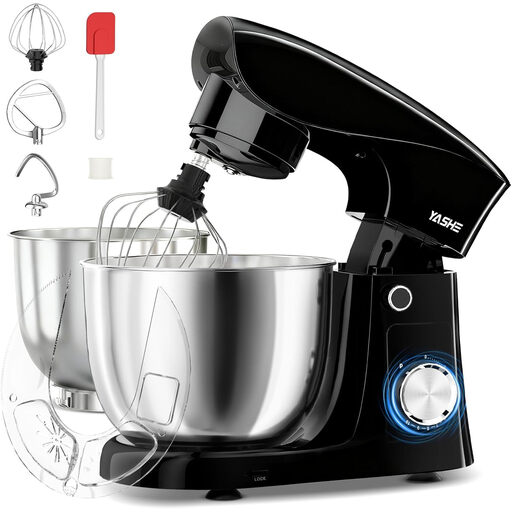 No image available
The two bowls can come in handy when you’re organising successive workshop batches.
The set includes 4.5 L and 5 L bowls, a beater, a whisk and a dough hook. The mixer has 10 speeds and a pulse function.
 No image available
The included beater is designed for batter. Check the manual to see which method is right for your cake batter.
The description lists a 5 L stainless steel bowl, 10 speeds, a pulse function, a beater, a whisk and a dough hook.
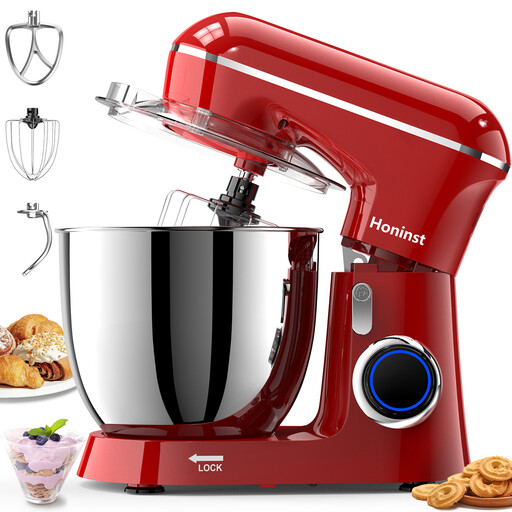 No image available
The listed beater is suitable for cake batter. Check whether the stated bowl size works for your recipe and batch plan.
The title lists a 6.5QT bowl, 10 speeds, a whisk, a dough hook and a beater. The usage information restricts the appliance to household use, so check whether that’s suitable for your intended workshop use.
 No image available
This more compact version may suit smaller batches and a limited workspace, as long as the recipe is within the stated cake capacity.
Kenwood lists a cake capacity of 1.8 kg for model KZM35.000GY. The product description gives a 4 L bowl, six speeds, a pulse function and dimensions of 33,5 × 18 × 30 cm.
 No image available
The flat beater is a useful included accessory for cake batter. Check the recommended bowl capacity against your recipe.
The description lists a recommended bowl capacity of 5.0 L, a flat beater, a whisk, a dough hook and 8 speeds. The product name lists 1000W Peak.
No. The Consumentenbond describes stand mixers with an open bowl and beater as suitable for tasks including baking. Food processors are mainly designed for slicing, grating and chopping. For cake batter, choose based on the mixing function and suitable attachment, not just the product category.
A flat beater is a suitable choice for cake batter. Check the manual and the accessories included with the exact version. KitchenAid recommends starting on a low speed with its flat beater and increasing the speed gradually.
For unpackaged cake offered to consumers, the NVWA requires information about the allergens present. For nuts, the specific nut must also be named. You should also decide how to manage ingredients, equipment and cleaning, as the mixer itself can’t guarantee allergen-free preparation.
According to the NVWA, a food safety plan or hygiene code is required if you sell food several times a year. First check whether your workshop actually meets that condition; running a workshop alone doesn’t mean that food is being sold.
Not automatically. According to the Dutch government, there’s no fixed statutory warranty period in the Netherlands, and the retailer is your point of contact if a consumer product is faulty. Compare any extra rights and exclusions included in an offered warranty. If you’ll use the mixer for commercial workshops, check the applicable purchase terms separately.