
Fans of the traditional rusk moment
You want to serve Muisjes as part of a stamppot supper, but only describe them as Fairtrade chocolate if the exact packaging supports that claim. De Ruijter describes Muisjes as sugar-coated aniseed.


Choose Muisjes on rusks if you want to keep the traditional aniseed moment as part of a stamppot supper. If you’d also like to serve Fairtrade chocolate, choose a separate chocolate product and check the certification on the exact variant; certification on that chocolate does not automatically apply to the Muisjes. For both products, check the ingredients and allergen information on the packaging.
You want to serve Muisjes as part of a stamppot supper, but only describe them as Fairtrade chocolate if the exact packaging supports that claim. De Ruijter describes Muisjes as sugar-coated aniseed.
For you, verifiable certification on the chocolate you choose matters more than the name Muisjes. You can serve the chocolate separately from rusks topped with Muisjes.
You’re serving several guests and want to check the ingredients and allergens for every chosen variant on the packaging before serving.
For this stamppot supper, Muisjes on rusks and Fairtrade chocolate are two separate choices. You can serve both without presenting them as one certified product.
Choose this if: you want to keep the traditional aniseed moment as part of the meal.
Bear in mind: Albert Heijn describes De Ruijter Feestmuisjes as sugar-coated aniseed, not chocolate.
Choose this if: your main aim is to serve demonstrably Fairtrade-certified chocolate.
Bear in mind: chocolate does not automatically replace the taste and presentation of traditional Muisjes.
| Point to consider | What to check when buying | Who it matters to |
|---|---|---|
| Fairtrade certification | Check the certification mark and product information for the exact chocolate variant. A retailer’s general policy does not tell you which Muisjes are certified. | If Fairtrade chocolate is my main aim, I want to be able to verify the claim on the product. For around 45% of consumers, this verifiable choice of chocolate would come first. |
| Traditional Muisjes | Choose the variant and texture you prefer, such as whole or crushed Muisjes. De Ruijter describes Gestampte Muisjes as a softer variety. | If you mainly want the familiar aniseed experience on a rusk, that takes priority over chocolate. This would be the main consideration for around 33% of consumers. |
| Ingredients and allergens | Read the packaging for each chosen variant before serving. The Feestmuisjes described by Albert Heijn contain wheat. | If guests need to avoid certain ingredients or allergens, I want to know what I’m putting on the table. Around 22% of consumers would consider this their first priority. |
Albert Heijn describes De Ruijter Feestmuisjes as sugar-coated aniseed. A pack of this variety therefore won’t meet your aim of serving Fairtrade chocolate.
Check the ingredients in the Muisjes and, if you’d also like to serve chocolate, choose a separate variety with verifiable Fairtrade certification.
According to Albert Heijn, the cocoa in its own-brand products is Rainforest Alliance or Fairtrade certified. This does not automatically mean that De Ruijter Muisjes, or any other product in the shop, is Fairtrade certified.
Base your choice on the certification and information for the specific product you’re buying.
Ingredients and allergens can vary between product variants or change over time. The Netherlands Food and Consumer Product Safety Authority highlights the importance of allergen information on labels.
Read the packaging of the products you’re actually going to serve.
Relevant if you want to serve traditional Muisjes on rusks.
Provides product information about different De Ruijter Muisjes varieties.
Lists both Muisjes varieties and separate Fairtrade chocolate products.
These Muisjes suit a traditional rusk moment as part of a stamppot supper. You’ll still need to choose a separate product if you want Fairtrade chocolate.
 No image available
A choice for anyone who wants to serve Muisjes with rusks.
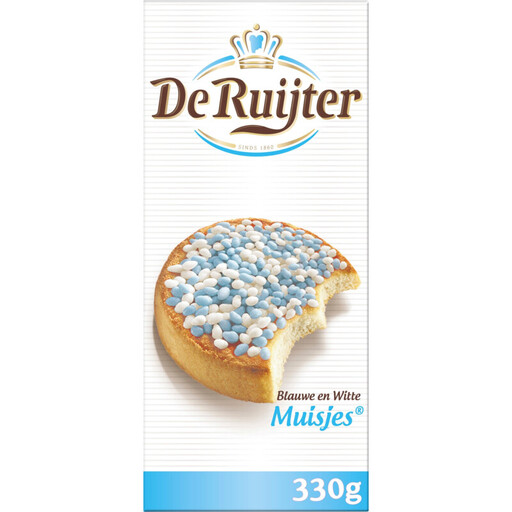
Blue and white variant, 330 g. Don’t consider this product Fairtrade chocolate; check the packaging for ingredients and allergens before serving it.
No. The De Ruijter Feestmuisjes described by Albert Heijn are sugar-coated aniseed. Check other varieties separately if their ingredients will affect your choice.
When the certification mark and product information substantiate this for the exact variant. For products with multiple ingredients, Fairtrade International also describes a certification mark with an arrow: ingredients that are available on Fairtrade terms must then have been sourced according to those terms.
Yes, as separate items: for example, serve Muisjes on rusks and choose chocolate with Fairtrade certification that you can verify on the exact variant. Don’t assume the Muisjes or the combination is certified just because the chocolate carries a certification mark.
Yes, read the packaging of the variant you’re serving now. The Netherlands Food and Consumer Product Safety Authority emphasises the need to list allergens on labels, and product information can change.