
Vandaag of morgen in huis

Kwaliteit gegarandeerd

Welkomstaanbiedingen ontgrendelen: GRATIS bezorging | Tot 80% korting | Gratis 30 dagen JoyPlus-proefperiode
Download de app
Stainless steel pans are popular because they can be suitable for induction, gas, electric and ceramic hobs. However, not every stainless steel pan is automatically convenient for everyday use. A thin base can distribute heat unevenly, an oversized pan may not sit properly on an induction zone, and a non-stick coating requires different care from untreated steel.
In this buying guide, you’ll learn what to look for when choosing stainless steel pans, stainless steel saucepans and a complete stainless steel pan set. The recommendations are based on verifiable product specifications, such as material, diameter, capacity, hob compatibility and cleaning instructions.
The term “stainless steel” does not tell you everything about the construction. A pan may consist of a single thin layer or have a multi-layer base. With tri-ply pans, aluminium is often sandwiched between layers of stainless steel. According to the product description, this can provide faster and more even heat distribution.
With a stainless steel saucepan, the base is particularly important. Check whether it is suitable for induction and whether the manufacturer provides information about a sandwich base, capsule base or multi-layer construction.
A stainless steel frying pan without a coating can withstand high temperatures, but food may stick more easily when the pan is cold or used over excessively high heat. A pan with a ceramic or other non-stick coating can make cooking foods such as eggs easier, but it often requires careful use and suitable cleaning methods.
Also look out for conflicting information. Some models state that metal utensils may be used, while sharp objects are nevertheless discouraged. Always follow the specific instructions on the product page.
A large set may seem good value, but it takes up space and may include duplicate sizes. For a one- or two-person household, a saucepan with lid, a medium-sized cooking pot and a frying pan are often enough. Families may benefit more from a set with 16, 20 and 24 cm pans, plus a larger pan for pasta or soup.
Also check whether the “number of pieces” refers only to the pans or includes the lids as well. Product information may differ between suppliers on this point.
304 stainless steel is a commonly used type of steel for household pans. Product descriptions often describe it as food-safe and corrosion-resistant. This does not mean every pan will perform identically: the thickness, base and combination with aluminium all affect heat distribution.
Some models use 316L stainless steel. Check the full product description carefully, as the materials listed may vary between individual components. For a pan with a glass lid and silicone handles, not every part will be made of steel.
Cromargan is a brand name used for certain WMF pans. According to the product information, this material consists of stainless steel, including 18/10 steel in the WMF Profi pan.
Look for an explicit statement that the product consists of pans for all hobs. Induction requires a magnetic base. A pan suitable for gas or ceramic cooking will therefore not automatically work on induction.
For induction, also consider the diameter of the base. A 28 or 30 cm pan may be larger than the active cooking zone. For everyday use, sizes from 18 to 24 cm are often easier to combine with standard cooking zones.
A 24 cm pan can have different heights and capacities. According to the product information, the COOKER KING steamer has a capacity of 10.5 litres; this is particularly practical for large families and batch cooking. For smaller meals, a compact 18 cm pan with a capacity of around 2.5 litres is easier to handle.
Also check whether the pan is dishwasher-safe. Some stainless steel pans are suitable for the dishwasher, while models with wooden or plastic handles may only be washed by hand. An untreated stainless steel pan is generally PFAS-free when the product information explicitly states that it has no non-stick coating. Always rely on the specific product specification rather than general marketing language.
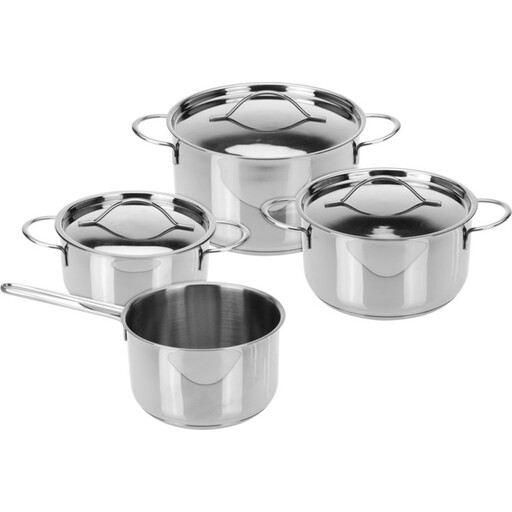
Why it suits this profile: The set contains three cooking pots with lids and a saucepan, in sizes ranging from 17 to 21 cm. This provides a practical foundation for everyday cooking without requiring a particularly extensive set from the outset.
The capacities are clearly specified, and the set explicitly states that it is suitable for gas, electric, ceramic, halogen and induction hobs. No non-stick coating is listed.
Four pans, internal measurement markings, sandwich base, dishwasher-safe and, according to the product information, PFAS-free.
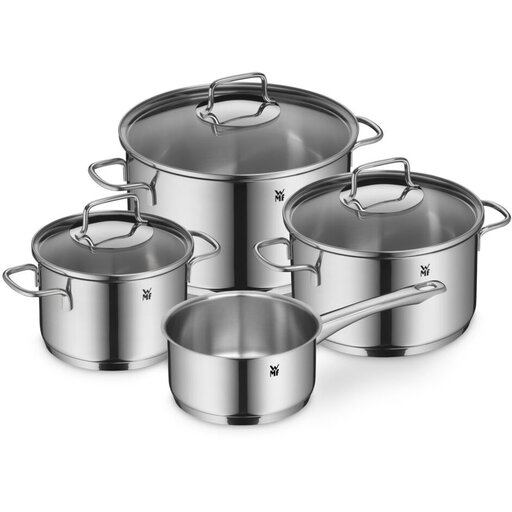
Why it suits this profile: This set is aimed at households that need several sizes and value a consistent design. It contains three cooking pots with lids and a saucepan.
The set states that it is suitable for all heat sources, including induction. The glass lids and wide pouring rims make it easier to use with greater control.
Cromargan stainless steel, TransTherm base, glass lids, ergonomic handles and dishwasher-safe construction according to the product information.
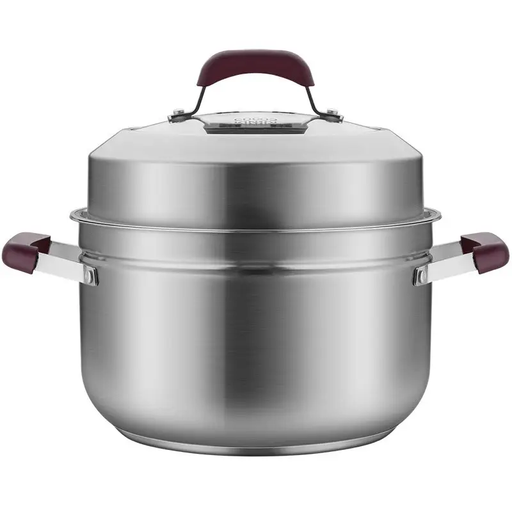
Why it suits this profile: With a stated capacity of 10.5 litres, this multifunctional pan is suitable for large portions, soups, pasta and steaming. It is ideal for families and people who like to cook ahead.
The product information lists a diameter, capacity and compatibility with gas, electric, ceramic and induction hobs. This makes it easier to match the capacity to your cooking routine.
304 stainless steel according to the product description, viewing lid, heat-resistant handle, steaming function and versatile use.
We’ve put together a complete, up-to-date list of products that fully meet these strict selection criteria and the applicable European safety regulations.
Preheat an untreated stainless steel frying pan gently before adding oil. Do not use an extremely high heat setting unless necessary. Soak stuck-on residue in warm water instead of immediately using a metal scouring pad.
Wash pans with a soft sponge and mild washing-up liquid, unless the product page states that they are dishwasher-safe. Dry them after washing to help prevent water spots. White marks or a rainbow-coloured haze are often caused by minerals, starch or overheating. According to various product instructions, a small amount of vinegar may help; rinse thoroughly afterwards.
For pans with a coating, silicone handle or wooden component, follow the manufacturer’s care instructions. For example, a steamer with a wooden handle should not go in the dishwasher, while some dishwasher-safe pans are specifically designed for this.
They can be, but always check the product listing. Look for “induction-compatible” or “suitable for all hobs”. A magnetic, flat base is essential. Also consider the diameter of the induction zone.
Their lifespan depends on the material thickness, base construction, use and care. A pan without a coating does not have a non-stick layer that can wear away, but it may discolour or warp if it is overheated for too long. Use an appropriate heat setting and avoid heating an empty pan unnecessarily.
A pan without a non-stick coating may be marketed as PFAS-free, but check that this is stated explicitly for the product. For models with ceramic or other coatings, you should review the full material description. Treat a brand claim as a statement made by the supplier, and therefore check the product specifications and instructions for use.
