
Vandaag of morgen in huis

Kwaliteit gegarandeerd

Welkomstaanbiedingen ontgrendelen: GRATIS bezorging | Tot 80% korting | Gratis 30 dagen JoyPlus-proefperiode
Download de app
A stainless steel frying pan can last for years, but not every stainless steel frying pan performs in the same way. One pan may be completely uncoated, while another has a ceramic or other non-stick coating. Terms such as 304 stainless steel, ‘honeycomb’ and ‘3-ply’ only mean something in practice if you know what they actually refer to.
For home chefs, keen cooks and households in the Netherlands, three things are particularly important: heat distribution, hob compatibility and maintenance. Below, you’ll find out how to check marketing claims and which models suit different cooking styles.
304 stainless steel is a widely used material for food contact. It is resistant to rust and corrosion, but a smooth stainless steel cooking surface is not automatically non-stick. Food can still stick when cooking eggs, fish or pancakes if the pan is too cold, becomes too hot or does not contain enough fat.
A PFAS-free frying pan may have a ceramic coating, but there are also uncoated stainless steel models. Therefore, always check whether the product description refers to a coating, a ceramic surface or simply polished steel.
A frying pan for all hobs should be suitable for gas, electric, ceramic and induction hobs. Even so, heat transfer varies. A thin, single-layer pan behaves differently from a 3-ply frying pan with an aluminium core.
Induction requires a magnetic base. Also check that the base diameter matches your cooking zone properly. A 28 cm pan does not always have a 28 cm heating surface.
A dishwasher-safe frying pan is convenient, but handles, coatings and seals may react differently to high temperatures and powerful dishwasher detergents. If the product information states that a pan is not dishwasher-safe, you should wash it by hand.
For uncoated stainless steel, preferably use a soft sponge and mild washing-up liquid. Discolouration or white deposits are often caused by overheating, salt or minerals in the water. These can usually be removed with a little vinegar, but avoid aggressive scrubbing.
A 304 stainless steel frying pan uses the grade of steel specified by the manufacturer. For example, WMF uses Cromargan 18/10 stainless steel in several models. PURECOOK and other brands mention 304 stainless steel in their product descriptions.
Also pay attention to the construction:
According to PURECOOK’s product description, the Tri-Ply 28 cm pan consists of stainless steel, aluminium and stainless steel. This design is intended to distribute heat more quickly and evenly. The performance claim comes from the manufacturer, so treat it as a product specification rather than a universal guarantee.
A 20 to 22 cm pan is suitable for one or two portions, such as an omelette, vegetables or dumplings. For a household of three or four people, 24 to 28 cm is often more practical. A 30 or 32 cm wok provides room for stir-fries, but also takes up more storage space.
A frying pan with lid is useful for simmering, reducing sauces and dishes where you want to retain moisture. Check whether the lid is included, as this varies by version.
An uncoated stainless steel pan requires a different approach:
If you mainly want to prepare eggs, pancakes or delicate fish with ease, a non-stick frying pan may be a better choice. With a coated pan, the care instructions are particularly important. According to the product information, the WMF Durado is PFAS-free and has a ceramic coating. The brand recommends hand washing and states that the pan is not dishwasher-safe.
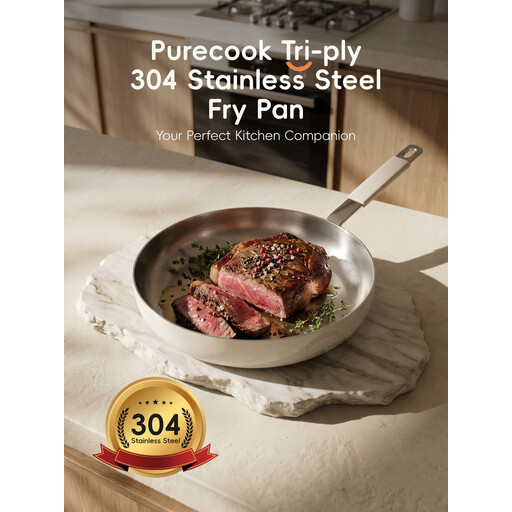
Why it suits this profile: The compact size is ideal for one- or two-person households and everyday portions such as eggs, vegetables and dumplings.
The product description specifies a 3-ply 304 stainless steel construction and suitability for induction and gas. This means you do not have to rely solely on an isolated coating claim.
22 cm, tri-ply 304 stainless steel, insulated silicone sleeve and no lid according to the product specification.
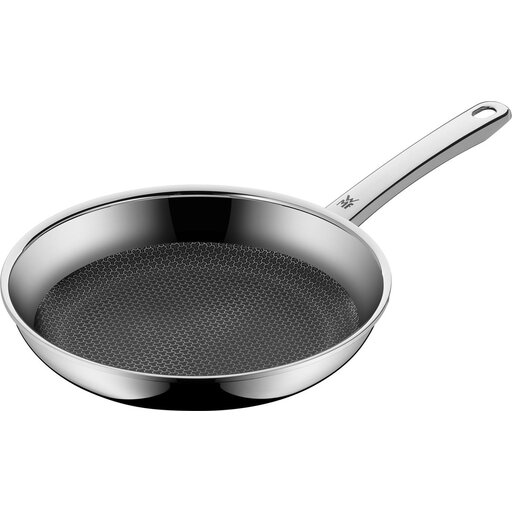
Why it suits this profile: This pan is aimed at people who regularly cook larger portions and want a combination of stainless steel, an aluminium core and a non-stick system.
The product information clearly specifies an aluminium core, stainless steel interior, honeycomb structure and a PermaDur coating. It also states that hand washing is required.
28 cm, suitable for induction and other heat sources, 3-ply construction and a five-year warranty according to the manufacturer.

Why it suits this profile: The combination of a large cooking surface, 3-ply construction and glass lid is ideal for families and anyone who wants to fry and stew in the same pan.
The specifications mention the tri-ply construction, compatibility with all hobs and oven use up to the stated temperature. According to the product information, the pan is dishwasher-safe.
28 cm, glass lid, 304 stainless steel-aluminium-stainless steel construction and suitable for gas, induction, electric and ceramic cooking.
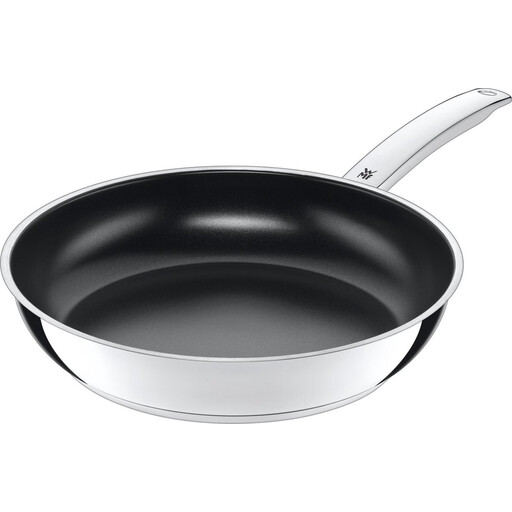
Why it suits this profile: This version is ideal for anyone looking for a stainless steel pan with a ceramic non-stick coating and who considers PFAS-free status an important product specification.
According to the product information, the ceramic coating is PFAS-free. At the same time, the care instructions clearly state that hand washing is required and that the pan is not dishwasher-safe.
24 cm, ceramic coating, stainless steel handle, induction compatibility and suitability for high temperatures according to the product specification.
After use, allow a stainless steel frying pan to cool down before washing it. Avoid running cold water over a hot pan; a sudden change in temperature can damage the material and glass. When using a coated pan, do not use abrasive cleaners and check whether metal utensils are permitted.
With uncoated stainless steel, a preheated pan with a thin layer of oil helps reduce sticking. A discoloured base does not necessarily mean that the pan is unusable, but repeatedly heating it while empty can cause warping. Always follow the manufacturer’s safety instructions.
We’ve put together a complete, up-to-date list of products that fully meet these strict selection criteria and the applicable European safety regulations.
Yes, provided the manufacturer states that it is induction-compatible and the pan has a magnetic base. According to their product information, most models in this overview are suitable for induction. Always check this for the exact version, particularly with older or unusual models.
Preheat the pan gradually, then add oil and wait until the food releases easily before turning it over. Do not use maximum heat unless necessary. For particularly delicate ingredients, a ceramic non-stick frying pan may be more practical than uncoated stainless steel.
Its lifespan depends on the material, use and maintenance. An uncoated stainless steel pan has no coating that can wear away, but it can still become scratched, discoloured or warped through incorrect use. With a coated pan, it is particularly important to follow the instructions regarding permitted utensils, temperatures and cleaning methods. A product warranty, such as the five years stated by WMF for certain Profi Resist models, is not a guarantee of unlimited service life.
