
Livraison le jour même et le lendemain

Qualité garantie

Débloquez vos offres de bienvenue: Livraison GRATUITE | Jusqu'à -80 % | 30 jours d'essai gratuits à JoyPlus
Téléchargez l'application
A stainless steel wok is ideal for home cooks who want to use one pan for stir-frying, sautéing, stewing and deep-frying. However, the wrong choice can quickly prove disappointing. A wok that appears versatile on paper may not be suitable for induction, may be too large for your cooking zone or may develop stubborn stains after just a few uses.
That is why product information matters more than eye-catching marketing terms. Look at verifiable features such as the material, base construction, diameter and care instructions.
A honeycomb wok can help prevent food from sticking, but the term does not automatically mean that no coating is present. Some models combine a honeycomb structure with a ceramic non-stick coating. Other models use only a textured stainless steel surface.
If you want a wok without Teflon, check whether the product description explicitly states “without coating”, “without Teflon” or “without PTFE”. If in doubt, it is sensible to compare the material information with the care instructions.
A stainless steel wok is not automatically suitable for induction. Induction hobs require a magnetic, flat base. A wok for a gas cooker may have a rounded base, whereas induction and ceramic hobs generally work better with a flat underside.
Therefore, check whether the manufacturer explicitly states compatibility with induction, gas, electric and ceramic hobs. Also pay attention to the diameter of the magnetic base, not just the pan’s overall size.
A 30 cm wok offers plenty of space for family-sized portions, but it also takes up more room on the hob and in the cupboard. A 28 cm wok is often easier to handle for one to three people. A 32 cm pan or larger can be useful for large portions, but may heat less evenly on a small cooking zone.
A lid is useful for stewing and simmering, but makes the wok heavier and taller. Consider in advance which dishes you will actually prepare.
304 stainless steel is a commonly used type of steel for kitchen pans. In product information, it is often described as food-grade stainless steel. According to the product descriptions from the relevant brands, 304 stainless steel is intended for daily contact with food and is resistant to corrosion. This is a product specification, not a guarantee that a pan will never discolour or become damaged.
A single-wall stainless steel wok responds quickly to changes in temperature, but can develop hot spots. A tri-ply wok usually consists of several layers, such as stainless steel, aluminium and stainless steel. According to the product information, the aluminium core supports faster and more even heat distribution. However, check whether tri-ply construction applies to the entire pan or just the base.
Use these guidelines as a practical starting point:
For stir-frying, the diameter is not the only important factor. A broad base provides contact with the cooking zone, while high, sloping sides give you room to toss the ingredients.
A stainless steel wok without a coating requires a different cooking method from a traditional non-stick pan. First heat the pan over a medium heat, then add oil and only place the ingredients in the pan once the oil is hot. Ideally, work with smaller batches; too much food lowers the temperature and increases the chance of sticking.
Use wooden or silicone spatulas when the product information requires this. With a wok featuring a ceramic coating, avoid sharp metal utensils, even when the manufacturer says that a textured structure provides additional protection.
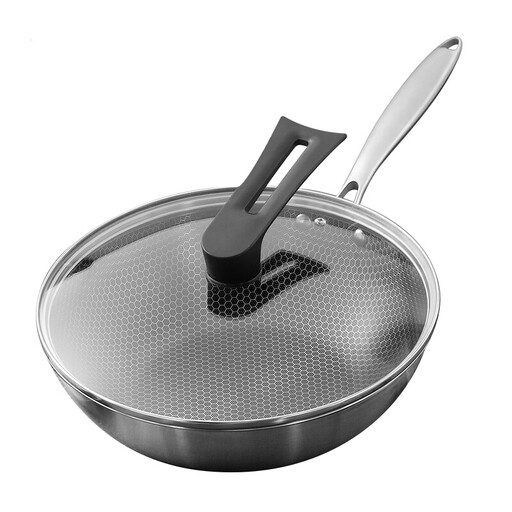
Why it suits this profile: A 30 cm wok with a lid provides plenty of room for everyday family meals and, according to the product information, is suitable for gas, induction and electric hobs.
According to the product description, this honeycomb wok has a stainless steel surface without Teflon. However, check the current specifications before buying.
30 cm diameter, matching lid, and suitability for stir-frying, sautéing and deep-frying according to the product information.
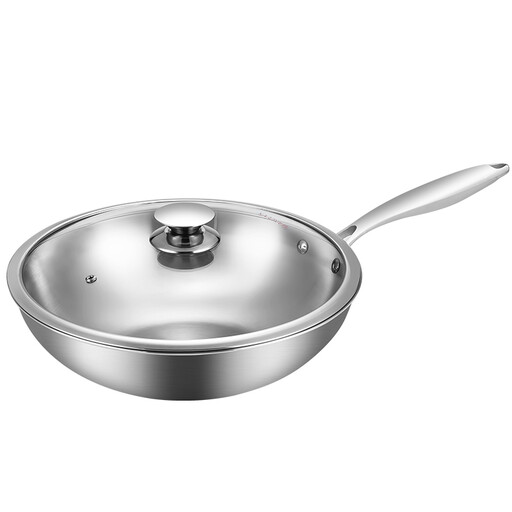
Why it suits this profile: This 304 stainless steel wok is aimed at buyers who value a coating-free pan and broad hob compatibility.
According to the product information, the pan has no non-stick coating and features a multi-layer base for induction, gas, electric and ceramic hobs.
28 cm size, glass lid, dishwasher suitability according to the product information, and suitable for stir-frying and searing.

Why it suits this profile: The combination of a 30 cm capacity, glass lid and flat base is ideal for families who want to combine stir-frying, stewing and cooking in one pan.
The product description states that there is a ceramic non-stick coating beneath the honeycomb structure. This prevents confusion with a completely coating-free wok.
Tri-ply 304 stainless steel, glass lid and, according to the product information, compatibility with induction, gas, electric and ceramic hobs.
We have put together a complete, up-to-date list of products that fully meet these strict selection criteria and the applicable European safety regulations.
Wash a new pan with warm water and washing-up liquid before using it for the first time. According to the product information, some 304 stainless steel models may have residual polishing wax. Boiling the pan and drying it carefully is recommended in such cases.
For everyday care:
That depends on the base. Choose a model that explicitly states that it is suitable for induction. A flat, magnetic base is generally required. Also check whether your cooking zone is large enough for a 28 or 30 cm wok.
Heat the wok first, then add oil and cook over a medium heat. Add ingredients to the pan in small batches. A coating-free wok takes some getting used to; always follow the brand’s specific usage instructions.
A wok with a lid is useful if, as well as stir-frying, you want to stew, simmer or keep ingredients warm. For quick stir-frying only, a lid is less essential. Also check whether the lid is made of glass and whether the handle is heat-resistant.
