
Vandaag of morgen in huis

Kwaliteit gegarandeerd

Welkomstaanbiedingen ontgrendelen: GRATIS bezorging | Tot 80% korting | Gratis 30 dagen JoyPlus-proefperiode
Download de app
A stainless steel steamer can last for years, but only if its construction suits your hob, household and cooking habits. Many shoppers focus mainly on the number of layers or an attractive price. As a result, they sometimes buy a pan that performs poorly on induction, is difficult to clean or turns out to be too small for the family.
Pay particular attention to these three pitfalls:
304 stainless steel is a popular choice for cookware. According to the product descriptions of the models available, this material is corrosion-resistant and suitable for contact with food. However, check whether this refers to the interior, the entire pan or just one component.
316 stainless steel is used in some models. According to the relevant product description, this type offers greater corrosion resistance than 304. That can be useful for intensive use or ingredients that are more acidic or salty. This material designation alone does not mean that a pan cooks better; the base construction and thickness remain important.
Also look out for additional layers. A tri-ply or multi-layer steamer, for example, consists of stainless steel with an aluminium core. According to the product information, this construction can distribute heat more evenly than a single layer. Also check whether the interior is uncoated. This prevents a coating from becoming damaged, but may sometimes require a lower heat setting to minimise discolouration.
A steamer for induction needs a magnetic base. The product description should mention induction explicitly. A model that only states “stainless steel” does not provide sufficient assurance.
Also check:
A cooking pan with a steamer insert is practical when you also want to use the lower pan separately. This gives you one pan for soup, pasta or sauce, plus an insert for vegetables, fish, dumplings or eggs.
For one or two people, a pan of around 2 to 2.5 litres may be sufficient. Families often benefit more from a 5-litre model or a steamer with two or three tiers. Consider the actual usable space: tall ingredients such as corn on the cob or a whole fish need more height than vegetables.
A steamer with a glass lid lets you monitor the cooking process without constantly lifting the lid. This is practical, but the glass and handles will still become hot. Check that the lid fits securely and that the handles contain heat-insulating silicone.
An electric food steamer is a different type of product. It usually has a water reservoir, timer and automatic switch-off. The trade-off is that you have an additional appliance to store and clean.
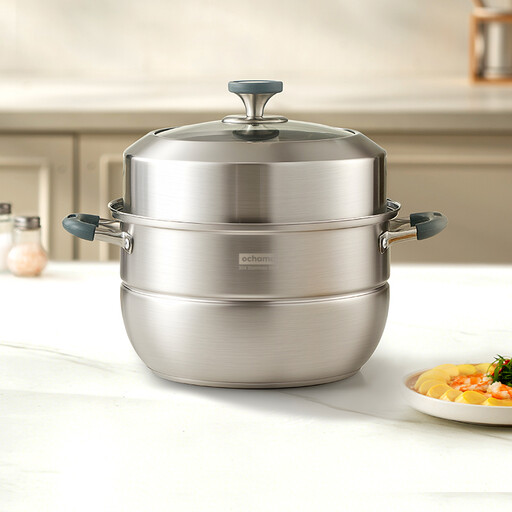
Why it suits this profile: The 28 cm double steamer offers a straightforward starting point for cooking vegetables, fish and dumplings on gas, electric or induction hobs.
The product description states that it is made from 304 stainless steel, has two tiers and is compatible with induction, gas and electric hobs.
Uncoated interior, stackable baskets and a construction suitable for several types of hob.

Why it suits this profile: This set is designed for anyone who wants to use a wok, milk pan, saucepan and frying pan as well as a steamer.
The steamer and soup pan comes with an insert and glass lid; the tri-ply construction is clearly described as steel-aluminium-steel.
Four-piece set, several sizes and a 316-steel wok alongside 304-steel components.
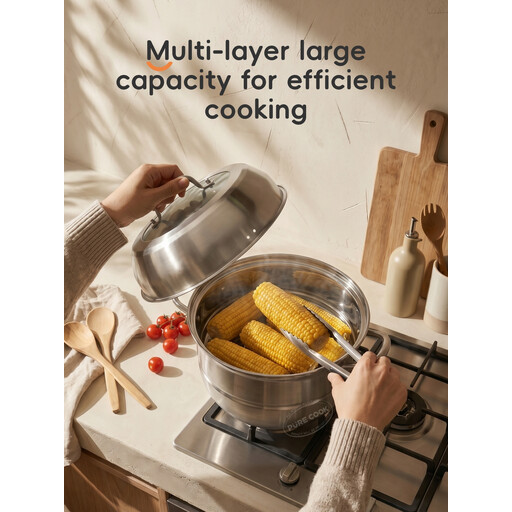
Why it suits this profile: With seven components and several insert levels, this set is ideal for larger households and batch cooking.
The specifications mention a composite magnetic base, glass lid, dishwasher-safe construction and use on induction, gas and ceramic hobs.
30 cm diameter, several steamer baskets and, according to the product information, capacity for 6 to 8 people.
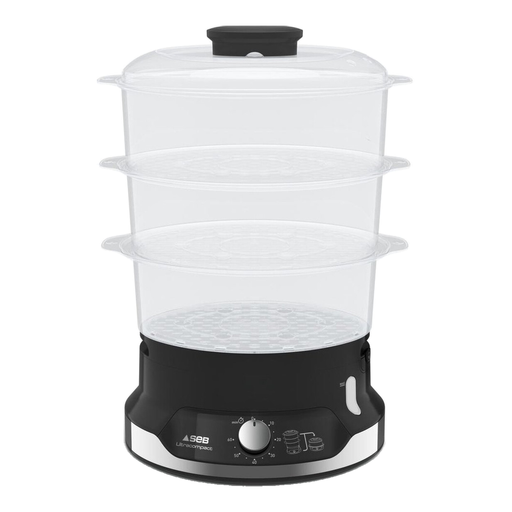
Why it suits this profile: This electric food steamer is convenient when you do not want to place a large pan on the hob or regularly prepare several dishes at once.
The three stackable bowls offer a combined capacity of 9 litres, a timer of up to 60 minutes and automatic switch-off.
800 watts of power, the option to refill the water reservoir and bowls that, according to the product information, are dishwasher-safe.
We have put together a complete, up-to-date list of products that fully meet these strict selection criteria and the applicable European safety regulations.
A stainless steel cookware set may seem like good value, but check whether you will genuinely use most of the components. For a household that only steams vegetables and fish, one compact pan with an insert may make more sense than a large set.
Also pay attention to the following points:
It can be, but check the product specifications. Look for a mention of induction compatibility and, preferably, a magnetic or composite base. The term “stainless steel” alone is not enough.
For one or two people, around 2 to 2.5 litres is often practical. For a family, a 5-litre pan, a diameter of 28 to 30 cm or several steaming tiers may be more convenient. Take into account the available space in your kitchen cupboard and on the hob.
That depends on the power rating, cooking time and your energy tariff. An 800-watt electric steamer uses a maximum of 0.8 kWh during one hour, although some models switch off sooner. A cooking pan on induction or gas has different energy-use factors. It is therefore best to compare your cooking time and portion size.
