
Vandaag of morgen in huis

Kwaliteit gegarandeerd

Welkomstaanbiedingen ontgrendelen: GRATIS bezorging | Tot 80% korting | Gratis 30 dagen JoyPlus-proefperiode
Download de app
A stainless steel steamer is useful for vegetables, fish, dumplings, eggs and baby food. However, not every stainless steel steamer is equally suitable for your hob or household. A pan may look spacious in the product photo, but in practice be too small for a family meal. A thin base, awkward handles or a poorly fitting lid can also make it less pleasant to use.
This buying guide helps you focus on the specifications that really matter. That way, you can avoid paying for marketing terms that offer no practical benefit.
A steamer for induction usually needs a magnetic, flat base. With gas, ceramic and electric cooking, stability and heat distribution are the main considerations. Always check whether the product description explicitly mentions your type of hob. “Universal” on its own says very little about the base construction.
An induction steamer must also make good contact with the cooking zone. A base that is too small or curved may heat less efficiently.
A 2-tier steamer or 3-tier steamer allows you to prepare different ingredients at the same time. That is convenient, but only if the tiers are tall enough and the steam can circulate properly. With compact pans, large pieces of fish, plates or dumplings may not fit comfortably.
So check the diameter, total height and capacity. For one or two people, a pan of around 18 cm may be sufficient. Families will generally benefit more from a model measuring 24 to 30 cm.
304 stainless steel is a common choice for cookware. It is more important to check whether the material is specified for the interior, the steaming insert and the base. For example, a product with a ceramic exterior may have a stainless steel inner wall, while its care requirements differ from those of completely uncoated steel.
A 316 stainless steel pan is often associated with greater corrosion resistance in product information. According to PURECOOK’s product description, the interior of the model in question is made from 316 stainless steel. This is a product specification, not a guarantee that the pan is suitable for every situation or will last indefinitely.
Ideally, choose a pan for which the material construction is clearly stated:
A thicker or multi-layer base may distribute heat more evenly than a single thin sheet of steel. However, bear the overall weight in mind: a large pan with several inserts can be difficult to lift when full.
Use the following guidelines as a starting point:
As well as the capacity in litres, consider the usable diameter. A tall pan with little surface area is not automatically practical for a whole fish or several bowls.
A steaming pan with lid should allow the lid to fit securely. A glass lid lets you monitor the cooking process without constantly allowing steam to escape. Handles with silicone coating may be more comfortable to hold, but should be cleaned according to the care instructions.
Also check:
A steaming insert can turn an ordinary cooking pot into a simple steamer. Do check the diameter and height, however, so that the insert does not wobble or touch the lid.
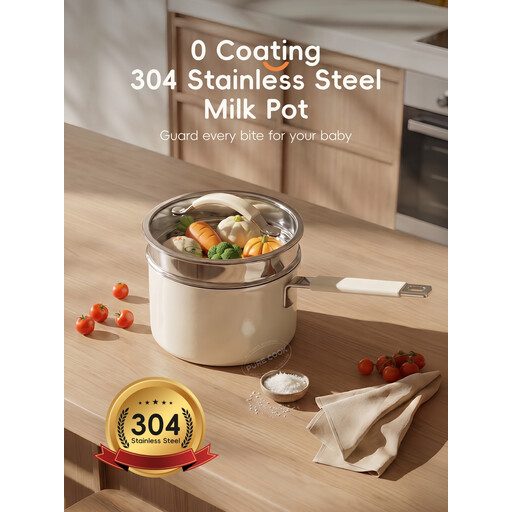
Why it suits this profile: The compact 18 cm size is suitable for small kitchens, student accommodation and portions for one or two people. The pan combines simmering and steaming in one design.
The product description specifies 304 stainless steel, a steaming insert and compatibility with all hobs. This makes the pan’s intended use clearer than a general claim of universal compatibility.
18 cm diameter, glass lid, insulating silicone handles and a 2-in-1 design for steaming and simmering.

Why it suits this profile: This 28 cm model with a capacity of around 5 litres is ideal for home cooks who want to use one pan for steaming, braising and roasting.
The specifications mention a TransTherm induction base, a thermometer and use on all heat sources. The maximum oven temperatures are also stated separately.
28 cm diameter, capacity of around 5 litres, glass lid with thermometer and a dishwasher-safe pan.
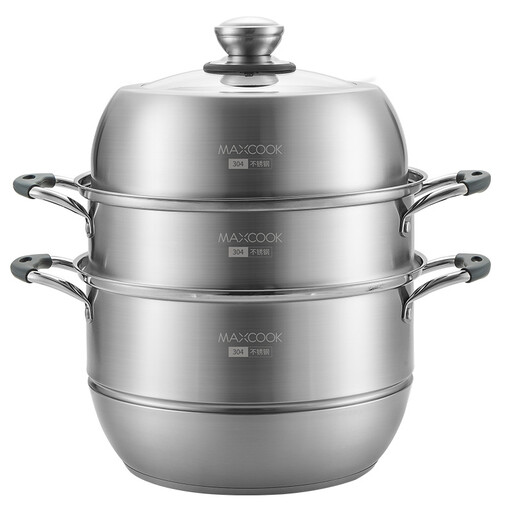
Why it suits this profile: The 3-tier construction is designed for households that steam several ingredients at once, such as vegetables, fish and dumplings.
According to the product information, the pan has a reinforced composite base and is suitable for induction, gas, electric and ceramic hobs. Hand washing is recommended.
304 stainless steel, three tiers, silicone handles and support for multiple types of hob.
We have compiled a complete, up-to-date list of products that fully meet these strict selection criteria and the applicable European safety regulations.
A stainless steel steamer requires little maintenance, but a few habits can help prevent discolouration and deposits:
Slight rainbow discolouration or white deposits are not unusual on stainless steel. According to care information from various manufacturers, food residue and minerals in water can cause this. A small amount of vinegar may help remove such deposits; rinse thoroughly afterwards.
It can be, but check the product listing. Look for terms such as induction-compatible, magnetic base or composite base. A pan described only as “stainless steel” is not automatically suitable for induction.
Its lifespan depends on the material thickness, base construction, frequency of use and care. Stainless steel does not have a non-stick coating that can peel off, but glass lids, silicone handles and any ceramic exterior coatings still require careful use. Always follow the specific cleaning and safety instructions.
A traditional steamer uses the heat source from your hob. A well-fitting lid and a steady, moderate temperature help reduce heat loss. With multiple tiers, you can cook different ingredients in a single cooking cycle. An electric steamer has its own power rating and timer, so compare the wattage and the cooking time you require.
