
Livraison le jour même et le lendemain

Qualité garantie

Débloquez vos offres de bienvenue: Livraison GRATUITE | Jusqu'à -80 % | 30 jours d'essai gratuits à JoyPlus
Téléchargez l'application
Stainless steel pans are popular in British kitchens because they can be used for everyday cooking on gas, induction, electric and ceramic hobs. However, not every stainless steel pan is the same. A thin pan may distribute heat unevenly, an unsuitable base will not work on induction, and a smooth interior without a non-stick coating requires a different cooking technique.
If you focus only on a low price or shiny finish, you risk buying a pan that sees little use after just a few months. With these practical checks, you can compare a stainless steel pan set, individual frying pan or cooking pot based on the features that really matter in everyday use.
The exterior may look sturdy, while the pan is actually made from a single thin layer. When cooking, heat can then build up mainly beneath the centre of the pan. This increases the risk of food sticking in certain areas and makes temperature control more difficult.
A 3-ply stainless steel pan usually consists of stainless steel on the inside and outside, with an aluminium core. Aluminium conducts heat efficiently, while the steel layers provide strength. However, check whether the layers run through both the base and the sides, or whether they are only incorporated into the base.
Induction requires a magnetic base. A product description may mention gas, electric, ceramic and induction cooking, but always check this for the specific model. An old or decorative steel wok is not automatically suitable for induction.
If you are looking for an induction cooking pot set, also look for a flat base. A rounded wok base makes less effective contact with an induction hob and may sit unstably.
Many stainless steel pans do not have a coating. This can be an advantage if you prefer to avoid coatings, but food may stick more easily if the pan is cold or the temperature is too high. The technique of “preheating the pan, adding oil and then placing in the ingredients” generally works better than starting directly on a high heat.
Products with a ceramic or other non-stick coating require different care. So do not look only for the term “non-stick”; check the type of coating, the recommended utensils and the cleaning method too.
304 stainless steel is often used for cookware. Manufacturers may specify this as the material for the interior or for the entire pan. Check the complete materials list, as a pan may also have an aluminium core, ceramic outer coating or plastic handle.
For products that refer to food-contact standards, treat this as information provided by the manufacturer. For example, PURECOOK states that certain models comply with the Chinese GB 4806.9 standard and US FDA requirements. This is not a general guarantee that every product described as 304 stainless steel has the same properties.
For a household of one or two people, a saucepan of around 16 to 18 cm and a frying pan of 20 to 24 cm are often practical. Families will usually benefit more from a 20 to 24 cm cooking pot and a 26 to 28 cm frying pan. A 30 cm pan is useful for stir-fries or several portions, but it also requires more storage space and a cooking zone that is large enough.
For stainless steel cooking pots, check the stated capacity in litres. A 5-litre pot is suitable for larger portions of soup or pasta, while a 1.5 to 2.5-litre model is better suited to sauces, porridge and smaller meals.
“Dishwasher-safe pans” are convenient, but check whether this applies to the entire pan. Handles, wooden components and some coatings may not withstand intensive dishwasher programmes. For example, hand washing is recommended for certain MAXCOOK models, while other products are described as dishwasher-safe.
For uncoated stainless steel, use a soft sponge and mild washing-up liquid. White marks are often caused by minerals or starch from water and food. A little vinegar can help loosen this residue. Allow the pan to cool before washing it, then dry it thoroughly.
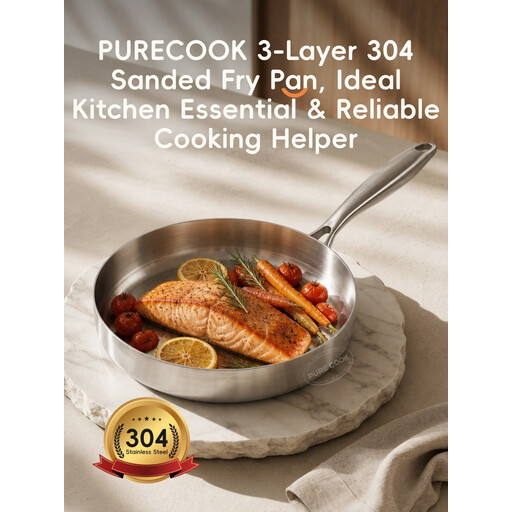
Why it suits this profile: A compact stainless steel frying pan for small portions, eggs, vegetables or a meal for one or two people. According to the product description, this model is suitable for gas, induction and other common heat sources.
The description specifies a 304 triple-ply construction with an aluminium core. This makes the construction clearer than with a pan that is simply described as “stainless steel”.
20 cm diameter, 304 stainless steel with an aluminium core and, according to the product specifications, suitable for induction and gas.
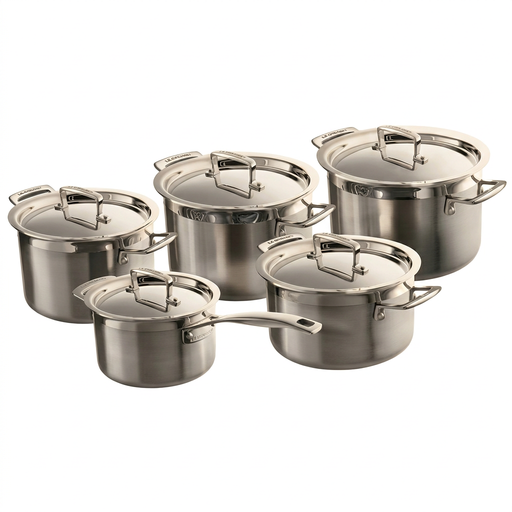
Why it suits this profile: A complete set for anyone who wants to combine several cooking pots made from the same material in different sizes. According to the product specifications, the set is suitable for induction, gas, electric, halogen, ceramic and oven use.
The description explicitly states that the set has a 3-ply construction, flat bases, measurement markings and no non-stick coating. This means you know exactly what you are buying in advance.
Set of five pans according to the product name, with glass lids, measurement markings and dishwasher-safe specifications.
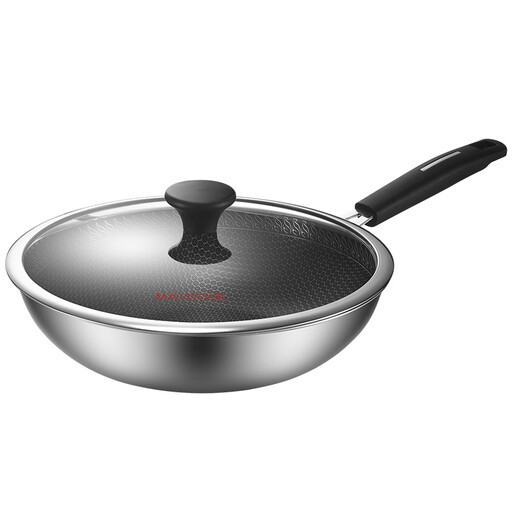
Why it suits this profile: A spacious wok for stir-frying, braising and cooking for several people. According to the product information, this model works on induction, gas, electric and ceramic hobs.
The product description clearly states that the pan has a ceramic non-stick coating and honeycomb structure. At the same time, hand washing is recommended, which helps prevent incorrect expectations about care.
30 cm diameter, glass lid, 3-ply construction and compatibility with multiple hobs.
We have put together a complete, up-to-date list of products that fully meet these strict selection criteria and the applicable European safety regulations.
That depends on the base. Look for an explicit statement confirming induction compatibility and, preferably, a flat, magnetic base. A pan set for all hobs will usually list gas, electric, ceramic and induction separately in the product specifications.
First, heat the pan over a medium heat. Then add oil and wait briefly before placing in the food. Lower the temperature once the pan is hot. Do not use an extremely high setting, and do not try to move meat or potatoes straight away; they will often release naturally once they have formed a crust.
Their lifespan depends on the material thickness, base construction, handles and care. A pan without a coating does not have a non-stick layer that can wear away, but it can still discolour or warp if it is overheated while empty. Do not leave a pan on high heat for an extended period, use suitably sized cooking zones and regularly check that the handles are still securely attached.
