
Livraison le jour même et le lendemain

Qualité garantie

Débloquez vos offres de bienvenue: Livraison GRATUITE | Jusqu'à -80 % | 30 jours d'essai gratuits à JoyPlus
Téléchargez l'application
A stainless steel lunchbox seems simple: you put food in it and take it with you. In practice, models vary considerably in terms of sealing, capacity, insulation and maintenance. A cheap lunchbox can therefore prove inconvenient if the lid leaks, the opening is too small or the size does not fit in your bag.
Whether you need one for work, school, commuting or a short trip, it is therefore wise not to focus solely on the price or the number of components. Pay particular attention to the following points.
A manufacturer may describe a lunchbox as leakproof, but that does not automatically mean it will remain sealed in all circumstances. Look for a silicone seal, locking clips or a screw-top lid. Also check whether the product description explains how the container should be transported.
Hot soup can also create pressure. For the Cooker King models, the product description recommends opening the silicone air valve before removing the lid. This is a practical detail that is often missing from general marketing copy.
304 stainless steel and 316 stainless steel are commonly used designations for stainless steel. 316 stainless steel is often chosen for applications where greater resistance to certain influences is desirable, but the material alone does not determine whether a lunchbox is pleasant to use. The quality of the welds, lid, seal and maintenance requirements are at least as important.
Therefore, check whether the material specification is clearly stated as 304 stainless steel food container or 316 stainless steel food container. If in doubt, ask for information about food contact and the relevant EU documentation. A material name is not a substitute for complete product information.
A standard metal lunchbox is not the same as an insulated food container. A single-wall food container may be suitable for bread, fruit or a meal that you will eat shortly after setting off. For soup or a hot stew, you are more likely to need a vacuum-insulated thermos food jar, soup thermos or thermal lunchbox.
Also consider the volume. A capacity of 1.5 litres is generous for a large meal, but it can be heavy and bulky for everyday use on a bicycle or in a full rucksack.
For everyday use, 304 stainless steel is a common choice. It is used in a range of food containers and lunchboxes. 316 stainless steel is a different type of steel with a different composition. Do not choose solely on the basis of the higher number; instead, look at the overall construction and the available maintenance information.
Also pay attention to the parts that are not made of steel. A silicone ring can retain odours over time or become less elastic. Check whether the seal can be removed and whether it may be cleaned by hand or in the top rack of the dishwasher.
A leakproof lunchbox should close securely without you having to force the closure. With a clip-lock model, it is important that the silicone ring sits correctly in the groove. With a thermos food jar, the screw-top lid must be fully tightened before you put the jar in a bag.
If you are carrying hot soup, first open any air valve in accordance with the instructions. Do not leave the container upside down for prolonged periods if the manufacturer advises against it. In practice, “leakproof” depends on closing, filling and transporting the container correctly.
A wide opening makes filling, eating and cleaning easier. A rectangular shape often makes better use of the space in a work bag than a tall jar. Check the stated dimensions, not just the number of millilitres.
For a meal-prep container, several compartments are useful if you want to keep ingredients separate. A single compartment is more practical for pasta, salad, rice dishes or a large portion of soup. Abrasive scouring pads and wire wool can damage the surface; mild washing-up liquid and a soft brush are generally more suitable.
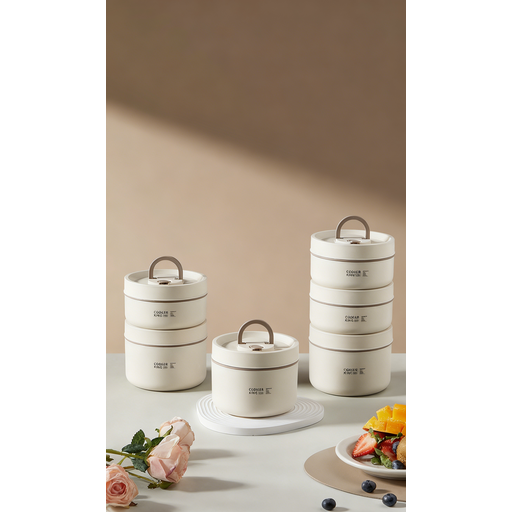
Why it suits this profile: A set of four containers offers flexibility for lunch, snacks and leftovers without requiring you to choose an insulated jar straight away.
The product description states that the containers are made from 304 stainless steel and are dishwasher-safe, and mentions a silicone air valve for hot dishes.
Four containers; the product description states that the metal containers are dishwasher-safe.

Why it suits this profile: Suitable for anyone taking hot or cold meals with them and who values a carry bag for commuting or short trips.
The product description states that it is made from 316 stainless steel and features vacuum insulation, a wide opening and a leakproof lid construction.
1.5-litre capacity; includes an insulated lunch bag; according to the product description, retains temperature for 4–6 hours.
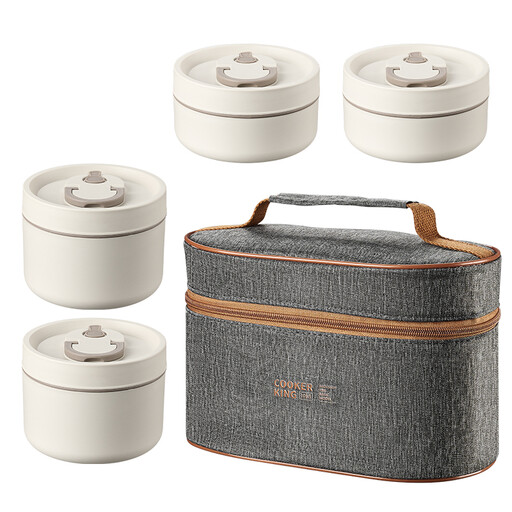
Why it suits this profile: Handy for meal prep, families or anyone who wants to prepare and take several portions with them at once.
The product information mentions five containers, silicone sealing rings and a pressure valve for hot dishes.
Five-piece set; according to the product description, the metal containers are dishwasher-safe; suitable for several portions.
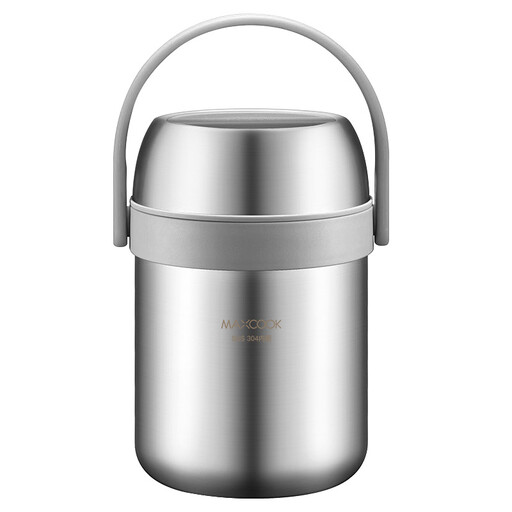
Why it suits this profile: The wide opening and generous capacity are well suited to soup, curry, pasta or a substantial lunch on the go.
The product description mentions vacuum insulation, a wide mouth and a tightly sealing lid. According to this information, the jar must not be turned upside down or tilted.
1.5-litre capacity; wide opening; according to the product description, retains temperature for 4–6 hours.
A reusable food container remains enjoyable to use for longer when you handle its components carefully:
A stainless steel lunchbox is not automatically suitable for use in a microwave. Steel should generally not be placed in a microwave. If you want to heat meals at home, it is better to look at a purpose-designed microwave-safe lunchbox.
We have put together a complete, up-to-date list of products that fully meet these strict selection criteria and the applicable European safety regulations.
Yes, but preferably choose an insulated food container with a wide opening and a suitable closure. With hot contents, always check the instructions for pressure release. A standard stainless steel lunchbox without vacuum insulation is mainly suitable when you will eat the meal soon or can heat it up later.
This varies depending on the model, quantity, starting temperature and surroundings. According to the product descriptions for the Maxcook models mentioned, the stated temperature retention is 4–6 hours. This is information provided by the brand, not a guarantee for every usage situation. For longer-lasting performance, preheat the jar and fill it as fully as possible.
The purchase price is usually higher than that of a single disposable container. However, with regular use, you can use a reusable lunchbox many more times. The overall cost depends on the purchase price, service life, cleaning and how often you use the container. Therefore, do not look only at the price; also consider replaceable seals, size and ease of maintenance.
