
Livraison le jour même et le lendemain

Qualité garantie

Débloquez vos offres de bienvenue: Livraison GRATUITE | Jusqu'à -80 % | 30 jours d'essai gratuits à JoyPlus
Téléchargez l'application
A stainless steel lunchbox may seem straightforward to choose at first glance. Yet small differences in the closure, layout and care requirements can determine whether it is convenient to use every day. For example, a lunchbox that looks leakproof in the product photo may have a loose seal. And a spacious food container will not always fit in a backpack or fridge compartment.
Joybuy Product Recommendation Officer selects products based on verifiable information, such as material, capacity, closure and care instructions. This helps you avoid paying solely for an attractive colour or a broad marketing claim.
A leakproof lunchbox needs more than a sturdy clip. Look for a silicone seal, check how the lid closes and review any warnings in the product information. Even a well-sealed container can leak when it is tilted inside a bag or when the lid has not been fully clipped shut.
So check:
A large capacity does not automatically make a lunchbox practical. Without compartments, bread, fruit and salad can come into contact with one another. A bento lunchbox or lunchbox with compartments helps divide portions, but the dividers are not always sealed separately.
For dry food, a shared interior is often sufficient. If you are taking sauces or moist food with you, choose separate containers or a model whose compartments are explicitly described as sealed.
An ordinary stainless steel food container will not keep food warm for hours by itself. For that, you need a thermos food jar or insulated food jar with vacuum insulation. According to Maxcook’s product description, the thermal function is designed to keep hot or cold food at the desired temperature for a certain period. The stated 4 to 6 hours are the manufacturer’s figures; the actual temperature depends on factors including the starting temperature, the amount of food and how often you open the lid.
304 stainless steel is often used for food containers and lunchboxes. 316 stainless steel also contains molybdenum and is generally chosen for its greater resistance to corrosion. That does not mean every 316 product will automatically be better suited to your needs. For everyday bread, fruit and leftovers, capacity, closure and ease of cleaning may be more important than the material grade alone.
Also check which parts are not made of steel:
For an individual lunch, a capacity of around 600 to 1,000 ml is often more practical than a very large container. If you prepare meals for several occasions, a set with different sizes may be more useful. As well as checking the millilitre capacity, look at the external dimensions. A stainless steel food container may take up more space than a plastic container with the same capacity because of its straight, sturdy shape.
Think in advance about where you will store the box:
“Dishwasher-safe” sometimes applies only to the metal container, not the lid or seal. According to the product description, Maxcook’s containers can be washed by hand or in the dishwasher. The thermos models must be hand-washed according to the manufacturer and should not be left submerged with the sealing section underwater for long periods.
Also look out for these differences:
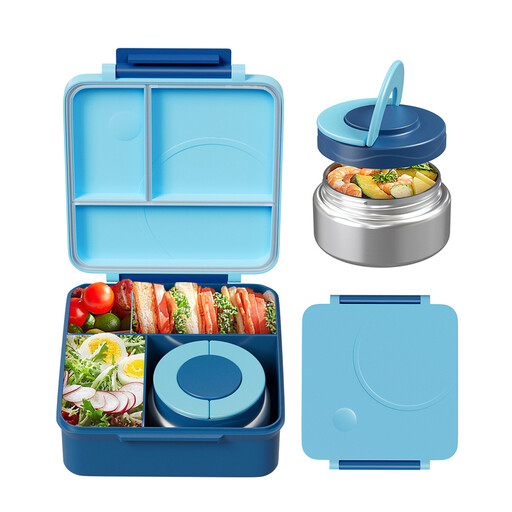
Why it suits this profile: The divided design is intended for carrying different parts of a lunch every day, for example to school or the office.
The product name specifies a divided layout and a single-latch closure. Before buying, check whether the compartments seal separately.
Divided lunchbox in blue; suitable for a simple lunch arrangement without several separate containers.

Why it suits this profile: Four 1,600 ml containers are designed for larger quantities of leftovers, groceries or preparing several meals.
The product information mentions dishwasher and freezer use, but also states that the containers must not be used in the microwave.
316L stainless steel; set of four rectangular containers; according to the product description, suitable for the dishwasher and freezer.

Why it suits this profile: The 1.5-litre thermos food jar with lunch bag is suitable for commuters, outdoor enthusiasts and anyone taking soup or a hot meal with them.
The wide opening makes filling and cleaning easier than with a narrow bottle-shaped design. According to the manufacturer, the jar is leakproof; however, transport it upright.
316 stainless steel; vacuum insulation; 1.5-litre capacity; includes an insulated lunch bag.
We have put together a complete, up-to-date list of products that fully meet these strict selection criteria and the applicable European safety regulations.
No, a metal lunchbox must not be used in the microwave. Heat the food first in a microwave-safe dish, then transfer it to the stainless steel container. Some food containers also state this explicitly in the safety information.
Check that the lid is fully closed, that the silicone seal is correctly positioned and that there are no food particles caught around the rim. Do not overfill a lunchbox and, where possible, transport liquid foods upright. “Leakproof” remains a product specification provided by the manufacturer and is not a guarantee for every transport situation.
Its lifespan depends on the steel, closure, seal and care. Stainless steel is generally suitable for repeated use, but clips and silicone rings can wear out. Wash the box according to the product instructions, dry it completely and replace a damaged seal whenever possible.
