
Livraison le jour même et le lendemain

Qualité garantie

Débloquez vos offres de bienvenue: Livraison GRATUITE | Jusqu'à -80 % | 30 jours d'essai gratuits à JoyPlus
Téléchargez l'application
A stainless steel lunch box is suitable for work, school, eating on the go and meal prep. However, the wrong choice can quickly become inconvenient. A lid that only seals properly when carried upright, not enough room for a full meal or a material that isn’t dishwasher-safe are all common causes of disappointment.
Use these checks to compare a stainless steel lunch box, bento lunch box or insulated food container based on practical features rather than marketing claims.
A manufacturer may describe a lunch box as leakproof, even if the seal is mainly designed for normal, upright transport. This matters if you’re taking soup, sauce or yoghurt in a rucksack.
So check:
For several products in this selection, the product description states that the container should be carried upright when filled with liquid food. So “leakproof” doesn’t automatically mean you can turn the lunch box upside down or carry it loose in a bag.
304 stainless steel and 316 stainless steel are common material grades, but the number alone doesn’t determine how well a lunch box will work for you. The closure, wall thickness, shape and care instructions matter too.
316 stainless steel is often chosen for its stated corrosion resistance. According to the Maxcook 316L set’s product description, this material is intended for food storage and is resistant to stains, odours and corrosion. This is a manufacturer’s product specification, not a guarantee that the product will never be damaged.
A large container might seem handy, but it takes up more space and can be heavy. A small lunch box, on the other hand, may not be practical for a meal with several components. So look at the external dimensions and layout as well as the capacity.
A compact lunch box with compartments may be enough for a sandwich, fruit and a snack. An insulated food container is more practical for soup or a hot meal. For multiple portions, meal prep containers in different sizes are often more efficient.
A 304 stainless steel lunch box is a popular choice for everyday use. This material is used in products including the PURECOOK bento lunch boxes and the Maxcook insulated food jar.
A 316 model may be worth considering if the material specification and corrosion resistance are important to you. Check that the product information clearly states which parts are made from which materials. A food container may have a stainless steel body, for example, while its lid is made from plastic, glass or silicone.
A good combination includes:
A dishwasher-safe lunch box saves time, but check whether this applies to the lid and silicone ring too. For some insulated models, the manufacturer recommends hand-washing to protect the seal and insulation.
A lunch box with compartments stops fruit, bread and snacks from getting mixed together. That makes a bento lunch box handy for school, the office or a picnic. For soup, porridge or a stew, an insulated food container with a wide opening is usually easier to use.
According to the product information, the Maxcook insulated food jars have a capacity of 1.5 litres, a wide opening and a vacuum insulation layer. The manufacturer states that they keep food at temperature for 4 to 6 hours. This is a stated product specification; the actual temperature depends on factors including the starting temperature, the amount of food and how often you open the jar.
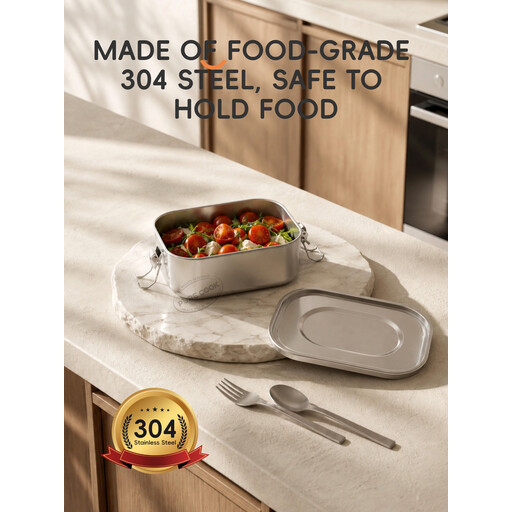
Why it suits this need: A simple single container for a meal, sandwiches or snacks, without a complicated layout.
The product description specifies 304 stainless steel, a silicone ring and two metal clips. Liquid food should be carried upright.
18.7 × 15 × 6.7 cm; single compartment; stated to be dishwasher-safe according to the product information.

Why it suits this need: A set of four matching food containers gives you space for meal prep, leftovers and storing food in the fridge or freezer.
Each container in the set has a stated capacity of 1,600 ml and a sealing lid. The product information says they can be used in the fridge, freezer and dishwasher.
316L stainless steel; four rectangular containers; dishwasher- and freezer-safe according to the product description.

Why it suits this need: For sports enthusiasts, campers and commuters who want to take soup, porridge or a hot meal with them.
The wide opening makes filling and cleaning easier. According to the product information, the jar is leakproof when properly closed, but it should be kept upright.
316 stainless steel; vacuum insulation; 1.5-litre capacity; stated temperature retention of 4–6 hours.
Wash a new lunch box before using it for the first time. Clean the container, lid and sealing ring after every meal, then let all the parts dry completely. A silicone ring can hold on to odours if it’s put away while damp.
Avoid using metal cutlery if the manufacturer warns that it may cause scratches. Only put parts in the dishwasher if the product information explicitly says they’re dishwasher-safe. Hand-washing is often recommended for insulated food containers; follow the instructions for the seal and lid.
We’ve put together a complete, up-to-date list of products that meet these strict selection criteria and the applicable European safety regulations.
It can be, but choose a model with a well-fitting silicone seal and a secure closure. Always check whether the product description mentions liquid food. Carry the lunch box upright, even if the model is described as leakproof.
Some models can. The container, lid and sealing ring may each have different care instructions. Hand-washing is often recommended for insulated food containers to protect the insulation layer and closure.
Its lifespan depends on how it’s used and cleaned, as well as the quality of the clips and sealing ring. Stainless steel generally stands up to everyday use, but a dented container, stretched ring or poorly fitting lid can affect how well it works. Replace removable sealing rings if the manufacturer offers them, and check the closure regularly.
