
Vandaag of morgen in huis

Kwaliteit gegarandeerd

Welkomstaanbiedingen ontgrendelen: GRATIS bezorging | Tot 80% korting | Gratis 30 dagen JoyPlus-proefperiode
Download de app
A stainless steel frying pan is a great fit for many British kitchens, from induction to gas and from quickly frying an egg to preparing a casserole with a lid. However, not every stainless steel frying pan is the same. A thin pan may distribute heat unevenly, a pan that is too small can be impractical for a family, and a coating may require different care from a completely uncoated pan.
As a Joybuy Product Recommendation Officer, I filter the most important product specifications so you can distinguish marketing claims from information you can actually verify.
“Stainless steel” does not automatically tell you anything about heat distribution. A pan made from a single thin sheet of steel may respond quickly, but it can also become hotter in certain areas. This increases the chance of food sticking or ingredients cooking unevenly.
Pay attention to the construction of the base. A tri-ply frying pan generally consists of several layers, often with aluminium between steel surfaces. Aluminium conducts heat well, while stainless steel provides strength and a neutral cooking surface. Always check the specific product description rather than relying solely on the term tri-ply.
An uncoated stainless steel pan is not a classic non-stick frying pan. With proper preheating, enough fat and the right temperature, ingredients can release more easily, but technique still matters. A pan with a ceramic or other non-stick coating may be easier to use for delicate dishes, but it usually requires softer utensils and more careful maintenance.
According to the product description, the WMF Profi Resist has a honeycomb structure with a non-stick coating over a stainless steel construction. This is a different option from an uncoated stainless steel frying pan.
A 24 cm pan is useful for smaller portions, while a 28 cm frying pan offers more room for several pieces of meat or vegetables. A deep frying pan or sauté pan is more practical for sauces, simmering and stewing. Also check the maximum oven temperature and whether the lid can go into the oven. With some models, the lid must be removed before using the pan in the oven.
The following details are useful for everyday cooking:
A brand’s claim about heat distribution or lifespan should be read as information from the product description. According to a brand’s own research, for example, a particular pan may last longer than a single-layer model; this is not a universal guarantee for every kitchen or cooking method.
A frying pan for all hobs must be explicitly suitable for your type of hob. Check whether it is listed as suitable for:
With induction, the diameter is not the only important factor. The base must also make good contact with the cooking zone. For example, a pan with a 24 cm cooking surface may be intended for a cooking zone of approximately 20 cm. Check the product specifications for confirmation.
Use this practical guide:
A frying pan with a lid keeps moisture in the pan more effectively and is practical for simmering. However, adding a lid does not automatically make an ordinary frying pan suitable as a saucepan; capacity, height and handle design still matter.
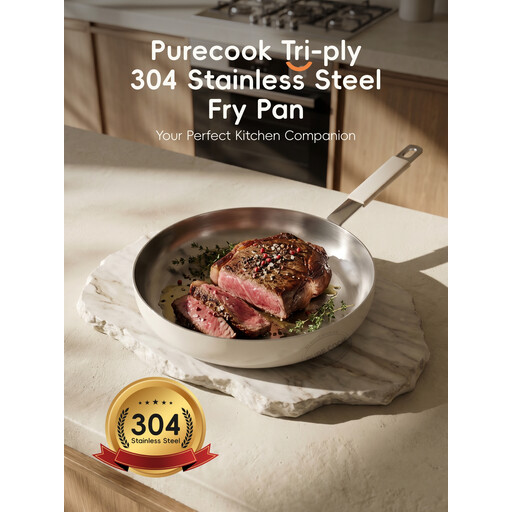
Why it suits this profile: The size is suitable for smaller households and everyday dishes. The pan has a three-layer construction, 304 stainless steel and removable silicone sleeves on the handle.
The product description specifies both the layer construction and hob compatibility. This means you do not have to rely solely on the general term stainless steel.
24 cm, tri-ply construction, suitable for induction and gas, with heat-insulating silicone sleeves.
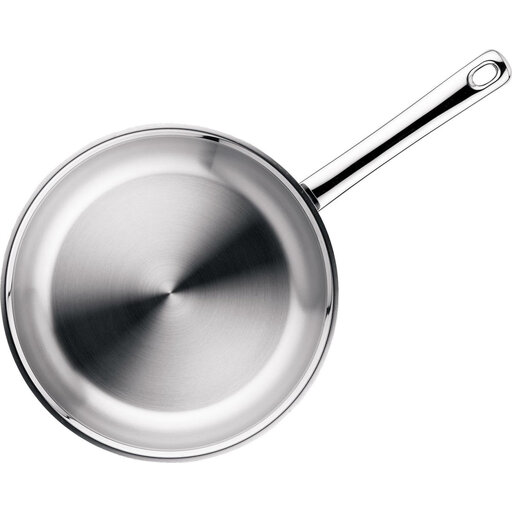
Why it suits this profile: This uncoated stainless steel pan is designed for anyone who values classic construction, a universal base and oven use.
The product specifications explicitly mention induction compatibility, a TransTherm base and an oven temperature of up to 250 °C.
18/10 Cromargan stainless steel, dishwasher-safe according to the product information, suitable for all heat sources.

Why it suits this profile: The 28 cm cooking surface and glass lid are practical for families, larger portions and dishes that are browned first and then left to simmer.
The stated oven limit of 220 °C, the lid and compatibility with gas, induction, electric and ceramic hobs are clearly specified.
Three-layer construction, 304 stainless steel, glass lid and dishwasher-safe according to the product description.
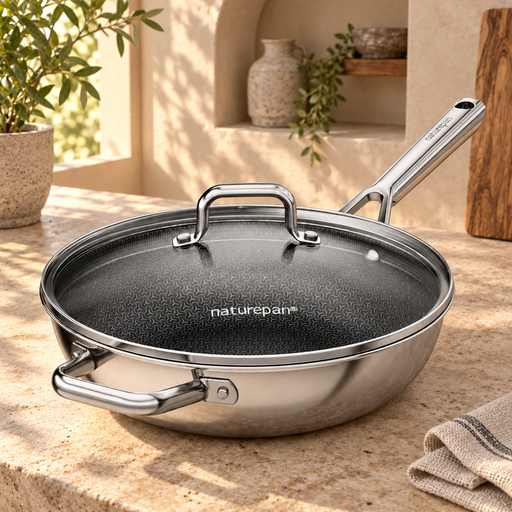
Why it suits this profile: The deep shape and lid are ideal for stir-fries, stews and sauces. The pan has a multi-layer stainless steel body with an aluminium core and ceramic coating.
The coating and care instructions are clearly stated. For oven use, the lid must be removed and the specified limit is 230 °C.
28 cm, lid included, suitable for induction, gas, electric and ceramic hobs; hand-washing is recommended to help protect the coating.
Heat a stainless steel frying pan gradually and preferably use medium heat. Allow a hot pan to cool before filling it with cold water. White marks or rainbow discolouration are often caused by water minerals, starch or overheating; according to the product information, vinegar may help remove these residues.
For a pan with a non-stick coating, wooden, silicone or nylon spatulas are a gentle choice. Always check whether dishwasher use is permitted. A durable frying pan remains practical only when its care requirements, hob and intended use are all compatible.
We have put together a complete, up-to-date list of products that fully meet these strict selection criteria and the applicable European safety regulations.
That depends on the base. Check whether the product information explicitly mentions induction compatibility. Also place the pan centrally on a cooking zone with a suitable diameter.
Preheat the pan slowly, then add oil and wait until the fat is hot. Only place the food in the pan once the surface is sufficiently hot. Moving the food too soon or using too low a temperature can cause it to stick.
An uncoated stainless steel pan is less susceptible to wear than a non-stick coating, but it requires more attention to temperature and fat. A coated pan may be easier to clean, but it generally requires softer utensils and careful maintenance.
