
Same-day & Next-day Delivery

Quality Guaranteed

Unlock Your Welcome Offers: FREE Delivery | Up to 80% OFF | Free 30-day JoyPlus trial
Download the APP
A stainless steel frying pan for induction can last for years, but not every stainless steel pan suits your hob, cooking style or cleaning routine. Marketing copy often uses terms such as “heats up quickly”, “even heat distribution” and “non-stick”, while important details are sometimes missing.
That is why you should pay particular attention to the construction, the actual base size and how you intend to use the pan. Below, you’ll find what to look out for and which models suit different households.
A tri-ply frying pan usually consists of three layers: stainless steel, an aluminium core and another layer of stainless steel. Aluminium conducts heat quickly, while stainless steel provides strength and a smooth cooking surface. However, you should check whether this construction is limited to the base or continues up the sides.
According to the product description, the PURECOOK models use a stainless steel–aluminium–stainless steel construction. This is a more specific description than simply saying “multi-layer base”.
A pan may be suitable for induction yet heat less efficiently if its base is much smaller than the cooking zone. So don’t just check whether it says “suitable for all hobs”; compare the diameter with your induction zone as well.
A 20 or 22 cm pan is handy for one or two people. For a family, 24 to 28 cm is often more practical. A large pan on a small cooking zone may also heat less evenly.
A frying pan without a non-stick coating does not work in the same way as a pan with a ceramic or other coating. Eggs, fish and potatoes may stick if the pan is too cold, the oil is added too late or the temperature is too high.
We recommend using the following method:
A smooth stainless steel surface can make cleaning easier, but you should not automatically interpret “non-stick” as permanent non-stick performance when it refers to a pan without a coating.
304 stainless steel is a commonly used grade of steel for cookware and is often described in product information as suitable for food contact. The PURECOOK pans in this guide use 304 stainless steel. The four-piece PURECOOK set also includes a wok made from 316 stainless steel. According to the product description, 316 stainless steel offers additional corrosion resistance, but that does not automatically mean every dish will turn out better.
Pay attention to the full materials list. In a tri-ply pan, aluminium may form part of the core, while the interior is made from stainless steel. This is different from a pan made entirely from one solid layer of steel.
A frying pan with even heat distribution needs more than just a thick base. The layer construction, base diameter and contact with the hob all play a role.
The PURECOOK models mentioned state that they have an aluminium core for fast heat conduction. According to PURECOOK’s own product information, the three-layer construction is designed to limit localised overheating. Treat this as a product specification, not a guarantee that food will never stick.
Choose the size according to your portions:
A frying pan with a lid offers more versatility, but takes up additional cupboard space. Also check whether the lid is heat-resistant and whether it is included in the delivery.
A PFAS-free frying pan may still have a ceramic non-stick coating. WMF Durado product information states that it has a ceramic coating and is PFAS-free. This pan is therefore not the same as a completely coating-free stainless steel frying pan.
The PURECOOK models, by contrast, are described as having an interior without a chemical non-stick coating. Always check the current product page if PFAS-free, coating-free or dishwasher-safe properties are decisive factors for you.
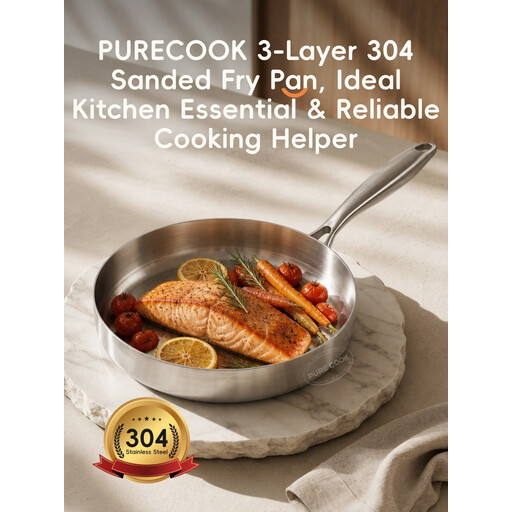
Why it suits this profile: The compact size is suitable for one or two people and for anyone who wants to gain experience cooking with stainless steel without a non-stick coating. According to the product information, the pan is suitable for induction and gas.
The description specifies the complete 304 stainless steel–aluminium–stainless steel construction and a smoothly finished rim. This makes the choice of materials and the finish easier to verify than a general marketing term.
20 cm diameter, tri-ply construction, suitable for induction and gas, no lid included.
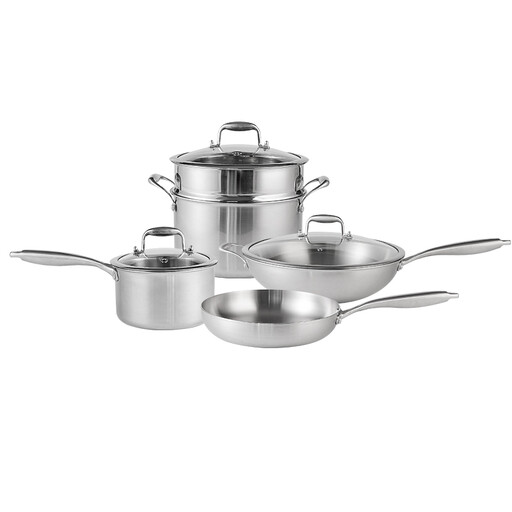
Why it suits this profile: This set is ideal for households that want to use a wok, milk pan and steamer alongside a frying pan. The combination of 304 and 316 stainless steel offers different sizes and uses.
The set lists the materials, components and cooking methods separately. This means you are not buying solely on the basis of the term “complete set”; you can check exactly what is included.
Four cookware pieces, tri-ply construction, suitable for induction, gas and ceramic hobs, stackable design.

Why it suits this profile: The 28 cm pan is designed for larger portions and dishes that you sear first and then leave to cook through with the lid on. According to the product information, the pan is suitable for induction, gas, electric and ceramic hobs, as well as use in the oven.
The product details list the compatible hobs, oven suitability, dishwasher compatibility and included glass lid separately. However, check the exact temperature limit before using it in the oven.
28 cm diameter, glass lid, tri-ply 304 stainless steel, dishwasher-safe according to the product description, suitable for all the listed hobs.
We have put together a complete, up-to-date list of products that fully meet these strict selection criteria and the applicable European safety regulations.
A durable frying pan stays in good working order for longer when you avoid thermal shock and aggressive cleaning products. Allow the pan to cool before rinsing it. Use a soft sponge and mild washing-up liquid. Even with dishwasher-safe models, washing by hand is often still a practical choice to help prevent discolouration and dull patches.
White spots or rainbow-like discolouration are usually caused by minerals, salt or overheating. A small amount of vinegar can help remove this type of residue. Do not use steel wool or abrasive products if you want to keep the surface looking its best.
No. Always check the product specification. A pan suitable for all hobs will usually explicitly mention induction, gas, electric and ceramic hobs. Also check the base diameter and the size of your induction zone.
That depends on the material, construction, use and maintenance. A coating-free stainless steel pan does not have a non-stick coating that can wear out, but it does require a different cooking technique. A ceramic or other coating may be easier to use with delicate ingredients, but it should be cared for according to the maintenance instructions.
A lid is useful for stewing, reducing sauces and dishes that continue cooking after searing. For quick frying or achieving a crisp sear, a lid is not essential. When buying, check carefully that the lid is actually included and what oven temperature limit applies to it.
