
当日/次日达

品质保障

开启新人专享福利: 全场免邮 | 低至 2 折 | 免费试用 30 天 JoyPlus 会员
下载 Joybuy
A stainless steel frying pan suits a wide range of cooking styles, from eggs and vegetables to meat, sauces and stir-fries. Yet the wrong pan can quickly disappoint. A thin base distributes heat less evenly, a size that's too large is awkward on a small induction zone, and a stainless steel interior requires a different cooking technique than a traditional non-stick coating.
With this buying guide, you can compare material, size, lid, hob compatibility and maintenance. That way, you'll find a pan that fits your household and daily cooking routine.
A pan made from single-walled stainless steel can get hot relatively quickly in the area above the heat source. This can cause ingredients to brown in the centre while the edges are less heated. So don't just look at the material – look at the construction too.
A tri-ply frying pan typically consists of several layers, for example stainless steel, an aluminium core and then stainless steel again. Aluminium conducts heat well, while stainless steel forms the inside and outside. Check the product information to see whether it's a full multi-layer construction or just a sandwich base.
A PFAS-free frying pan can have a stainless steel interior without a chemical coating. That doesn't mean food will release on its own. With a stainless steel frying pan, the sequence preheat, add oil, then place the ingredient in the pan helps to reduce sticking.
A pan with a ceramic or other non-stick coating works differently. According to the product information from some brands, certain ceramic-coated models are free from PTFE, PFOA and PFAS. Always check which coating is actually on the interior and what the usage and care instructions are.
The diameter on the packaging is usually the outer measurement. The usable cooking space can be smaller. A 24 cm frying pan is practical for one or two portions. A 26 cm frying pan offers more room for a household of two to four people. A 28 cm frying pan is handy for larger portions, but requires a suitable cooking zone and enough storage space.
304 stainless steel is a commonly used stainless steel for cookware. Product listings often describe this type as food-contact safe and resistant to corrosion. Check whether the specification refers to the whole pan, the interior or just certain parts.
A 304 stainless steel pan without an interior coating is interesting if you don't want to use a chemical non-stick coating. Bear in mind: stainless steel can discolour from high temperatures, salts or mineral-rich water. This can usually be removed with vinegar or a suitable cleaning agent, depending on the care instructions.
With a tri-ply frying pan, look at the layer construction, not just the marketing name. An aluminium core between two stainless steel layers can contribute to more even heat distribution. The pan may therefore be suitable for frying, sautéing and simmering.
Choose a handle with a sturdy attachment and check whether a silicone sleeve is removable. An insulated grip can be more comfortable to hold, but may still get warm during prolonged cooking. Use oven gloves when the pan or handle is hot.
A stainless steel frying pan for induction must have a magnetic base. Many models are also listed as suitable for gas, electric and ceramic hobs. Check the official product information if you want to use a halogen hob or oven.
Also pay attention to the base diameter. A large pan on a small induction zone may heat up less evenly. A pan advertised as a frying pan for all hobs still needs to fit the dimensions and power of your hob.
A stainless steel frying pan with lid is useful for simmering, braising and reducing sauces. A glass lid lets you keep an eye on the cooking without letting steam and heat escape each time. Check whether the lid is included and whether it's suitable for oven use.
Wash a coating-free stainless steel pan with mild washing-up liquid and a soft sponge. Avoid steel wool and harsh abrasives if the manufacturer advises against them. Let the pan cool down before filling it with cold water. With a non-stick frying pan, wooden, silicone or nylon spatulas are usually a safe choice according to the product instructions.
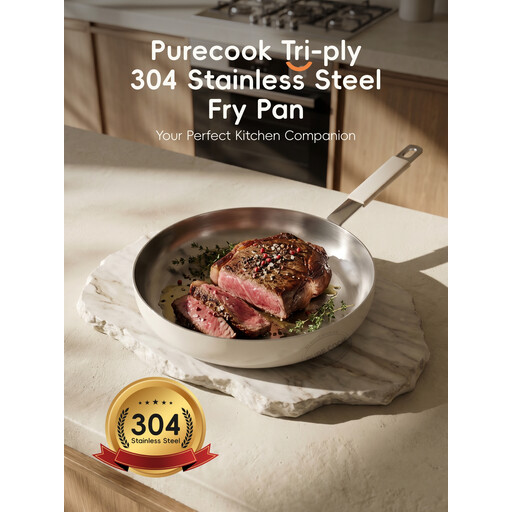
Why this fits the profile: According to the product information, the size is intended for two to three people and suits everyday cooking such as vegetables, eggs and meat.
The tri-ply construction means you don't have to rely on a thin single-layer stainless steel base. According to the product description, the interior has no chemical coating.
24 cm, 304 stainless steel, three layers and suitable for induction and gas according to the product listing.
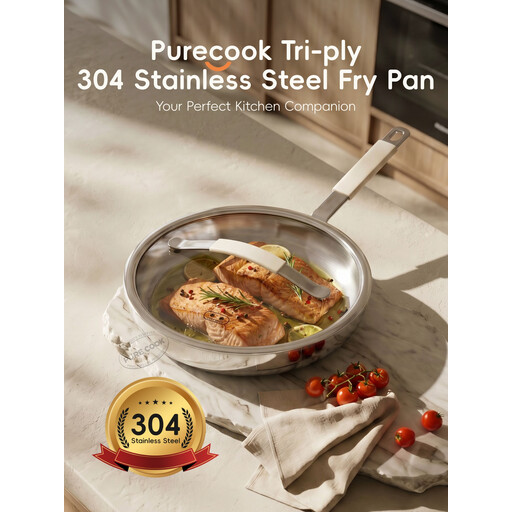
Why this fits the profile: The 26 cm cooking space is aimed at meals for three to four people. The glass lid supports frying, sautéing, braising and simmering.
The product information states a three-layer construction, 304 stainless steel and an interior without chemical coating. This makes the material and construction clearly described.
26 cm, glass lid, tri-ply construction and according to the listing suitable for induction and gas.
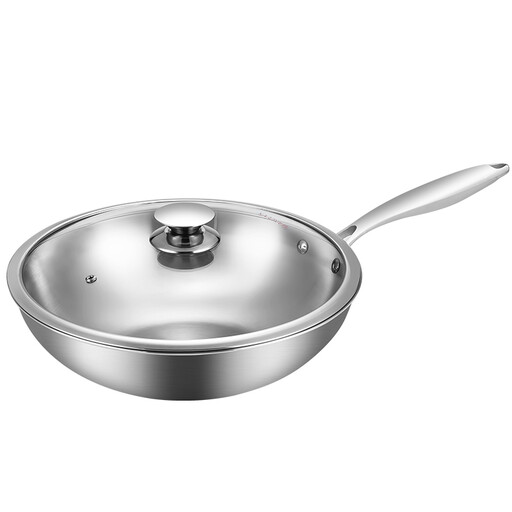
Why this fits the profile: This stainless steel wok is designed for stir-frying, searing and simmering. The size offers extra room for larger portions.
The product description mentions a tri-ply base, a coating-free 304 stainless steel interior and the need for the hot-pan-cold-oil method to reduce sticking.
28 cm, glass lid, suitable for induction, gas, electric and ceramic hobs according to the product listing.
We've put together a full, up-to-date list of products that fully meet these strict selection criteria and current European safety regulations.
Follow this simple sequence with a coating-free pan:
Don't use more heat than necessary. On induction especially, a stainless steel pan can react quickly. A little discolouration or a rainbow-like haze doesn't automatically mean the pan is unusable; follow the manufacturer's instructions for cleaning.
That depends on the base. The product listing must explicitly mention induction compatibility. Also place the pan centred on an induction zone that roughly matches the diameter of the base.
The lifespan depends on material, construction, heat use and care. A coating-free pan has no non-stick layer that can wear away, but it can scratch, warp or discolour with incorrect use. Let a hot pan cool down and avoid abrasive cleaning when it's not recommended.
Energy consumption is mainly determined by cooking time, heat setting, pan base and hob. A tri-ply pan can distribute heat more evenly, but how you use it matters more than the material name alone. A non-stick frying pan often requires lower to medium temperatures and suitable utensils; a coating-free stainless steel pan mainly needs a good preheating and oiling technique.
