
当日/次日达

品质保障

开启新人专享福利: 全场免邮 | 低至 2 折 | 免费试用 30 天 JoyPlus 会员
下载 Joybuy
A stainless steel frying pan can last for years, but not every stainless steel pan performs the same when cooking. Some models have only a thin sheet of steel, while others use an aluminium core for better heat distribution. Terms like “food-safe”, “durable” and “suitable for all hobs” also deserve a closer look.
For home chefs and households in the UK, three pitfalls are particularly relevant:
A 304 stainless steel frying pan is typically made from stainless steel known for its corrosion resistance. However, the term 304 alone doesn’t tell you whether a pan cooks well. Also look at the construction, finish and product information about use and care.
With a tri-ply frying pan, the pan usually consists of:
According to product descriptions from PURECOOK and Maxcook, this combination provides faster and more even heat distribution than a single-layer stainless steel construction. This is a claim made by the brands themselves; always check the technical specifications of the specific model.
An aluminium core can help reduce local hot spots, but it won’t prevent food from burning if the temperature is too high. Stainless steel remains a material where cooking technique matters.
The right diameter depends on your household and cooking style:
A large pan on a small induction zone won’t heat evenly everywhere. So check the diameter of the base, not just the top rim. A pan with a lid is handy for simmering, reducing sauces and dishes where moisture needs to be retained. For quick frying and easy storage, a model without a lid can be more practical.
A frying pan for induction must have a magnetic base. Products in this selection are described in their product information as suitable for gas, induction, ceramic and electric cooking, among others. Still check compatibility with your hob before buying.
Also look out for:
A dishwasher-safe frying pan is convenient for everyday use, but dishwasher detergents and high temperatures can cause the shine, handle or accessories to age more quickly. With a stainless steel pan that has no coating, hand washing with a soft sponge is often a simple choice.
A frying pan without a non-stick coating requires a different approach than a classic non-stick pan:
According to Maxcook’s usage information, the “hot pan, cold oil” method can help reduce sticking. This is a usage tip from the brand, not a guarantee of a completely stick-free result.
New stainless steel pans may have production residues. Wash the pan thoroughly with warm water and washing-up liquid before first use. For discolouration caused by minerals or starch, a mild acid such as diluted vinegar can help. Do not use an abrasive scouring pad if you want to preserve the finish.
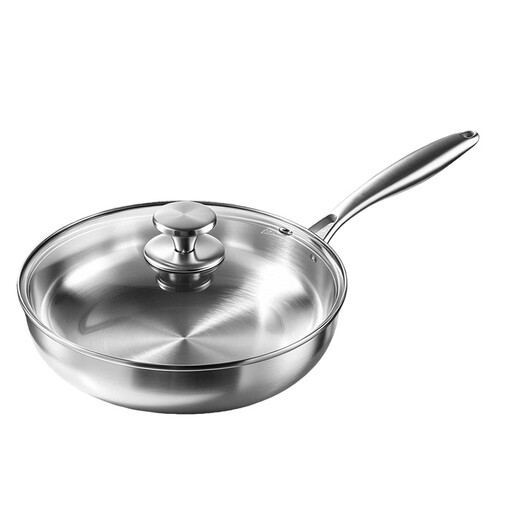
Why this fits the profile: The compact size is suitable for one to two people and everyday cooking such as eggs, vegetables and pancakes.
The product description mentions a tri-ply construction of stainless steel, aluminium and stainless steel, with no chemical coating. This means the user knows what to expect when cooking.
22 cm, suitable for induction, gas, electric, ceramic and halogen according to the product information; dishwasher-safe.
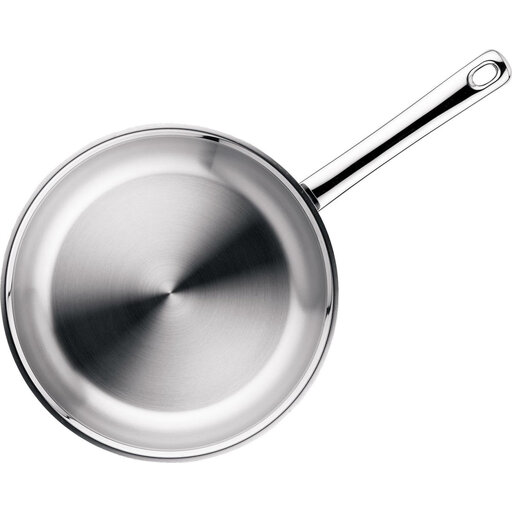
Why this fits the profile: A fitting choice for those who value a well-known construction, a stainless steel handle and use on multiple heat sources.
The product information explicitly mentions the TransTherm base, induction compatibility and a maximum heat resistance of 250 °C.
Cromargan 18/10 stainless steel, suitable for all heat sources and dishwasher-safe according to the product description.

Why this fits the profile: The wide cooking surface and glass lid suit families and cooks who combine frying, roasting, stir-frying and simmering.
The product description mentions three layers, 304 stainless steel, an aluminium core and compatibility with multiple hobs. The lid allows simmering without having to open it constantly.
28 cm, glass lid, tri-ply construction and suitable for gas, induction, ceramic, electric, halogen and oven use according to the product information.
We’ve put together a full, up-to-date list of products that fully meet these strict selection criteria and current European safety regulations.
Yes, when the pan has a magnetic base and the manufacturer states induction compatibility. Also check that the base matches the diameter of the induction zone. A tri-ply pan with a stainless steel outer layer is often designed for multiple hobs, but the product specification remains the deciding factor.
Heat the pan over a medium heat, then add oil and wait until the ingredient releases naturally when turned. Do not use an extremely high setting and do not heat the pan empty for long periods. A frying pan without a non-stick coating requires some adjustment to your cooking technique.
The lifespan depends on the material thickness, construction, heat treatment and care. A stainless steel pan without a coating has no non-stick layer that can wear away, but it can discolour, warp or become damaged through incorrect use. Let the pan cool down before cleaning it, avoid thermal shock and dry it thoroughly after washing.
