
Vandaag of morgen in huis

Kwaliteit gegarandeerd

Welkomstaanbiedingen ontgrendelen: GRATIS bezorging | Tot 80% korting | Gratis 30 dagen JoyPlus-proefperiode
Download de app
A stainless steel frying pan can last for years, but only if the material, base and usage suit your kitchen. If you focus mainly on a shiny finish or a low price, you are more likely to encounter food sticking, a warped base or a pan that does not work properly on induction hobs.
For UK households, these three pitfalls are particularly important:
304 stainless steel is a commonly used type of stainless steel for contact with food. Product descriptions sometimes refer to it as “food-grade” or “food-safe”. On its own, this tells you nothing about all the pan’s cooking properties. You should also consider how the pan is constructed.
A single-layer stainless steel pan does not always heat evenly. A tri-ply frying pan usually consists of three layers: stainless steel on the inside and outside, with an aluminium core. Aluminium conducts heat more quickly, while stainless steel provides strength and a neutral cooking surface. According to PURECOOK’s product description, the three-layer 304 stainless steel pan is designed to distribute heat more quickly and evenly.
Whenever you see claims about durability, scratch resistance or food safety, always check the brand’s product information. A claim such as “lasts longer” is based on the manufacturer’s own information and is not a universal guarantee for every user.
An induction frying pan needs a magnetic base. Do not rely on the word “stainless steel” alone: not every stainless steel pan works on induction. Compatibility is often broader for gas, electric and ceramic hobs, but a flat base remains important in all cases.
Pay attention to these points:
A frying pan for all hobs is practical if you move house or use different heat sources. According to the product information, the 5five Stainless Steel Cooking Pot - 28 cm has an aluminium and stainless steel induction disc and is dishwasher-safe. This is a cooking pot with a lid, not a traditional flat frying pan, but it is useful for larger portions, sauces and stews.
For one or two people, 20 to 24 cm is often sufficient. A 26 to 28 cm pan is better suited to a family or meals containing several ingredients. A 30 to 32 cm wok provides extra room for stir-frying, but requires a larger cooking zone and enough storage space.
A stainless steel pan with a lid is useful for simmering, stewing and keeping food warm. A glass lid lets you monitor the cooking process without having to lift it repeatedly. Do check whether the lid knob and handle are heat-resistant, and whether the pan with its lid will fit in your cupboard.
An uncoated stainless steel pan is suitable for browning, searing and stir-frying, but it takes some getting used to. Heat the pan over a medium heat first, then add oil and only place the food in the pan once the oil is hot. Leave meat or potatoes to cook for a little while before turning them; moving them too soon increases the chance of sticking.
A non-stick frying pan can be easier to use for eggs, pancakes and delicate fish. In that case, check the type of coating, the maximum temperature and the care instructions. According to the product information, the WMF NordicProfi has a PFOA-free non-stick coating, but this pan is not dishwasher-safe. According to the manufacturer, the WMF Profi Resist models combine a stainless steel construction with a honeycomb structure and PermaDur non-stick coating; hand washing is also recommended for these models.
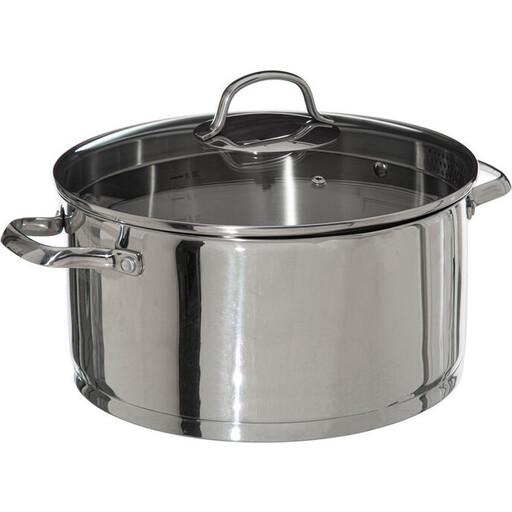
Why it suits this profile: This stainless steel cooking pot has a capacity of 8.6 litres and, according to the product information, is suitable for induction and the dishwasher. This makes it practical for larger households and everyday meals.
The induction disc is explicitly mentioned, so you do not have to rely on the general term stainless steel alone. The lid is made from toughened glass.
28 cm, 8.6-litre capacity, glass lid and dishwasher-safe design according to the product specifications.

Why it suits this profile: This 24 cm stainless steel frying pan is designed for everyday cooking for around three people and, according to the manufacturer, has a TransTherm base, a stainless steel handle and compatibility with all heat sources.
The manufacturer explicitly states the suitable heat sources, diameter and base construction. This allows you to match the pan to an induction zone of approximately 20 cm.
Cromargan 18/10 stainless steel, TransTherm base, oven-safe up to 250 °C and dishwasher-safe according to the product information.
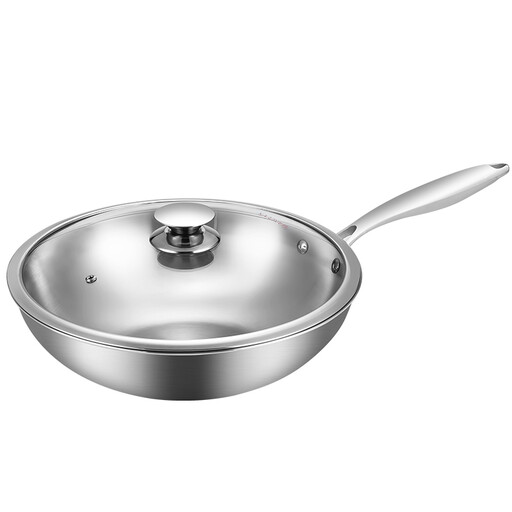
Why it suits this profile: This 28 cm stainless steel wok is designed for stir-frying, searing and everyday cooking on induction, gas, electric and ceramic hobs.
The product information clearly states that this wok has no chemical non-stick coating. The recommended method is to use a preheated pan with oil over a medium to low heat.
Tri-ply 304 stainless steel, glass lid, suitable for several types of hob and dishwasher-safe according to the product description.
After use, allow a stainless steel pan to cool down before rinsing it. A sudden change in temperature can place unnecessary stress on the material. For everyday cleaning, use warm water, a mild washing-up liquid and a soft sponge. White spots or rainbow-like discolouration are often mineral deposits; a small amount of vinegar can help remove them.
With a coated pan, metal utensils, abrasive sponges and high temperatures are potential risks. Always check the manufacturer’s care instructions, even when a product is advertised as dishwasher-safe.
We have put together a complete, up-to-date list of products that fully meet these strict selection criteria and the applicable European safety regulations.
Only if the pan is listed as suitable for induction in the product specifications. Also check that the diameter of the base corresponds to your induction zone. A pan that is larger than the active zone will not always heat evenly.
Preheat the pan gradually, then add oil and avoid using too high a temperature. Allow the food to sear before turning it. This technique makes a real difference, particularly with meat, fish and potatoes.
Its lifespan depends on the wall thickness, base construction, cooking temperature and care. An uncoated pan does not have a non-stick coating that can wear out, but it can still become discoloured or damaged through incorrect cleaning. So do not consider only the purchase price; also look at hob compatibility, care requirements and the warranty.
