
当日/次日达

品质保障

开启新人专享福利: 全场免邮 | 低至 2 折 | 免费试用 30 天 JoyPlus 会员
下载 Joybuy
A stainless steel frying pan is ideal for everyday cooking, from frying potatoes to searing meat. Stainless steel is strong, heat-resistant and suitable for many types of hob. However, not every stainless steel frying pan is a practical purchase. A thin base can become too hot in certain spots, a smooth pan requires a different cooking technique from a non-stick pan, and a product with an attractive claim is not automatically suitable for your induction hob.
As a Joybuy Product Recommendation Officer, I therefore start by checking verifiable product information: the material construction, diameter, hob compatibility, care requirements and included accessories.
Some pans are suitable for gas, electric and ceramic hobs, but not for induction. This is stated explicitly for the Tefal Easy Cook & Clean 32 cm, for example: according to the product information, this aluminium pan is not suitable for induction. Always check the specifications for the exact model, rather than relying only on the title or category.
Also pay attention to the size of the base. On an induction hob, a pan will generally work more efficiently when its magnetic base sits neatly over the cooking zone.
A 3-layer frying pan or tri-ply frying pan often consists of stainless steel, an aluminium core and another layer of stainless steel. Aluminium conducts heat well, while stainless steel provides strength and a cooking surface without a traditional non-stick coating. This construction can help distribute heat more evenly across the base than a single thin sheet of steel.
However, check whether “tri-ply” refers to the entire pan or just the base. The product description should clearly state how the materials are layered.
A stainless steel frying pan without a coating is not automatically completely non-stick. Eggs, fish and potatoes can stick if the pan is too cold, too little fat is used or the heat is too high. A non-stick pan is easier to use with delicate ingredients, but its coating often requires more care when it comes to utensils and temperature.
Many models use 304 stainless steel, a type of steel that the product information identifies as suitable for contact with food. Some pans, including models from WMF, specify 18/10 stainless steel. Also check whether the pan has an aluminium core or a multi-layer base.
Food safety claims should be read in context. When a manufacturer refers to GB 4806.9 or US FDA regulations, this concerns the compliance stated by the manufacturer. It is not a general guarantee that every part of every pan has the same properties.
If you are specifically looking for a PFAS-free frying pan, check that this is clearly stated for the model you have chosen. The product information for WMF Durado frying pans states that they are PFAS-free; for a stainless steel pan without a coating, the description may only say “coating-free” or “without a non-stick coating”. These phrases do not automatically mean the same thing.
A 28 cm frying pan is a sensible size for families, as long as the base and weight suit your hob and your strength. A wide pan on a small induction zone may heat less evenly.
A frying pan with a lid is useful for simmering, sauces and dishes where moisture needs to be retained. Check the maximum oven temperature for both the pan and the lid separately. The 28 cm PURECOOK pan, for example, lists a glass lid and oven use up to 220 °F in the product information; check the current product specification for the converted temperature and local usage instructions.
“Dishwasher-safe frying pan” does not always mean that the finish will remain unchanged after repeated dishwasher cycles. Some stainless steel models are officially dishwasher-safe, while WMF Profi Resist and WMF Durado should be cleaned by hand according to their product information. Washing by hand with a soft sponge helps reduce discolouration and dull patches.

Why it suits this profile: The 28 cm size provides plenty of room for family meals. The product information lists 304 stainless steel, an aluminium core, a glass lid and compatibility with gas, induction, electric and ceramic hobs.
The stated tri-ply construction makes it clear that this is not a single-layer, thin stainless steel pan. Before buying, however, check the current oven limit and dimensions.
3-layer stainless steel-aluminium-stainless steel construction, lid included and dishwasher-safe according to the product information.
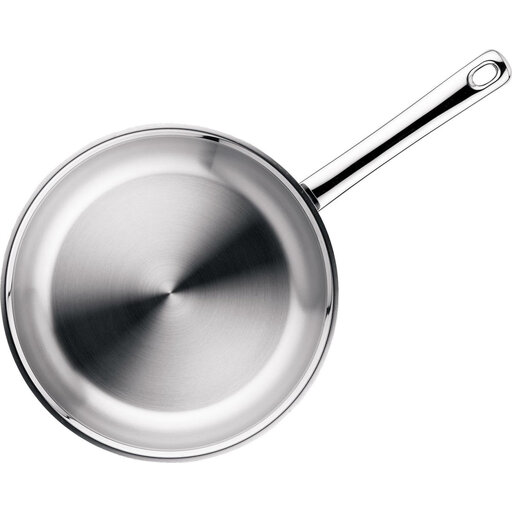
Why it suits this profile: This pan is aimed at anyone looking for a traditional stainless steel surface, a universal base and a compact size. According to the product information, it is suitable for all heat sources, including induction.
The specifications explicitly mention 18/10 Cromargan stainless steel, a TransTherm base and dishwasher compatibility. This makes the materials and care requirements easier to compare.
24 cm size, oven-safe up to 250 °C and suitable for all heat sources according to the stated product specifications.
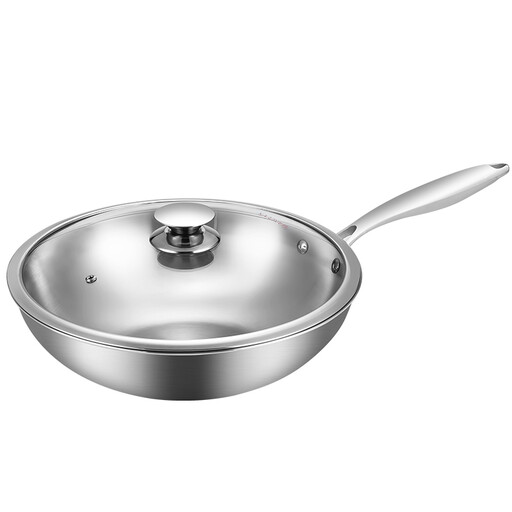
Why it suits this profile: The wok shape is practical for stir-frying, searing and cooking larger quantities. The product information lists a composite base, 304 stainless steel, a glass lid and compatibility with induction, gas, electric and ceramic hobs.
The manufacturer states that there is no traditional non-stick coating. To reduce sticking, use a preheated pan, cold oil and medium heat.
Coating-free 304 stainless steel construction, 28 cm diameter, glass lid and dishwasher compatibility according to the product information.
We have put together a complete, up-to-date list of products that fully meet these strict selection criteria and the applicable European safety regulations.
A stainless steel pan can develop white marks or a rainbow tint after use due to minerals, salt or starch. A little vinegar and a soft sponge can often help remove these marks. Avoid steel wool and harsh abrasive cleaners when the manufacturer advises against them.
That depends on the base. Look in the product specifications for “induction suitable” or “all hobs”. A magnetic, flat base is important here. Do not rely solely on the term stainless steel, as not every stainless steel pan works on induction.
Its lifespan depends on the construction, use and care. A pan without a non-stick coating does not have a coating that can wear away, but it can still become scratched, discoloured or warped through incorrect use. The manufacturers of some tri-ply models claim a longer lifespan than for single-layer stainless steel; treat this as a brand claim and focus mainly on comparing the specific material and warranty details.
According to the product information, some models are dishwasher-safe. Others, including several WMF pans, are intended to be washed by hand. Check this for each model. For a neat finish that lasts longer, cleaning with warm water, mild washing-up liquid and a soft sponge is often a practical choice.
