
当日/次日达

品质保障

开启新人专享福利: 全场免邮 | 低至 2 折 | 免费试用 30 天 JoyPlus 会员
下载 Joybuy
A stainless steel frying pan can last for years, but not every stainless steel frying pan performs in the same way on the hob. Differences include the construction of the base, the size, the handle and whether it has a non-stick coating. If you only look at a shiny finish or an appealing product claim, you could end up with a pan that heats up too slowly, causes food to stick or does not work properly with your induction zone.
This buying guide helps home chefs, keen cooks and families check the most important features before choosing a pan.
A pan made from a single layer of stainless steel is strong, but it may distribute heat less evenly. This can lead to hot spots. Look instead for a sandwich base or tri-ply frying pan. Tri-ply construction typically consists of stainless steel, an aluminium core and another layer of stainless steel. Aluminium conducts heat efficiently, while stainless steel provides strength and a neutral cooking surface.
Pay attention to the difference between a three-layer base and a pan where multiple layers run through the entire wall. The product description should clearly state which construction is used.
If you are looking for a PFAS-free frying pan, read the product information carefully. “Stainless steel” does not automatically mean that a pan is coating-free. For example, the WMF Profi Resist has a stainless steel interior with an aluminium core and a PermaDur non-stick coating. That is a different choice from a coating-free 304 stainless steel frying pan.
Some manufacturers explicitly state that a product has no chemical non-stick coating. According to the product description of the Maxcook Tri-Ply 304 wok, it is coating-free. This does not mean that food will never stick: with uncoated stainless steel, preheating, enough oil and the right temperature are important.
A stainless steel pan for induction must have a magnetic or specially designed base. Also check whether the stated size is suitable for your cooking zone. A 28 cm frying pan may have a larger diameter than the effective contact area on your induction hob.
Also check whether the pan is suitable for oven use, dishwasher-safe and what material the handle is made from. A stainless steel handle can become hot; silicone or plastic does not stay cool in all circumstances. Always follow the manufacturer's warnings and temperature limits.
A 304 stainless steel frying pan is a common designation for stainless steel. According to PURECOOK's product information, the pan is made from 304 stainless steel and aluminium. The manufacturer lists China GB 4806.9 and US FDA requirements as the applicable food safety standards. These are product claims from the specification; if in doubt, check the supplier's latest documentation.
WMF uses Cromargan 18/10 in the Profi Resist range, with an aluminium core and a chromium outer layer. Here too, the overall construction is more important than the name of the steel alone.
A 28 cm frying pan does require more storage space and may feel heavier. Do not look only at the outer diameter; also consider the flat base and the weight.
Uncoated stainless steel takes a little practice. First heat the pan over a medium heat, then add oil and only place the food in the pan once the oil is hot. Allow meat or potatoes to sear before trying to turn them.
Use a soft sponge and mild washing-up liquid. White marks or a rainbow-coloured haze are often caused by minerals or overheating; according to the product information from various suppliers, vinegar can help remove them. Allow a hot pan to cool before washing it.
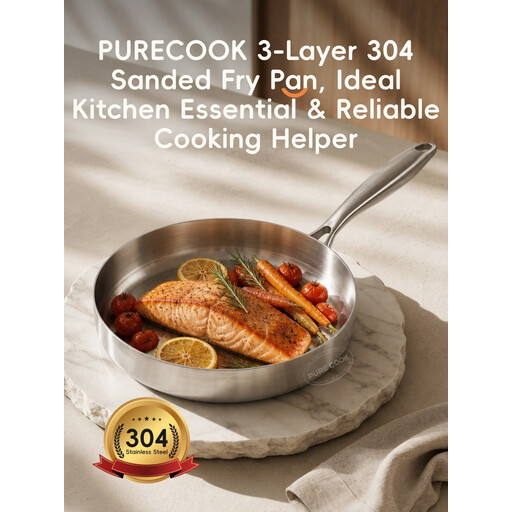
Why it suits this profile: The compact size is suitable for small portions and kitchens with limited storage space. According to the product description, this pan works on gas, induction and other common heat sources.
The stated tri-ply construction with an aluminium core is clearer than a general claim about “rapid heating”. The smaller size also reduces the chance of a mismatch with a small cooking zone.
20 cm diameter, 304 stainless steel with an aluminium core and a smoothly finished rim. The pan is supplied without a lid.
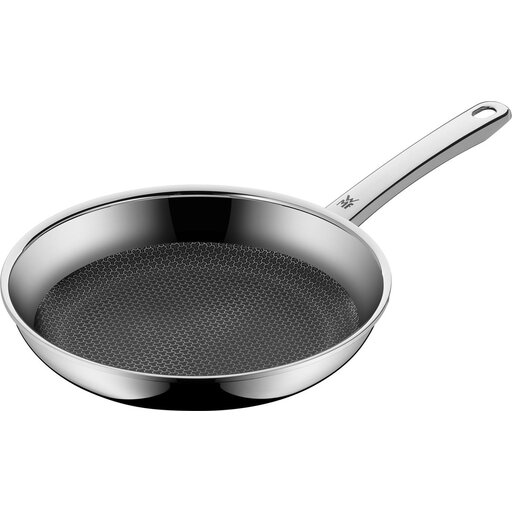
Why it suits this profile: According to WMF, this pan combines a three-layer construction with a honeycomb structure and PermaDur non-stick coating. It is a good choice for anyone who regularly cooks meat but has less experience with uncoated stainless steel.
The product information clearly states that the pan has a coating. You are therefore not buying a coating-free, PFAS-free frying pan, but a pan with non-stick properties according to the manufacturer.
28 cm diameter, suitable for induction and other heat sources, heat-resistant up to 260 °C according to the product specification and covered by a five-year guarantee according to WMF.

Why it suits this profile: The large pan is designed for families and cooks who want to combine frying, stir-frying and stewing in one pan. The included glass lid is practical for dishes where moisture needs to be retained.
The manufacturer explicitly states that it has a three-layer stainless steel–aluminium–stainless steel structure and is compatible with gas, induction, ceramic, electric and halogen hobs, as well as oven use. Check the stated oven temperature before using the pan.
28 cm size, glass lid, dishwasher-safe according to the product description and suitable for all the hobs listed.
We have put together a complete, up-to-date list of products that fully meet these strict selection criteria and the applicable European safety requirements.
Yes, many models are suitable for induction, but always check the product specification. A compatible base and a suitably sized cooking zone are important. All three models mentioned state that they are compatible with induction.
Heat the pan over a medium heat, add enough oil and wait until the oil is hot. Then place the food in the pan and give it time to sear. Excessively high temperatures can cause discolouration, while temperatures that are too low increase the likelihood of sticking.
A coating-free stainless steel pan does not have a non-stick coating that can wear out with use, but it does require the right cooking technique. Its lifespan depends on the material, base construction, use and care. A coated pan can make frying more convenient, but it should be used according to the care instructions to protect the coating.
