
当日/次日达

品质保障

开启新人专享福利: 全场免邮 | 低至 2 折 | 免费试用 30 天 JoyPlus 会员
下载 Joybuy
A stainless steel frying pan can last for years, but only if the material, base and size are right for your hob and cooking style. If you focus mainly on a shiny finish or a low price, you may only discover the drawbacks after a few weeks: food that sticks easily, a base that heats unevenly or a pan that cannot go under a lid or in the oven.
This buying guide will help you choose a stainless steel frying pan for everyday frying, searing, stir-frying and simmering. The focus is on verifiable product specifications rather than general marketing claims.
Not every stainless steel pan is the same. A single-wall pan may respond relatively quickly to changes in temperature, but it can also create hot spots more easily. A tri-ply frying pan usually consists of several layers, such as stainless steel, aluminium and stainless steel. The aluminium core helps conduct heat, while the stainless steel layers provide strength and contact with the food.
Also pay attention to the exact material specification. 304 stainless steel is widely used for cookware and is known as a corrosion-resistant type of steel. That does not automatically mean that every pan with this label has the same thickness, finish or heat distribution. Always check the complete construction, not just the term “304”.
A standard stainless steel pan usually does not have a traditional non-stick coating. As a result, food may stick if the pan is too cold, the oil is added too early or the temperature rises too high. A commonly used method is to heat the pan over a medium-high heat, then add the oil and only place the ingredient in the pan once the oil spreads into a thin layer.
A non-stick frying pan with a stainless steel exterior may be easier to use for eggs, pancakes and fish. If so, check which type of coating has been used, whether metal utensils are discouraged and whether the pan is dishwasher-safe. For a PFAS-free frying pan, follow the product information provided by the brand or retailer. According to the product information, the WMF Durado is described as PFAS-free and has a ceramic coating; this is a product specification, not a general characteristic of all stainless steel pans.
A 24 cm frying pan is practical for one to three portions and takes up little space. A 28 cm frying pan provides more surface area for vegetables, meat or a meal for several people, but it also requires a suitably sized induction zone.
With an induction frying pan, the magnetic base must align well with the cooking zone. A pan may be described as suitable for induction, gas, ceramic and electric cooking, but the actual heat distribution also depends on the diameter and flatness of the base. Check the diameter of the cooking zone as well as the product details.
For everyday use, the following points are relevant:
Claims such as “31% longer lifespan” or “10 times more durable” are only meaningful when the comparison method is clear. Treat such figures as claims made by the brand, not as a guaranteed result for every user.
A coating can make frying easier, but usually requires softer utensils and careful maintenance. A coating-free pan is less susceptible to wear affecting a non-stick layer, but may require more practice.
Look out for contradictions in the product information. Some models are sold as a dishwasher-safe frying pan, while hand washing is recommended to keep the finish looking good for longer. Also check:
A glass lid is useful when simmering and reducing sauces, as you can monitor the contents without constantly releasing steam. The lid and handle may become hot, so use suitable protection.

Why it suits this profile: This pan is 28 cm, has a tri-ply construction and comes with a glass lid. According to the product information, it is suitable for induction, gas, ceramic, electric and halogen cooking.
The three layers are clearly specified, so you do not have to rely solely on the general stainless steel label. Before buying, however, check the stated oven limit of 220 °F and the cooking zone you intend to use.
304 stainless steel, tri-ply construction, glass lid and, according to the product information, dishwasher-safe.
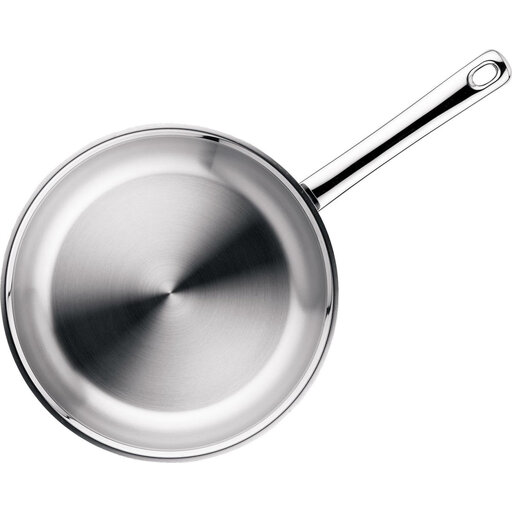
Why it suits this profile: This 24 cm stainless steel pan is designed for classic searing and everyday use. The product information states that it is made from Cromargan 18/10 stainless steel, has a TransTherm base, is induction-compatible and can be used in the oven up to 250 °C.
Heat distribution is linked to a specific TransTherm base rather than simply to a general claim about stainless steel.
24 cm size, oven-safe up to 250 °C and, according to the product information, dishwasher-safe.
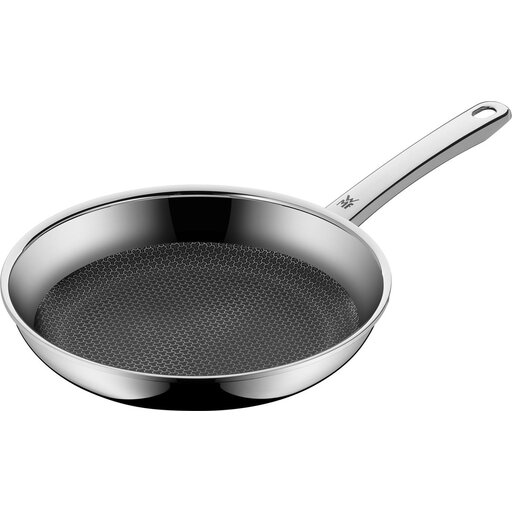
Why it suits this profile: The combination of an aluminium core, stainless steel interior, chrome exterior and PermaDur coating is intended for users who regularly sear food at high temperatures but also want easy release.
According to the product information, the honeycomb structure is designed to offer partial protection to the coating. The pan is not dishwasher-safe, so hand washing is part of its care routine.
28 cm cooking surface, tri-layer construction, induction-compatible and heat-resistant up to 260 °C according to the product information.
We have put together a complete, up-to-date list of products that fully meet these strict selection criteria and the applicable European safety regulations.
Heat an uncoated pan gradually and preferably use a medium heat. Allow the pan to cool after use before rinsing it. White marks or a rainbow-coloured film are often caused by minerals or food residue; a mild acid such as diluted vinegar may help, according to general care instructions. Do not use an abrasive scourer if the manufacturer advises against it.
For a coated pan, wooden or silicone utensils are usually a safe choice. Store the pan dry and regularly check that the handle, base and any silicone components are still firmly attached.
Often, yes, but always check the product listing. Look for “induction-compatible” and check that the base is flat and magnetic. Match the diameter to the induction zone for even heating.
Usually, the pan has not been preheated properly, the temperature is too high or too little fat has been used. Heat the pan gradually, add oil and give meat or vegetables time to release naturally before turning them.
An uncoated stainless steel pan does not have a non-stick layer that can wear out through scratching or overheating. On the other hand, cooking technique is more important. A coated pan may be easier to use with delicate ingredients, but it requires careful maintenance and suitable utensils.
