
Vandaag of morgen in huis

Kwaliteit gegarandeerd

Welkomstaanbiedingen ontgrendelen: GRATIS bezorging | Tot 80% korting | Gratis 30 dagen JoyPlus-proefperiode
Download de app
A stainless steel food storage container set might seem straightforward to choose at first glance. Yet the wrong sizes, mediocre closures and unclear temperature claims can regularly lead to wasted money. A container that doesn’t stack well takes up unnecessary space. A lid without a reliable seal can leak in your bag. And “dishwasher-safe” doesn’t always mean every part will last as long as the next.
This guide helps households, meal preppers, students, athletes, commuters and campers compare stainless steel storage boxes in a practical way.
A capacity of 1,000 ml sounds generous, but the shape determines how efficiently the container fits in your fridge. Deep models are suitable for soup, curry or larger portions. Rectangular food storage containers often sit more easily side by side on a fridge shelf or in a lunch bag.
So don’t just check the millilitres – also look at:
A silicone ring can improve the seal, but the closure also needs to fit snugly against the rim. With food storage containers that have lids, click-lock fastenings or a firmly fitting glass lid construction are checkpoints that tell you more than just the marketing term “airtight”.
Don’t fill a container with liquid food right to the brim. Also, always check that the clips or sealing ring are fully secured before you take it with you. No lid is designed to be overfilled or closed at an angle.
Stainless steel storage boxes must not go in the microwave. A product description may mention oven use for certain models, but that often applies without the lid only. With glass lids, it’s also wise to avoid sudden temperature changes.
Always follow the specific safety warnings for the product. Do not use a container over an open flame, and check whether the model is suitable for the fridge, freezer, dishwasher or indirect heating.
304 stainless steel is a common material choice for food storage. In the product information for several PURECOOK models, an uncoated, odourless interior is mentioned. That can be handy for oily dishes or strongly spiced leftovers, because the material is said to hold onto smells and grease less readily.
316 stainless steel is described in the product information for Maxcook as a steel type with high corrosion resistance. That is relevant for users who frequently clean, freeze and use their containers for a wide variety of dishes. However, the material choice alone doesn’t determine the overall user experience – the lid, closure, weld seams, finish and care all count too.
Bear in mind that terms like “food-grade” or “BPA-free” come from the respective product description. Always check the current specifications and included information when you buy.
For daily use, a set with multiple sizes can be more practical than four identical containers. Think about:
A set of food containers with different sizes helps you keep less empty space in your fridge or freezer. For a lunch on the go, low, rectangular models are often easier to take along than deep bowls.
A well-sealing lid should be easy to open, but not come loose during normal transport. Silicone seals are usually removable, so you can clean the groove more thoroughly. Let the ring and the container dry completely before you store them.
If you’re mainly after convenience, you can choose dishwasher-safe storage containers. Just check whether the product information states this for the whole set or only for the metal container. Glass lids require extra care with knocks and temperature changes.
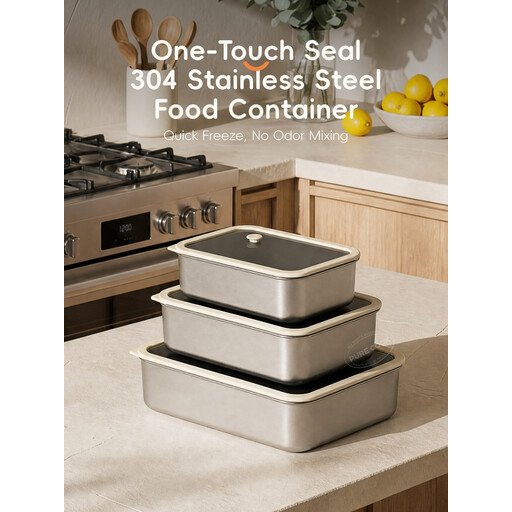
Why this fits the profile: The set is aimed at everyday storage, meal prep and lunch portions. The product information mentions three sizes of 1,000, 1,800 and 3,000 ml with glass lids.
The different capacities stop you from using an identical, oversized container for every portion. According to the product description, the silicone ring is designed for an airtight seal.
304 stainless steel, glass lids and three generous sizes. According to the product information, the containers are suitable for the fridge, freezer and dishwasher.

Why this fits the profile: Four identical rectangular containers of 1,600 ml are practical for fixed meal prep routines, families and users who prepare several meals in advance.
The fixed rectangular shape makes the capacity predictable and helps with organisation. The product description mentions well-fitting lids, freezer use and dishwasher cleaning.
316L stainless steel, four identical containers of 1,600 ml and suitable for the freezer and dishwasher according to the product information.
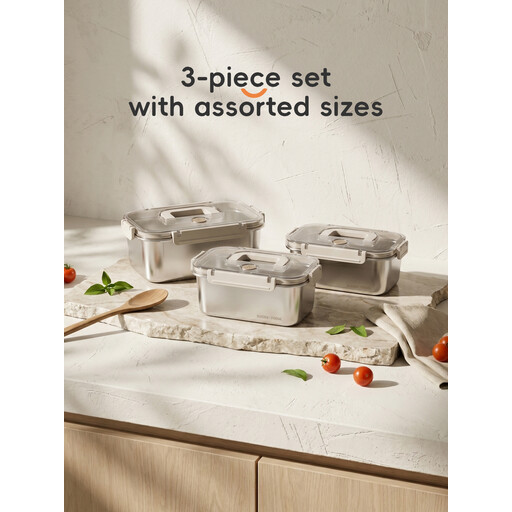
Why this fits the profile: The sizes of 1,700, 2,100 and 3,200 ml suit larger portions, family leftovers, camping and stocking up in the fridge or freezer.
The four corner clips and silicone ring are designed for a stable closure, according to the product information. The lid must be removed before microwave or oven use; always check the safety instructions.
Large rectangular sizes, stackable design and a BPA-free PP lid according to the product description. The parts are described as dishwasher-safe.
We’ve put together a full, up-to-date list of products that fully meet these strict selection criteria and comply with current European safety regulations.
Wash new containers with mild washing-up liquid before first use. Don’t use an abrasive sponge or harsh cleaning agent on stainless steel – these can cause scratches. Regularly remove the silicone ring and lid rim to clean away food residue.
For freezer use:
A stainless steel lunchbox is generally heavier than a plastic one. For cyclists, that difference can matter, while for home use or camping it may be less important.
No. Stainless steel should not go in the microwave. If a product also mentions oven use, first remove the lid and follow the manufacturer’s specific warnings.
Many models are described as freezer-safe. Check this per product and leave room for expanding food. With glass lids, you need to be extra careful about temperature changes.
The lifespan depends on the material, closure, lid, use and care. A stainless steel container can remain usable for a long time if you avoid scratches, open flames, overheating and harsh cleaning products. Replace a silicone ring or lid when it becomes deformed, cracked or no longer seals properly.
