
Vandaag of morgen in huis

Kwaliteit gegarandeerd

Welkomstaanbiedingen ontgrendelen: GRATIS bezorging | Tot 80% korting | Gratis 30 dagen JoyPlus-proefperiode
Download de app
A stainless steel food storage container set with lids may seem straightforward to choose at first glance. However, sets vary considerably in terms of material, capacity, closure and possible uses. For example, a container may be described as “leak-proof”, while its closure may not be suitable for carrying liquid soup in a full bag. Not all lids are microwave-safe either, even when the metal container itself can withstand heat.
For households, meal preppers, families, students and commuters, these three pitfalls are particularly important:
Use the checks below to compare stainless steel food storage containers objectively.
For food storage containers intended for everyday use, you will often come across 304 stainless steel. In the product information for several sets, this material is described as food-safe, uncoated and resistant to oil and corrosion. This makes it a common choice for leftovers, meal prep and fridge storage.
316 stainless steel and 316L stainless steel are generally chosen for their higher corrosion resistance. This can be useful for intensive use, for example when frequently carrying salty or acidic dishes. Always check, however, that the stated material refers to the container itself. The lid is usually made from PP plastic, glass and/or silicone.
Also look out for terms such as BPA-free. This is relevant to plastic lids, but says nothing about the quality of the metal container. For example, the PURECOOK 304 rectangular set combines food-safe 304 stainless steel with a BPA-free PP lid and a silicone sealing ring.
A good closure consists of more than four clips. Look for:
“Leak-proof” is a product claim made by the seller. Therefore, focus primarily on the construction described. The PURECOOK 304 deep set lists a silicone ring and a borosilicate glass lid. Maxcook sets are described as having close-fitting lids and an airtight storage function. When transporting food, always make sure the clips are properly closed and leave some room around liquids.
Many containers for the fridge and freezer are not automatically suitable for every heating appliance. Metal must not be put in a microwave. Some product descriptions state that the container is suitable for an oven or microwave when the lid is removed, while the safety warning specifically says not to use it in a microwave. In this situation, the warning takes precedence: do not use the stainless steel container in a microwave unless the manufacturer provides clear, consistent instructions.
Also check whether:
A dishwasher-safe food storage container is easier to keep clean, but removable parts should be able to dry separately to help prevent moisture and odours around the ring.
For meal prep, a range of capacities is more useful than three identical containers. A combination of approximately 600 ml, 1,100 ml and 2,200 ml, for example, works well for snacks, lunch and a larger meal. For a family or larger leftovers, capacities from 1,500 ml to 3,500 ml may make more sense.
Rectangular, stackable kitchen containers generally make better use of the space in a fridge. Round containers are handy for salads, fruit and smaller portions, but can leave more unused space between containers. A deep shape can offer plenty of capacity, while a shallower container is more practical for food you want to see or portion quickly.
Also consider the weight. A metal lunchbox is durable and sturdy, but may be heavier than plastic. This is relevant for commuters, schoolchildren and cyclists.
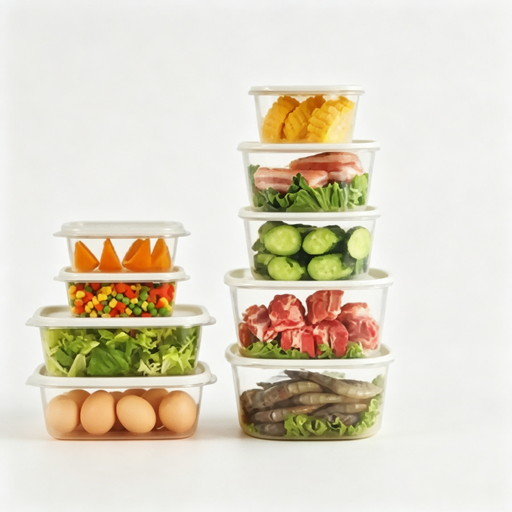
Why it suits this profile: A 9-piece set offers an accessible way to store different types of food. Before buying, check the exact capacity and material specifications on the product page.
The set means you do not have to combine several separate containers straight away. Check the closure and usage restrictions before carrying liquids.
9-piece set; designed for kitchen organisation and food storage.

Why it suits this profile: According to the product information, this metal lunchbox set uses 316 stainless steel and includes 600 ml, 1,100 ml and 2,200 ml containers.
The material type and capacities are clearly stated. This allows you to assess the choice against your needs, rather than relying solely on general marketing terms.
316 stainless steel; three useful sizes; according to the product information, suitable for the freezer and dishwasher.

Why it suits this profile: Four rectangular containers, each holding 1,600 ml, are suitable for large portions, several meal-prep meals or family use.
The consistent rectangular shape makes stacking straightforward. Bear in mind the weight and the warning that the containers must not be used in a microwave.
316L stainless steel; four identical 1,600 ml containers; according to the product information, suitable for the freezer and dishwasher.
Wash new food storage containers before using them for the first time. Clean the inside with a mild detergent and a soft sponge. Remove a detachable silicone ring from the lid if the manufacturer permits this. Allow the container, lid and ring to dry completely before stacking them.
Do not use abrasive cleaners or sharp objects on the stainless steel. With glass lids, it is advisable to avoid significant temperature differences. Placing a container straight from the freezer into hot water can put unnecessary strain on the glass and closure.
We have put together a complete, up-to-date list of products that fully meet these strict selection criteria and the applicable European safety regulations.
That depends on the product specifications. Many sets are described as freezer-safe, but leave room for food to expand and check that the lid is suitable for low temperatures.
No, metal containers should not, in principle, be used in a microwave. If a product page contains conflicting information, follow the safety warning and use a different container for microwave heating.
Clean the container, lid and silicone ring separately, and allow everything to dry thoroughly. Do not fill the container to the brim, fasten all the closures and regularly check that the ring is still flat and undamaged.
