
Vandaag of morgen in huis

Kwaliteit gegarandeerd

Welkomstaanbiedingen ontgrendelen: GRATIS bezorging | Tot 80% korting | Gratis 30 dagen JoyPlus-proefperiode
Download de app
Buying a new pan might seem straightforward – until you have to choose between single-walled stainless steel, tri-ply cookware, a ceramic coating or a complete pan set. With induction hobs, there’s another important factor: not every stainless steel pan will work well on a magnetic hob.
Marketing copy often throws around words like “fast”, “healthy” or “indestructible”. Such claims don’t mean much without verifiable specifications. So pay close attention to the construction, hob compatibility, size and care instructions.
Induction requires a magnetic base. Always check that the product description explicitly states induction-compatible or suitable for all hob types. A pan may be made of stainless steel, but without the right magnetic base it won’t function properly on an induction hob.
Tri-ply cookware usually consists of three layers: stainless steel on the inside and outside with an aluminium core. Aluminium conducts heat well, while stainless steel offers strength and corrosion resistance. Do check whether the layers are only in the base or run all the way up the sides of the pan. That affects heat distribution at the sides.
Many stainless steel pans don’t have a chemical non-stick coating. This means eggs, fish or cheese can stick more easily if the temperature is too high or you use too little fat. A stainless steel frying pan usually needs preheating, then adding oil, and then adjusting the heat. If you’re after convenience, you might consider a pan with a ceramic coating – but do check the care instructions and whether metal utensils are allowed.
For everyday use, 304 stainless steel and 316L stainless steel are common material grades you’ll see. 304 stainless steel is often described in product information as food-grade stainless steel. 316L is more commonly found in larger cooking pots. These material names tell you about the type of steel, but they don’t on their own guarantee a certain cooking performance.
A multi-layered base with an aluminium core can improve heat distribution. With a tri-ply pan, it’s worth looking at:
A pan of 18 to 20 cm works well for a single-person household or a couple. For a family, an induction pan of 20 to 24 cm and a stainless steel wok of 28 to 32 cm are more practical. Don’t just look at the diameter – also consider the height and the usable capacity.
A tall pan is great for pasta, soup and stews. A wide frying pan gives you more surface area for vegetables, dumplings or meat. For smaller quantities, a milk pan with a steamer insert can save space.
A pan set with a glass lid lets you keep an eye on the cooking process without lifting the lid every time. Check that the glass is heat-resistant and that there’s a steam vent. Welded handles have no rivets on the inside where food residue can build up.
Also note the difference between dishwasher-safe pans and models where hand washing is recommended. A product may technically be dishwasher-safe, but hand washing can keep the finish, handles or colour looking good for longer. Don’t use harsh abrasives on stainless steel. White marks from water minerals or discolouration from overheating can often be removed with a mild acid, such as diluted vinegar.
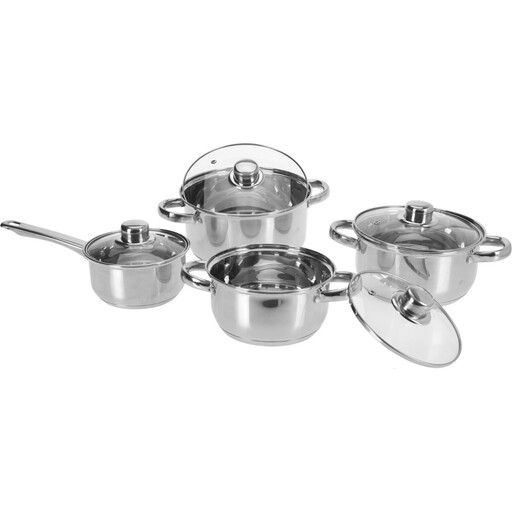
Why this fits the profile: The set includes four pans with four glass lids in sizes from 14 to 20 cm. That’s practical if you want to stock up on the basics of a kitchen in one purchase.
The product description states suitability for gas, electric, ceramic and induction hobs. Do check the current details about the non-stick coating mentioned and dishwasher use before buying.
Four cooking pans, four glass lids, various diameters and stated dishwasher safety.

Why this fits the profile: According to the product information, this 28 cm frying pan uses a three-layer stainless steel-aluminium-stainless steel construction. That suits anyone looking for a wide pan for frying, stir-frying and braising.
The description mentions tri-ply, induction compatibility and a glass lid. That makes the key checkpoints clearer than with a pan that only says “stainless steel”.
28 cm size, three layers and, according to the product information, suitable for gas, induction, ceramic, electric and halogen cooking.
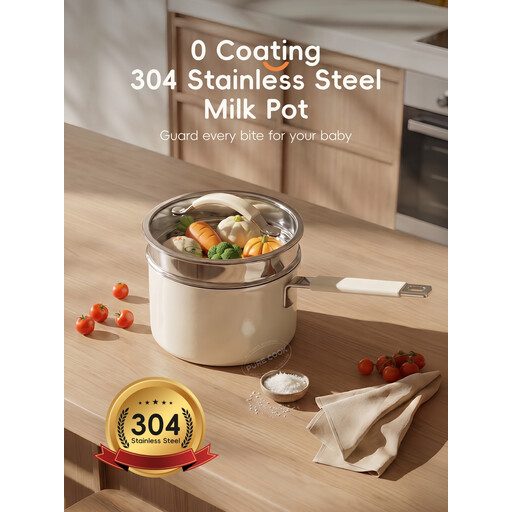
Why this fits the profile: According to the product description, this compact 18 cm pan combines heating and steaming. That’s handy for small kitchens, breakfast preparation or portions for one or two people.
The product lists a steamer insert, glass lid and compatibility with all hob types. According to the description, the interior has no chemical coating.
18 cm diameter, steaming and simmering function, glass lid and removable silicone protective covers.
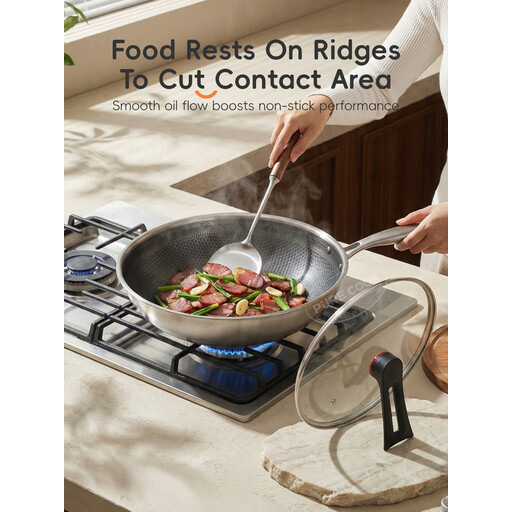
Why this fits the profile: The 32 cm size offers plenty of room for stir-frying, braising and cooking for several people. The product description mentions a honeycomb texture and tri-ply construction.
The description distinguishes between the stainless steel construction and the honeycomb texture. Hand washing is recommended, which avoids any false expectations about care.
32 cm diameter, glass lid, tri-ply construction and, according to the product information, suitable for induction, gas and ceramic hobs.
We’ve put together a full, up-to-date list of products that fully meet these strict selection criteria and current European safety regulations.
No. Look for an explicit mention of induction compatibility or a magnetic base. If in doubt, you can hold a magnet against the bottom, but the product information remains the best guide for safe and proper use.
First, preheat the pan gradually, then add oil, and only put the food in when the cooking surface is hot. Don’t use an unnecessarily high heat setting. A pan without a non-stick coating does require a bit of getting used to in terms of cooking technique.
It varies from product to product. Some models are listed as dishwasher-safe, while others recommend hand washing. Also check the materials of the handles, lid knob and any coating. Dry the pan after cleaning to minimise water spots.
