
Careful upholstery cleaner
You want to tackle stains before handover without causing discolouration or visible water marks. Follow the fabric’s care instructions and test the method in an inconspicuous area first.


First check whether the specific upholstery can be cleaned with water, then test your chosen method in an inconspicuous area: an upholstery cleaner doesn’t make every fabric suitable for wet cleaning. For a few marks, a compact machine may be practical; for several backrests, the right nozzle, reach and tank capacity matter more. If it’s a one-off job, compare buying with borrowing or hiring.
You want to tackle stains before handover without causing discolouration or visible water marks. Follow the fabric’s care instructions and test the method in an inconspicuous area first.
You have several backrests that can be cleaned with water and are looking for a suitable upholstery nozzle, enough reach and tanks that are right for the job.
You may not need the machine after handover. Milieu Centraal suggests borrowing or hiring when you only need something temporarily; compare those options with buying for this job.
Best for: a few marks on upholstery that can be cleaned with water, especially if you want a machine that’s easy to store.
Bear in mind: check that the tank capacity and nozzle are right for the number of backrests.
Best for: several backrests, when the hose, nozzle and tanks are suited to the job.
Bear in mind: larger tanks don’t eliminate the need to empty, rinse and dry the machine.
Best for: a steam model only if the upholstery care instructions allow this method; borrowing or hiring may suit a one-off job.
Bear in mind: a steam function doesn’t prove that steam is safe for your backrest.
Check the upholstery before choosing a machine. Then consider the number of backrests, drying time and whether you’ll use the machine after handover to decide which features matter.
| Concern | What to check | Who should prioritise this? |
|---|---|---|
| Fabric suitability | Follow the furniture label and test in an inconspicuous area. BISSELL’s US upholstery care advice says W and WS are suitable for water-based cleaning and advises against its own wet-cleaning method for S or X; use this guidance only if those codes actually appear on the label. | I don’t want to discolour the upholstery or leave water marks before handover. Around 36% of consumers put protecting the fabric first. |
| Number of backrests and reach | Check the upholstery nozzle, hose and cord, and the capacity of both tanks for the exact model. Rowenta lists a 1.75 m hose and 1.8- and 1.5-litre tanks for the Clean It IN5011. | If I’m cleaning several backrests, I want to be able to move the machine around and, if needed, refill or empty it less often. Around 29% of consumers focus mainly on the size and reach of the job. |
| Moisture and drying time | Test the method first and allow time for the upholstery to dry. Don’t assume a stated drying time is guaranteed for your fabric or conditions. | I want to check how the treated backrest dries before handover. Around 21% of consumers put drying time first. |
| One-off use and maintenance | Compare buying with borrowing or hiring, and check how to empty and rinse the model. A rinse function or autoclean accessory doesn’t necessarily replace every maintenance step. | For a one-off cleaning job, I want to avoid having to store and maintain a machine afterwards. Around 14% of consumers prioritise one-off use and putting the machine away. |
A machine may be designed for upholstery, but that doesn’t tell you whether the specific fabric can withstand the cleaning method you choose.
Follow the furniture care instructions and test the method in an inconspicuous area first.
Using an unsuitable method can cause discolouration or visible water marks.
BISSELL’s claim of around 30 minutes’ drying time applies to the Steam Only setting on the SpotClean HydroSteam Select. It doesn’t automatically apply to other settings, fabrics or conditions. BISSELL also warns that wetting only part of a surface can leave visible marks.
Start well before handover and check how your upholstery dries after a test clean.
Allow extra drying time if the backrest is still damp after the test.
Every tank has a capacity limit, and a rinse or autoclean function doesn’t necessarily eliminate all maintenance steps.
Check the instructions for the exact model for emptying, cleaning and rinsing. If it’s a one-off job, consider borrowing or hiring too.
Allow time after cleaning to empty the tanks, clean the machine and put it away.
Compare the Clean It Compact IN3020 with the Clean It IN5011 for size, reach and tank capacity.
The SE 3 Compact Home N1 is a spray-extraction option supplied with an upholstery nozzle.
The 3000 Series mentioned here refers specifically to the refurbished XW3193/11R1 stain remover.
According to BISSELL, the SpotClean HydroSteam Select has several cleaning modes for use on surfaces that are suitable for the method chosen.
These are portable cleaners marketed for upholstery and spot cleaning. Before use, check that the chosen wet-cleaning or steam method is suitable for the specific fabric.
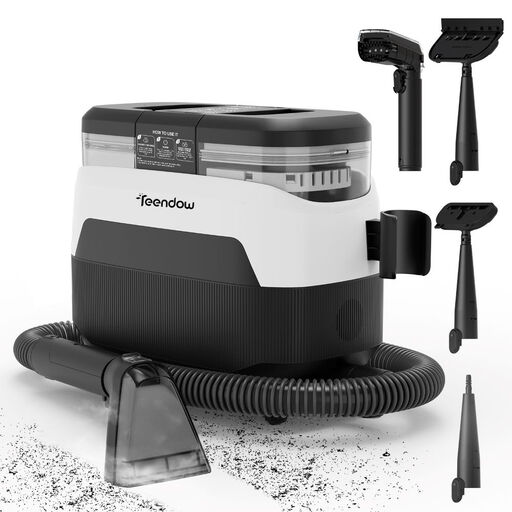 No image available
For spot cleaning upholstery that is suitable for the chosen method; the product description mentions a brush for fabric.
The product name lists 12,000 Pa of suction power. The product description gives a 1.2 m hose, a 4 m cord, a 1,250 ml clean-water tank and a 950 ml dirty-water tank.
The product description also mentions a steam function; check whether steam is suitable for your upholstery.
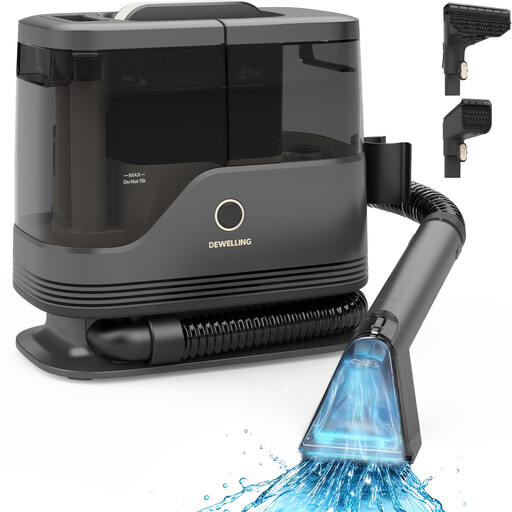 No image available
For sofas and upholstery that can be wet-cleaned; the product description explains that it sprays and vacuums up dirty water.
The product description lists two nozzles, 1-litre and 0.55-litre tanks, a 1.15 m hose and a 5 m cord. It also mentions a self-cleaning function on the handle.
The stated suction power is 13 kPa; check the manual for after-use maintenance.
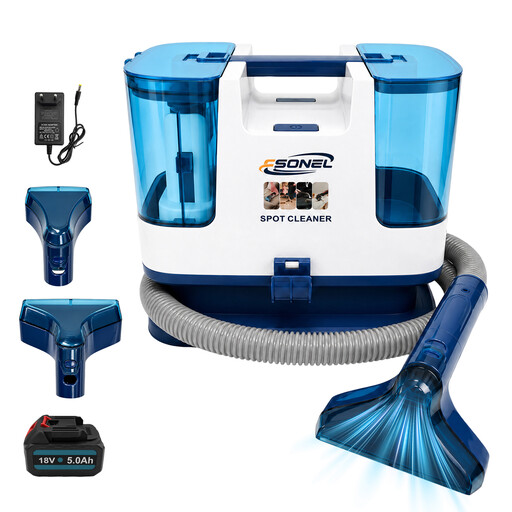 No image available
For spot cleaning sofas or car seats that can be wet-cleaned; the product description explains that it sprays and vacuums up dirty water.
The product name lists 400 W and 17 kPa suction power. The product description mentions a battery-powered version and an integrated dirty-water tank.
This is the version with 1 battery; check the model before ordering.
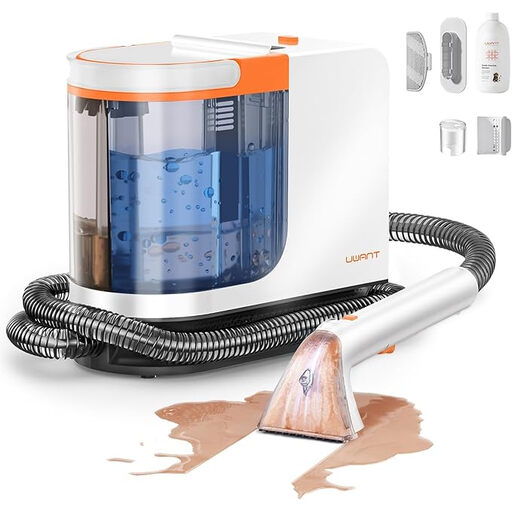 No image available
For spot cleaning sofas and upholstery; the product description lists these surfaces as suitable for use.
The product name lists 18 kPa suction power. The product description mentions a 14 cm brush and a self-cleaning function.
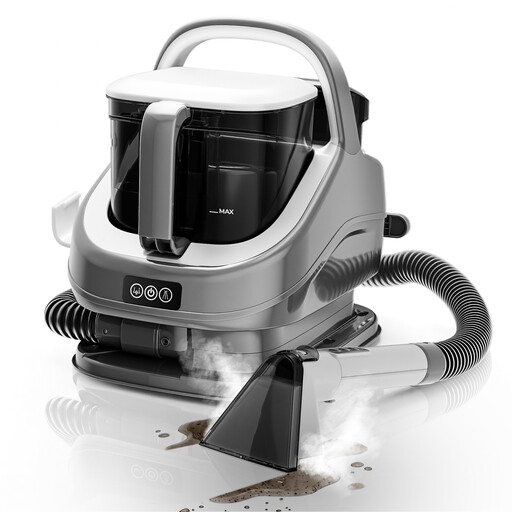 No image available
For sofas and upholstery that are suitable for the chosen water or steam method; the product description lists several cleaning modes.
The product description lists cold-water, hot-water and steam modes, 13 kPa suction power, 1,400 ml and 1,200 ml tanks, a 1.1 m hose and a 3 m cord.
The product description warns against using the machine on fabrics that aren’t water-resistant.
No. Follow the care instructions for the specific upholstery and test in an inconspicuous area first. BISSELL’s US upholstery care advice describes W and WS as suitable for its own water-based cleaning method and advises against using that method on S or X; use this guidance only if those codes actually appear on the furniture label.
First remove any loose dirt and test the method in an inconspicuous area. Then check the instructions for the exact model for emptying and rinsing; Kärcher lists a rinse function for the SE 3 Compact Home N1.
Not necessarily: Milieu Centraal suggests borrowing or hiring when you only need something temporarily. Compare those options with buying, and consider whether you’ll use the machine again later.
In the Netherlands, you have statutory consumer rights as well as any manufacturer’s warranty. ACM ConsuWijzer says the seller must offer an appropriate free solution if a product doesn’t perform as you could reasonably expect under normal use. Online purchases from a business also often come with a 14-day cooling-off period, subject to exceptions; the Dutch government explains how this period works.