
Practising with housemates
You practise regularly while other people are at home and want to hear the piano through headphones. A headphone socket helps, but the sound of the keys and pedal is a separate consideration.


For practising scales in a shared home, a portable digital piano with a suitable headphone socket, a comfortable key feel and a metronome is a sensible place to start. Headphones let you hear the electronic piano sound privately, but they won’t automatically silence the keys or pedal for others. So, measure your set-up and check what’s included with the exact version you’re considering. Roland and Casio describe models with headphone sockets, while Roland and Korg list a metronome for the models mentioned.
You practise regularly while other people are at home and want to hear the piano through headphones. A headphone socket helps, but the sound of the keys and pedal is a separate consideration.
You use scales to practise your touch and control of tempo. Compare how the keyboard feels and check how to set the metronome to your preferred time signature and tempo.
You need to move or put away the instrument after practising. So, consider not just the piano’s dimensions and weight, but also the space needed for a stand, a seat and connections.
A good fit if: you want to practise at home and sometimes listen to the piano through headphones, and at other times through built-in speakers. Roland describes this combination for the FP-10.
The trade-off: the piano takes up space even without a permanent stand, and headphone playback doesn’t tell you whether housemates can hear the keys or pedal.
A good fit if: you want to take the instrument to rehearsals or performances as well as practising at home, and need the relevant connections.
The trade-off: check whether the exact model has built-in speakers. If not, you may need separate amplification to play without headphones.
In a shared home, the main things to consider are your headphone set-up, the keyboard, the space available and what’s included with the model.
| What to consider | What should you check? | Who should pay particular attention? |
|---|---|---|
| Practising with less piano sound at home | Check the headphone socket on the exact version and, where possible, listen for key and pedal noise with the speakers off too. | If I practise while my housemates are at home, I want to hear the piano privately without assuming the keys will be completely silent. Around 34% of consumers prioritise limiting the piano sound that housemates can hear. |
| Touch and rhythm | Try the feel and repetition of the keys, and check how to set the metronome’s tempo and time signature. | If you use scales to practise touch and timing, you’ll want a keyboard and tempo support that suit the way you play. Around 33% of consumers give touch and rhythm top priority. |
| Space and moving the piano | Measure the available width and depth, including space for a stand and a seat; also consider how much weight you’ll need to lift. | If I need to put the piano away after practising, I want to know whether the whole set-up will fit and can be moved. Around 20% of consumers prioritise storage and portability. |
| What’s included with the model | Check the packaging details for the exact model to see whether it includes a pedal, stand and any other parts you need. | If you want to put together a practice space without having to search for extra items, you’ll want to know in advance what’s included. Around 13% of consumers give a complete set-up top priority. |
Headphones let you hear the electronic piano sound privately, but they don’t prove that housemates won’t hear the keys, pedal or vibrations.
Where possible, listen for mechanical noise with the speakers off too, and agree on practice times.
The piano’s dimensions and weight don’t tell you how much space the whole set-up needs. A stand, seat and pedal set-up may also take up room.
Measure the space needed for the complete set-up and check which accessories are included with each version.
Depending on the version, you may still need a suitable stand, seat or pedal set-up.
The FP-10 is a portable option if you’re looking for one practice instrument with weighted keys, headphone playback and a metronome.
The CDP-S110BK is worth considering if a shallow casing and the ability to move the instrument are important to you.
The ES60 is a portable option if you’re considering the position of the headphone socket and how easy the instrument is to move.
The B2 is worth considering if you want to compare a weighted keyboard, metronome and clearly specified basic accessories.
The compact P-145 is an option to compare if you’re looking for a straightforward instrument with a weighted 88-key keyboard.
These Joybuy options are keyboards with 61 keys. Compare their range and the practice features or accessories listed for the exact version.
 No image available
This could suit you if you’re looking for a portable instrument with a headphone socket; the product title also mentions weighted keys and built-in speakers.
The title lists 61 keys, fewer than the 88-key range of the practice models mentioned. Check that this range suits what you want to practise.
 No image available
This could suit you if you’re looking for a keyboard with a built-in metronome and speakers; these features are listed in the product title.
The title lists 61 keys. Compare this range with the space you need to practise scales the way you want to.
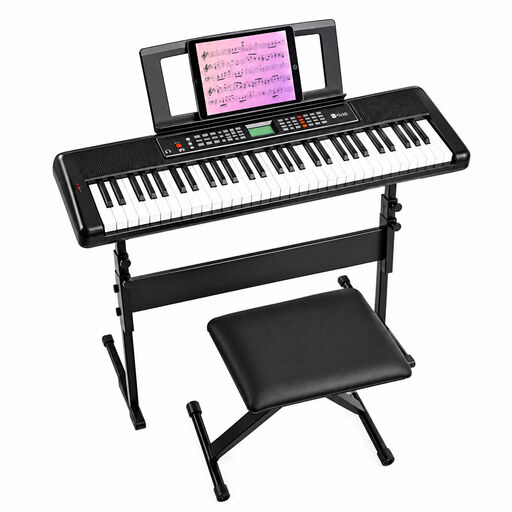 No image available
This could suit you if you’re looking for a keyboard with a basic set-up included; the product title lists a stand, bench and music stand.
The title lists 61 keys. Also check exactly which items are included in the set on offer.
No. You’ll hear the electronic piano sound privately, but housemates may still hear the keys, pedal or vibrations. Try the set-up at home and agree on practice times if needed; local rules can vary by council and situation.
Use a metronome at a tempo that lets you play the notes evenly, and only increase the tempo once you can do so. Roland lists a metronome for the FP-10 and Korg for the B2; check how to set the tempo and time signature on other models.
It varies by model and version. Korg lists a damper pedal as included with the B2 and the stand as optional; check the contents of the exact package before you buy.
According to the Dutch government, you’re entitled to a product that works properly and should generally contact the seller to find a solution. There’s no fixed statutory guarantee period for all products; what you can reasonably expect depends, among other things, on the product and the purchase.
Keep the volume low and take listening breaks. As a general tip for safe listening, the World Health Organization recommends setting your device volume to no more than 60% of the maximum. This isn’t a guaranteed safe level for every piano and headphone combination.