
Piano student in a rehearsal studio
You want to practise melody and accompaniment with a suitable key action. The keyboard range and pedal matter more than having a wide choice of sounds.


A portable digital piano with built-in speakers is a practical choice if the rehearsal room isn’t equipped with amplification. A model without speakers may suit you if a suitable pair of headphones or a monitor setup is available. Then compare the key action, the range you need, the pedal connection and the outputs. Extra sounds and controls are most useful if you’ll use them during rehearsals.
You want to practise melody and accompaniment with a suitable key action. The keyboard range and pedal matter more than having a wide choice of sounds.
You move between rehearsal rooms and want to know in advance whether you can hear the piano straight away, or whether you’ll need headphones or studio monitoring.
You want to play the tune with others and make sure the sounds, outputs and existing studio setup work together.
Start with the sound setup and the arrangement you want to practise. Then compare the keyboard and connections with the facilities in your rehearsal room.
| What to consider | What to look for | Who should pay extra attention? |
|---|---|---|
| Piano feel and keyboard range | Try the key action and check that the range suits your arrangement. Yamaha lists 88 GHC keys for the P-225; Korg lists 88 RH3 keys for the D1. | If I’m practising melody and accompaniment, I want an action and range that suit my arrangement. Around 36% of consumers prioritise piano feel and keyboard range. |
| Being able to hear yourself straight away | Ask which headphones, monitors and mixer inputs are available. Check the speakers and outputs on the exact version you’re considering. | Without a permanent sound system, I want to know how I’ll hear myself and whether I can connect headphones. Around 29% of consumers prioritise being able to hear themselves straight away. |
| Transport and setup | Check the weight and dimensions of the version you’re considering, and find out whether a stand or bag is included. Yamaha lists the P-225 at 11,5 kg; Korg lists the D1 at 16 kg. | If I often need to take the piano to another rehearsal room, I want to know what I can transport and where the instrument will fit. Around 21% of consumers put transport and setup first. |
| Sounds and studio connections | Decide which sounds you’ll use and compare the audio outputs and other connections you need with the studio equipment. Studiologic lists two audio outputs and four audio inputs for the Numa X Piano 88; Nord lists separate piano and synth layers for the Piano 6 88. | For band rehearsals, I want to match the sounds and connections to the equipment. Around 14% of consumers prioritise sounds and studio connections. |
Korg says the D1 has no built-in speakers. Whether you can hear yourself clearly therefore depends on the headphones or sound system available.
Before buying, ask what monitoring is available and compare it with the outputs on the exact version you’re considering.
The piano’s weight doesn’t tell you whether the rest of the rehearsal setup is available or whether the instrument will fit in the space you have.
Check the dimensions and weight of the version you’re choosing, what’s included in the box and the space where you plan to practise.
A wider range of sounds and connections is most relevant if you’ll use them in your arrangement or studio setup. They aren’t automatically necessary for a single piano part.
First decide which sounds and connections you’ll actually use during your own rehearsals.
The P series is worth considering if you’re looking for a portable digital piano with a piano-style keyboard.
The D1 may suit a studio with existing monitoring or players who practise with headphones.
The RD-08 is a stage-focused option to consider if you’re looking for a weighted keyboard.
The Numa X Piano 88 is worth considering if the piano will be part of a studio setup with external audio equipment.
The Nord Piano 6 88 is worth considering if you want to use programmable layers alongside piano sounds during rehearsals.
For practising on a digital piano without a separate amplifier, check that the built-in speakers and connections on the version you choose suit your rehearsal room.
 No image available
The product title describes a portable design with built-in speakers, so you can practise without a separate amplifier.
61 keys, weighted keyboard, 300 sounds, 300 rhythms, LCD screen, USB-MIDI, headphone socket and music stand.
 No image available
The product title mentions speakers and a metronome, so you can practise without a separate amplifier and keep to a steady tempo.
61 keys, MIDI controller, recording function and music stand.
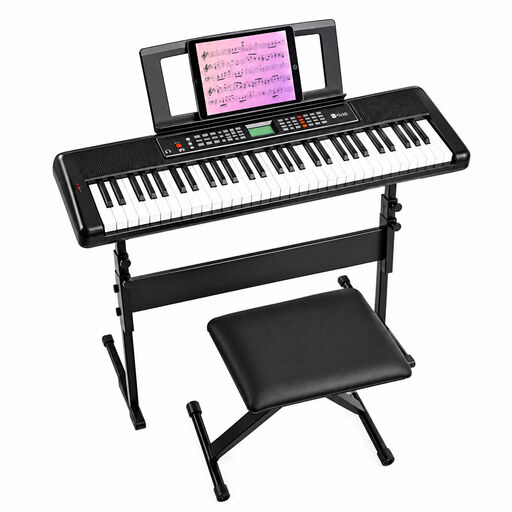 No image available
The title describes a set with a stand, stool and music rest for a dedicated practice space.
61 keys, three levels of guided practice, 300 sounds, 300 rhythms, LCD screen and USB-MIDI.
No, it depends on the range and accompaniment in your arrangement. An 88-key keyboard is worth considering if you also want to practise full piano parts or wide splits. Check the sheet music before deciding how much range you need.
Check in advance whether you can play through suitable headphones or use the line outputs with the studio sound system. According to Korg, the D1 has both connection options but no built-in speakers. Make sure you have the right cables and monitoring setup.
Check that the stand, power supply and pedal are suitable for the exact version, and follow the manual for use and maintenance. Don’t open electrical equipment to repair it yourself; the Nord Piano 6 manual says servicing should be carried out by qualified personnel.
For consumer purchases in the Netherlands, the seller is responsible for the statutory guarantee. If the product doesn’t meet what you could reasonably expect, the seller must offer an appropriate solution free of charge. According to the Netherlands Authority for Consumers and Markets’ ConsuWijzer, the statutory guarantee does not have a fixed two-year term.
Electrical and electronic equipment sold in the Netherlands must comply with the applicable European product rules. Ondernemersplein, a Dutch government business information service, lists electrical safety and electromagnetic compatibility among the requirements. Equipment with Bluetooth or a radio module may also be subject to rules for radio equipment. For products covered by CE rules, the manufacturer must assess the required conformity and apply the marking; this does not confirm that a specific piano has been checked.