Choose a keyboard that feels comfortable when playing scales repeatedly, and decide whether you want to listen through built-in speakers, headphones or external equipment. A portable digital piano with speakers is handy if you want to play without extra audio equipment; a speakerless stage piano is a good fit if you already use headphones or a sound system. Remember to measure the entire setup, including the stand and music rest.
Who is this choice relevant to?
Pianist working on their touch
You practise minor scales repeatedly and want to focus on how the keyboard feels when you play. Try the exact model yourself: Roland and Yamaha specify the types of keyboard action, but that won’t tell you which feel you’ll find comfortable.
Practising in a shared home
You want to practise regularly with headphones and be considerate of housemates or neighbours. Check the connections and, if necessary, agree on arrangements for noise; the Dutch government advises trying to reach an agreement together first when dealing with noise from neighbours.
Player with a small spare room
The piano needs to fit in a limited space, which may also be used for other things. Compare the instrument’s dimensions with the space needed for the stand, music rest and seat.
What should you look for when choosing?
Portable piano with speakers
A good fit if: you want to play straight away in your spare room and also practise with headphones. Roland lists built-in speakers and two headphone outputs for the FP-30X.
Bear in mind: how the keyboard feels is a personal matter. Also check how much space the complete setup needs and which pedal configuration you want.
Speakerless stage piano
A good fit if: you plan to play through headphones or existing audio equipment. The Korg D1 has line outputs and comes with a damper pedal.
Bear in mind: Korg’s manual states that the D1 has no built-in speakers, so you’ll need headphones or connected audio equipment to hear the instrument.
| What to consider |
What should you check? |
Who is this important to? |
| Key action and range |
Check the number and type of keys on the exact model, and try playing both slow and faster scales yourself. |
If I play minor scales repeatedly, I want to know whether the keyboard suits my technique. Around 36% of consumers make touch their main priority. |
| Practising with headphones |
Check the model’s headphone connection and consider when you’ll use speakers or external equipment. |
If I practise in a shared home, I want to listen through headphones and be considerate of others. Around 29% of consumers make quiet practice their main priority. |
| Space and setup |
Measure the available space and compare it with the dimensions of the piano and any accessories you plan to use. |
If the spare room has another purpose too, I want to know whether the complete setup will fit. Around 21% of consumers make the space required their main priority. |
| Playing straight away and practice features |
Check whether the model has speakers, a metronome or a recording function, and what’s included in the box. |
If I want to get started without extra audio equipment or use built-in practice features, I want to check these details beforehand. Around 14% of consumers make a ready-to-play practice setup their main priority. |
Specifications help you compare models, but they can’t tell you which keyboard will feel comfortable to play. Yamaha lists the P-225 as having a body measuring 1.326 × 272 mm without the music rest; the stated depth is greater with the music rest fitted. Casio lists a body depth of 232 mm for the PX-S1100BK. Always measure the space and accessories for the model you plan to use.
Common buying mistakes
-
Assuming a stage piano has built-in speakers
This varies by model: Korg’s manual states that the D1 has no built-in speakers, while Roland lists them for the FP-30X.
Check how you’ll listen to the sound on the exact model before choosing the rest of your setup.
-
Measuring only the piano body
The space you need may change when you add a music rest or stand. Yamaha lists different dimensions for the P-225 with a music rest and with an optional stand.
Measure the available space and compare it with the dimensions of the setup you actually plan to use.
-
Assuming the included damper pedal will suit any pedal setup
Korg says the D1 comes with a damper pedal; several pedal options are listed for the Roland FP-30X.
Check what’s included with the exact model and whether it suits the pedal setup you want to use.
A different pedal or stand setup may require additional accessories.
Brands to compare
Roland
The FP-30X is a portable piano for practising at home, with the option to connect headphones.
- Roland lists 88 PHA-4 Standard keys, built-in speakers and two headphone outputs for the FP-30X.
- A stand and more advanced pedal options are separate choices; the manufacturer’s claims about key action can’t tell you which playing feel will suit you.
Yamaha
The P-225 is worth comparing if a piano-style keyboard and the body dimensions are important to you.
- Yamaha lists 88 GHC keys and a body measuring 1.326 × 272 mm without the music rest.
- The dimensions of the complete setup vary depending on whether you add a music rest or optional stand; the specifications can’t tell you which playing feel you’ll find comfortable.
Korg
The D1 is a speakerless stage piano for anyone who wants to play through headphones or external equipment.
- Korg lists line outputs and an included damper pedal.
- According to Korg’s manual, the D1 has no built-in speakers.
Casio
The Privia PX-S1100BK is worth considering if the depth of the body is a key factor.
- Casio lists a depth of 232 mm for the PX-S1100.
- That measurement alone doesn’t tell you how much space the complete setup needs or how the keyboard feels to play.
Kawai
The ES120 is worth a look if you want a built-in metronome and recorder.
- Kawai lists an adjustable metronome and song recorder for the ES120.
- These features don’t prove that the keyboard feels better or that they’ll help you practise more effectively.
Joybuy products
These Joybuy options are 61-key keyboards with features that may be useful for practising scales. They are not the same as the 88-key models mentioned above for comparison, so check that the key range suits what you want to practise.
 No image available
MLS-931 digital piano, 61 keys, black
The headphone socket gives you an option for listening while practising in a shared home.
The product is described as having a weighted 61-key keyboard. The product description also mentions a metronome, recording function, speakers, USB-MIDI and music rest.
View at Joybuy
 No image available
Electronic keyboard piano, 61 keys, black
This model may suit you if you want to practise with headphones and use built-in learning or recording features.
The product description mentions a headphone output, metronome, recording and playback functions, and a three-level learning system. The title lists speakers and 61 keys.
View at Joybuy
 No image available
Digital keyboard set, 61 keys, black
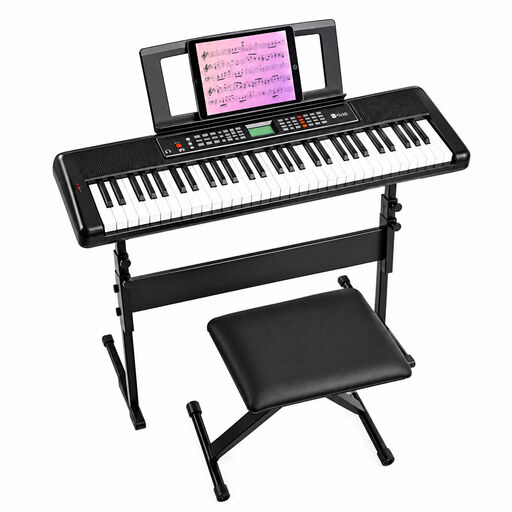
This set may suit you if you’re looking for a keyboard with a listed stand setup.
The product title lists 61 keys, a stand, bench and music rest. The product description mentions recording and playback functions and a headphone output; the title lists a three-level learning mode.
View at Joybuy
Frequently asked questions
Can I practise on a stage piano without speakers and without extra equipment?
Only if you use headphones. Korg’s manual states that the D1 has no built-in speakers; to listen without headphones, you’ll need external audio equipment. This isn’t necessarily true of every stage piano.
What should I consider when placing a piano in a spare room?
Measure the space for the complete setup, not just the keyboard. Yamaha lists separate dimensions for the P-225 with a music rest and optional stand; also allow space for the pedal and seat with the setup you choose.
How can I practise the tempo of minor scales without an extra device?
Check whether your chosen model has a metronome. Kawai lists an adjustable metronome and song recorder for the ES120; check these features separately if you choose another model.
What are my rights when buying a piano online?
For many online distance purchases from a business, the Dutch government says you have a 14-day cooling-off period; the same rules don’t apply to purchases from a private seller. Separately, Dutch law protects you if a product is faulty: contact the seller if there’s a problem. There is no fixed general statutory guarantee period.


