A 61-key stage keyboard could be suitable if the parts you want to play with your left and right hands fit within its range and space is your main consideration; Yamaha lists the CK61 as 910 mm wide. If you need a wider range or a weighted keyboard, compare the dimensions of the complete setup: the Studiologic Numa Compact SE measures 127 × 23 cm, while the Roland RD-08 measures 1,284 × 258 mm according to their manufacturers.
Who is this for?
Accompanist with limited space
You want to play bass notes or chords with your left hand, and be able to leave the instrument set up or put it away after practising. Both the key range and the dimensions of the complete setup will affect your choice.
Piano student practising with both hands
You practise left-hand patterns alongside a right-hand part, so key range and key feel matter. A shorter, lighter keyboard is not necessarily the same as a weighted piano keyboard.
Practising in a shared room
You want to practise with headphones and check that the pedal, stand and power supply are suitable for your setup.
What should you look for when choosing?
Start by working out which notes you want to play with both hands, then measure the space for the instrument and how you plan to set it up.
| What to consider |
What to look for when buying |
Who this matters to |
| Fit of the instrument and setup |
Measure the available width and depth. Yamaha lists the CK61 as 910 mm wide; Studiologic gives the Numa Compact SE dimensions as 127 × 23 cm. |
If space is limited, you’ll want to know whether the instrument and playing area will fit together; around 36% of consumers say available space is their top priority. |
| Range for both hands |
Compare the lowest bass note and highest right-hand note you need with the keyboard’s range. A split assigns sounds to different zones, but it doesn’t add keys; Roland describes this feature for the RD-08. |
If you want to play your own bass notes or chords with your left hand, you’ll need enough keys left for the other part; around 29% of consumers prioritise playing their own accompaniment. |
| Key feel for piano practice |
Check the keyboard type of the exact version. Studiologic describes the Numa Compact SE as semi-weighted, while Roland describes the RD-08 as having a weighted PHA-4 keyboard. |
If piano-style key feel and a wide enough range matter to you, look beyond the instrument’s dimensions alone; around 21% of consumers say piano-style key feel is their top priority. |
| Listening and connections |
Check the headphone socket, power supply and included pedal equipment for the exact version. Studiologic states that the Numa Compact SE’s speakers do not work when powered by USB alone. |
If you practise in a shared space, you’ll want to listen without disturbing others; around 14% of consumers prioritise practising with headphones. |
Common buying mistakes
-
Looking only at the depth of the piano
A shallow instrument doesn’t necessarily take up little width. Studiologic lists the Numa Compact SE as 127 × 23 cm; Yamaha gives the CP73 a depth of 35.5 cm.
Measure the available space in both directions and check the dimensions of the exact version.
You may need a different stand or a different spot in the room.
-
Confusing a split function with automatic accompaniment
A split assigns sounds to different parts of the keyboard. This is not the same as having bass, chords or rhythms play automatically; Roland describes split zones for the RD-08, while Yamaha lists automatic accompaniment for the PSR-EW320.
Decide whether you want to play the accompaniment yourself or have it generated automatically, then check that the instrument has the feature you need.
-
Assuming a pedal and power supply are always included
What’s in the box and the power options can vary between versions. Studiologic states that the Numa Compact SE’s built-in speakers do not work with USB power alone.
Before buying, check what’s included, pedal compatibility and the power requirements of the exact version.
With some versions, you may need to buy a compatible pedal or power supply separately.
Brands and models to compare
Studiologic
The Numa Compact SE is an 88-key option for anyone looking for a shallow stage keyboard with splits and built-in sounds.
- Studiologic lists dimensions of 127 × 23 cm and a weight of 7.1 kg.
- Its keyboard is semi-weighted, so it doesn’t have the same type of hammer action as the Roland RD-08. The built-in speakers do not work with USB power alone.
Roland
According to Roland, the RD-08 combines 88 weighted keys with separate sounds for the left and right hands.
- Roland lists an adjustable split, built-in speakers and dimensions of 1,284 × 258 mm.
- The keyboard description can’t tell you how the keys will feel to you, so try them for yourself if you can.
Yamaha
The CK61, CK88 and CP73 differ in key range, keyboard type and dimensions.
- Yamaha lists 61 FSB keys for the CK61, 88 GHS keys and built-in speakers for the CK88, and 73 BHS keys for the CP73. The CP73 is 108.6 cm wide.
- The CP73 is 35.5 cm deep, so its narrower width doesn’t necessarily mean it has the smallest depth.
Casio
The CDP-S110 is a digital piano worth comparing if you don’t need stage-style controls.
- Casio lists 88 keys with Scaled Hammer Action Keyboard II and an SP-3 sustain pedal included.
- Check that the controls on the exact version suit your practice needs; the specifications given do not confirm the split controls found on the stage-focused models mentioned here.
Korg
The Liano is a portable digital piano to consider if simple home practice matters more to you than a weighted hammer-action keyboard.
- Korg lists 88 touch-sensitive LS keys, a headphone socket and an included pedal switch.
- The stated dimensions are 1,282 × 290 mm without the music stand, and it weighs 6.0 kg without batteries or the stand; the specifications do not mention hammer action.
Joybuy picks
Below are Joybuy picks with 61 keys for anyone considering a shorter range for practice. Compare these digital pianos and keyboards with the features you need for your left-hand part.
 No image available
MLS-931 digital piano, 61 keys
This 61-key digital piano could suit you if you’re specifically looking for a shorter range; it has fewer keys than models with 73 or 88 keys.
View at Joybuy
 No image available
Electronic keyboard piano, 61 keys
This 61-key keyboard piano is an option if your left-hand part fits within its range; it has fewer keys than models with 73 or 88 keys.
View at Joybuy
 No image available
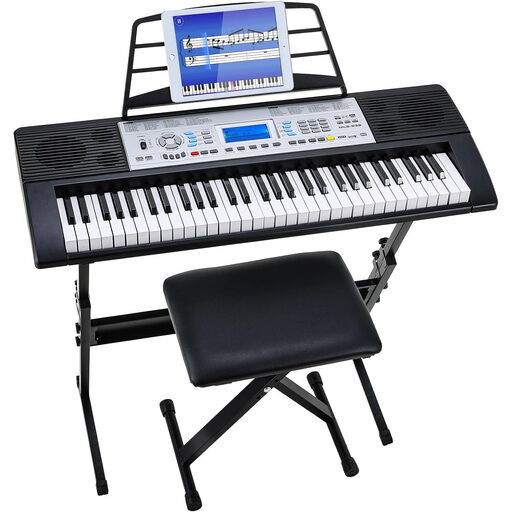
Digital keyboard set, 61 keys, with stand and stool
This 61-key set with a stand and stool could suit you if you’re looking for a practice setup with a shorter range; it has fewer keys than models with 73 or 88 keys.
View at Joybuy
Frequently asked questions
Do you need a split function for left-hand accompaniment?
No, not if you want to play the same piano sound with both hands. If you want a different sound for each hand, Roland says the RD-08 has an adjustable split point; check that enough keys remain on each side for your parts.
Does a split function automatically create accompaniment?
No. A split assigns sounds to different parts of the keyboard, while automatic accompaniment is a separate feature. If you want bass, chords or rhythms to play automatically, check that the instrument specifically supports this feature.
How do you set up two different sounds on a Roland RD-08?
According to Roland, hold down SPLIT and press the key where you want the new split point. You can then choose a sound for each zone on the Scene screen and save the setting.
Do the Studiologic Numa Compact SE speakers work with USB power alone?
No. Studiologic states that the built-in speakers do not work when the instrument is powered by USB alone; use the included power supply instead.
What are your rights when buying from a Dutch retailer?
According to ACM ConsuWijzer, if a product is faulty, the seller must put it right free of charge under the terms of the statutory guarantee; a manufacturer’s guarantee does not replace this right. For a standard online consumer purchase, you generally have 14 days from delivery to change your mind, subject to legal exceptions.


