
Piano-focused melody player
You want to practise the melody and accompaniment with a piano-like touch, and compare the feel of the keys before buying. Yamaha, Roland and Kawai describe different keyboard actions to help you make this choice.


For piano-focused practice, a stage piano with hammer-action keys is a good choice. A lighter instrument with semi-weighted keys may be more convenient if you need to carry it often, but it will feel different to play. Next, decide how you want to listen: through built-in speakers, wired headphones or the rehearsal room’s sound system. Check the specific model’s outputs, pedal connection and included accessories too.
You want to practise the melody and accompaniment with a piano-like touch, and compare the feel of the keys before buying. Yamaha, Roland and Kawai describe different keyboard actions to help you make this choice.
You want to hear yourself clearly when playing with others, so you’ll need a listening setup that works with the built-in speakers or available audio outputs. Roland, Kawai and Studiologic offer different options for external sound systems.
You regularly take your instrument to a rehearsal room and need to balance weight and ease of setup against the key feel you want. Kawai and Studiologic publish the weights of the ES120 and Numa Compact 2x.
When learning a hymn tune in a rehearsal room, the main things to consider are the key action, how you’ll listen, quiet practice and portability.
| What to consider | What should you check? | Who is this important for? |
|---|---|---|
| Key action and range | Compare the type of keyboard, number of keys and pedal options. Yamaha lists 88 GHC keys for the P-145; check what’s included with the version you’re considering. | If I want to practise the melody and accompaniment, I’ll focus on the key action and range; around 40% of consumers make key action their main priority. |
| Being heard when playing with others | Ask which inputs and cables are available in the rehearsal room. Roland lists outputs for external powered speakers on the FP-30X, while Kawai’s ES120 manual mentions LINE OUT. | When playing with others, I want to know how I’ll be heard through the equipment available; around 30% of consumers prioritise being heard. |
| Quiet practice | Check the type of headphone socket and whether you have compatible wired headphones. Roland lists two headphone outputs for the FP-30X and says this model does not support Bluetooth headphones. | If I want to practise a passage quietly, I’ll check the headphone socket; around 20% of consumers make quiet practice their main priority. |
| Transport and setup | Compare the weight and check what power supply and listening equipment you’ll need. Kawai lists the ES120 at 12,5 kg and Studiologic lists the Numa Compact 2x at 7,1 kg; according to Studiologic, the Numa Compact 2x’s built-in speakers won’t work when it’s powered by USB alone. | If I need to carry the instrument often, I’ll weigh up portability against the key feel I want; around 10% of consumers make portability their main priority. |
According to Roland, the FP-30X does not support Bluetooth headphones, even though the instrument has Bluetooth features.
Check which direction the Bluetooth connection supports and what type of headphone socket the specific model has.
You may need compatible wired headphones or an adapter.
According to the manufacturer, the Studiologic Numa Compact 2x has semi-weighted keys. This is a different type of keyboard action from the hammer-action keys on the piano-focused alternatives mentioned here.
Try both key feels with the same melody before weighing up portability against key action.
According to Studiologic, the Numa Compact 2x’s internal speakers can’t be used when the instrument is powered by USB alone.
Make sure the power supply suits your listening setup, especially if you move the instrument around.
According to Studiologic, you’ll need to use the supplied power supply to run the internal speakers.
The P series includes portable digital pianos, including the compact P-145 for piano-focused practice.
The FP-30X is a portable digital piano with built-in speakers and connections for external sound systems.
Kawai describes the ES120 as a portable digital piano and lists a rehearsal room as one possible place to use it.
The Numa Compact 2x is worth comparing if a low listed weight and a range of sounds are important to you.
The Privia PX-S1100 is a compact digital piano to compare if space is limited.
These Joybuy options are 61-key instruments for practice in a compact setup. Compare their range with what you need for the melody and any accompaniment.
 No image available
This instrument could suit you if you’re looking for a compact practice setup and 61 keys give you enough range for your music.
The product title lists a weighted keyboard, speakers, a headphone socket, USB-MIDI, an LCD screen and a music rest. With 61 keys, it has a more limited range than the 88-key piano-focused models mentioned here; check that the melody and accompaniment fit within its range.
 No image available
This keyboard could suit practice with a metronome and music rest, provided 61 keys give you enough range for your melody and accompaniment.
The product title lists MIDI, a recording function, speakers, a metronome and a music rest. With 61 keys, it has a more limited range than the 88-key piano-focused models mentioned here.
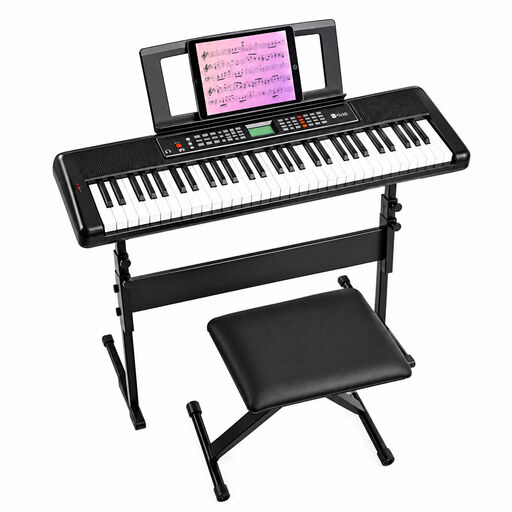 No image available
This set could suit you if you’re looking for a keyboard with a stand and bench for practice, and 61 keys give you enough range.
The product title lists a stand, bench, music rest, three-level learning function, LCD screen and USB-MIDI. Its 61-key range is also more limited than that of the 88-key models mentioned here.
Not if you’re listening through compatible wired headphones or a suitable external sound system. Decide in advance how you want to practise in the rehearsal room, then check that the chosen model’s connections suit your setup.
No. According to Roland, the FP-30X does not support Bluetooth headphones. Use wired headphones with one of the Phones sockets.
Check that you have a suitable stand and pedal, and find out which power supply and cables you’ll need for your listening setup. According to Studiologic, the Numa Compact 2x’s built-in speakers won’t work when the instrument is powered by USB alone.
The ACM states that the seller is responsible for the statutory guarantee, which takes into account what you can reasonably expect from the product. According to the Dutch government, a 14-day cooling-off period applies in many cases when you buy from a business at a distance. Check the terms that apply to your specific purchase.