
Players in a shared home
You want to practise your tune with headphones and take into account the noise the keys themselves may make in the room.


For practising at home, a good starting point is an instrument with a suitable headphone socket and the key action you want to learn. If you also want to play your tune without extra audio equipment, look for models with built-in speakers. For example, Yamaha says the CK88 has switchable speakers, while the CP88 has no built-in speakers.
You want to practise your tune with headphones and take into account the noise the keys themselves may make in the room.
While you’re learning, you mainly want a keyboard and pedal setup suited to piano playing, without a host of unnecessary stage features.
You want to practise at home on an instrument that will also have the connections and controls you need for performances later on.
| Consideration | What to look for | Who is this important for? |
|---|---|---|
| Quiet practice | Check the headphone socket and plug size on the exact model. Also consider whether the keys will still be audible in your room. | If you practise in a shared home, you’ll want to keep the electronic sound private without assuming the keys themselves are silent; quiet practice is the top priority for around 36% of consumers. |
| Piano-style touch | Compare the keyboard on the exact model and, if possible, try out its key action. Don’t assume every model in a brand’s range has the same feel. | When learning a festive tune, you’ll want a keyboard that suits the piano technique you’re practising; around 29% of consumers prioritise piano-style touch. |
| Playing without extra audio equipment | Check whether the model has built-in speakers and what you need to play without headphones. | If you want to play your tune so you can hear it straight away, built-in speakers can save you from needing separate audio equipment; this is a priority for around 21% of consumers. |
| Performing live later | Decide whether you need stage outputs and additional controls; check the connections and weight of each model. | If you want to use the same instrument live later on, stage connections and controls matter alongside home practice; around 14% of consumers prioritise future use in this way. |
You can’t play a stage piano without built-in speakers and expect to hear it without connecting anything else. Yamaha says the CP88 has no speakers.
Decide in advance whether you’ll only play with headphones or also want to hear the sound without extra equipment. For the latter, you’ll need a separate audio setup if your model has no built-in speakers.
Headphones keep the electronic sound private, but that doesn’t mean the keys will be inaudible in the room. The World Health Organization emphasises that both sound level and listening time matter for safe listening.
Assess the sound of the keys in your own room, start at a low listening volume and take breaks during longer practice sessions.
What’s included can vary between models. Casio lists an SP-3 pedal with the CDP-S110BK, while Nord lists a Nord Triple Pedal 2 with the Nord Piano 6.
Check what comes with the exact version and whether the pedal is suitable for what you want to practise.
The CK88 is designed for both home and stage use; the CP88 is a stage-focused piano with no built-in speakers.
According to Roland, the RD-08 combines a weighted keyboard with built-in speakers and stage-focused controls.
The Nord Piano 6 88 is aimed at players who want to layer piano and sample sounds, including for live performances.
The CDP-S110BK is a portable digital piano alternative for those who mainly want to learn at home, rather than looking specifically for a stage instrument.
This selection includes 61-key keyboards and digital pianos for practising at home. They’re alternatives to an 88-key stage piano; check whether each model’s features suit your practice and audio setup.
 No image available
Worth considering if you want to practise at home on a weighted keyboard and don’t need the full 88-key range.
The product title lists 61 weighted keys, speakers and a headphone socket. The keyboard doesn’t have 88 keys.
 No image available
A compact 61-key option to compare if you want to practise at home and don’t need the full 88-key range.
The product title lists speakers, MIDI and a metronome. Before buying, check the headphone socket and other connections on the exact version.
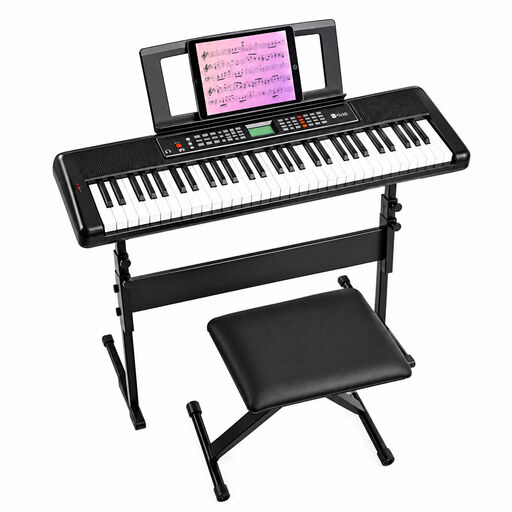 No image available
A set to consider if you want to create a practice space at home with a 61-key keyboard and stand.
The product title lists a stand, bench, music rest, 300 tones, 300 rhythms, a three-level learning function, an LCD screen and USB-MIDI. The keyboard doesn’t have 88 keys; check whether the exact version has a headphone socket.
No, not if you mainly want to practise at home. You could also compare portable digital pianos with a keyboard and headphone socket suited to your practice goals; only choose stage features if you need them.
First, check the plug size, turn the volume down before you start playing and take breaks during longer sessions. The World Health Organization points out that both sound level and listening time matter; wearing headphones doesn’t automatically make listening safe.
Measure the space available, including room for the stand and playing, and check the power supply, headphone plug, pedal connection and included accessories for the exact version. A stage instrument without speakers needs a suitable external audio setup so you can hear it.
For a typical online purchase as a consumer from a business, you usually have 14 days to change your mind, although this depends on the purchase. The Dutch government states that there is no fixed statutory period for legal guarantees in the Netherlands. If a product is faulty, contact the seller.
Wearing headphones doesn’t exempt you from general rules on nuisance to neighbours. The Dutch government notes that in many municipalities, nuisance is covered by the APV (local by-laws); check your local rules and be considerate of your living situation.