What should you look for when choosing?
Start with the feel of the keys and how you want to practise at home. Then check whether you have enough space and whether stage-oriented features will be useful for your plans.
| What to consider |
What should you check? |
Who is this important to? |
| Key action |
Compare the feel of the full keyboard and try it out for yourself, if possible. Roland lists 88 weighted PHA-4 keys for the RD-08, Korg lists 88 RH3 keys for the D1, and Yamaha lists 88 GHC keys for the P-225. |
If my main aim is to learn piano, I want a key action that feels comfortable and suits what I’m practising for. Around 40% of consumers give the feel of the keys their top priority. |
| Quiet practice |
Check whether the model has a headphone socket and built-in speakers. Korg says the D1 has no speakers, while Roland lists stereo speakers for the RD-08. |
If I want to practise without sound coming from speakers, I’ll look for a headphone socket and check what arrangements I need to make with housemates or neighbours. Around 30% of consumers prioritise quiet practice. |
| Attic space |
Measure the space for the instrument, music rest, stand and seat. Casio specifies a cabinet depth of 232 mm for the PX-S1100; also check how much room the complete setup will take up. |
With limited space in the attic, I want to know whether there’s room for the whole instrument, music rest and seat. For around 20% of consumers, where the instrument will fit is the top priority. |
| Performing later on |
Check which sound controls and connections you need. Roland lists direct controls for sounds and layers on the RD-08, while Korg lists LINE OUT on the D1. |
If I might want to play with others or perform later on, I want controls and connections that suit those plans. Around 10% of consumers prioritise the option to perform in future. |
Joybuy products for practising at home
These Joybuy products are 61-key instruments for practising at home. Bear in mind that they have fewer keys than the 88-key models compared above.
 No image available
MLS-931 digital piano, 61 keys, black
An option if you’re looking for a 61-key instrument to practise on at home.
The product name lists a weighted keyboard, 300 sounds, 300 rhythms, an LCD, USB-MIDI, speakers, a headphone socket and a music rest.
View at Joybuy
 No image available
Electronic keyboard piano, 61 keys, black
An option if you’re looking for a 61-key instrument with speakers.
The product name lists a MIDI controller, recording function, metronome and music rest.
View at Joybuy
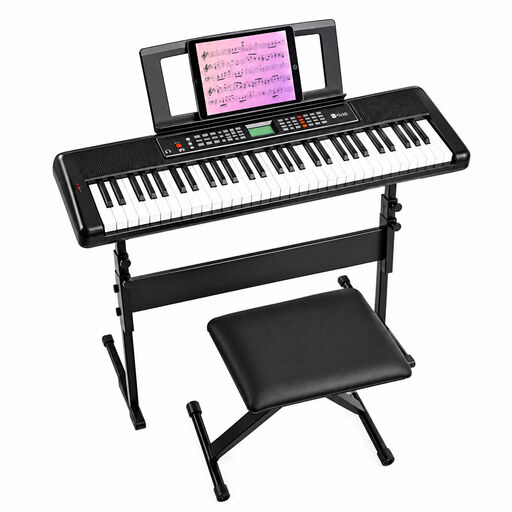 No image available
Digital keyboard piano set, 61 keys, with stand and bench
A set to consider if you’re looking for a 61-key instrument with accessories for your playing area.
The product name lists a stand, bench, music rest, 300 sounds, 300 rhythms, a three-level learning mode, LCD and USB-MIDI.
View at Joybuy
Frequently asked questions
Can I practise on a stage piano without an amplifier?
It depends on the model. Roland lists built-in stereo speakers for the RD-08, while Korg describes the D1 as having no speakers. Use headphones with the D1, or connect external audio equipment to hear it.
How can I check whether a piano will fit in my attic?
Measure the space for the complete setup and compare it with the dimensions of the exact model. For example, Yamaha specifies that the P-225 is 1.326 mm wide and 272 mm deep without the music rest; Korg gives dimensions for the D1 both with and without the music rest.
Does the piano come with a pedal or stand?
Check what’s included with the exact version. Korg says the D1 comes with a damper pedal, while the stand is sold separately. Yamaha lists the LP-1/FC35 three-pedal unit for the P-225 as an optional extra.
What can I do if I’m not happy with a piano bought online or it turns out to be faulty?
Online consumer purchases generally come with a statutory cooling-off period; ACM ConsuWijzer says it ends 14 days after delivery. Check which exceptions apply. The Netherlands Authority for Consumers and Markets says that the seller is responsible for the statutory guarantee if a product does not meet legal requirements.
Can I play music in my attic at any time?
There isn’t one playing time that automatically applies to every home. The Dutch government says local council rules on noise nuisance may apply; check the rules for your address and, if necessary, agree arrangements with your neighbours or housemates.


