
Pianist learning at home
If you’re mainly learning the piano part, weighted keys and easy practice may matter more than stage controls. Yamaha describes the P-225 as a compact piano with 88 keys; Roland lists built-in speakers for the RD-88 EX.


A digital piano with weighted keys and built-in speakers is a practical choice if you want to practise in your loft straight away, without extra audio equipment. A stage piano without speakers is a better fit if you already have headphones or an amplifier and value hands-on stage controls. Check the connections, pedal and dimensions of the complete setup for the exact model, including the music stand.
If you’re mainly learning the piano part, weighted keys and easy practice may matter more than stage controls. Yamaha describes the P-225 as a compact piano with 88 keys; Roland lists built-in speakers for the RD-88 EX.
If you often practise when others don’t want to hear sound from speakers, check the headphone socket and make sure it’s compatible with your headphones. The Korg D1 has a headphone socket; Roland lists two headphone outputs for the FP-30X.
If you want to learn at home and might play on stage later, consider the controls, sound options and audio outputs too. Roland describes stage features on the RD-88 EX; Nord offers the Piano 6 with either 73 or 88 keys.
A good fit if: you want to practise with audible sound in your loft and have direct access to stage features.
The trade-off: stage features aren’t necessarily needed to learn a single piano theme.
A good fit if: you mainly play with headphones or already have suitable external audio equipment.
The trade-off: you’ll need extra equipment to play out loud in the room if your model doesn’t have speakers.
A good fit if: learning the piano part is your main priority and live controls aren’t essential.
The trade-off: compare the connections and controls with your plans before choosing the instrument for performances too.
| What to consider | What should you check? | Who should pay particular attention? |
|---|---|---|
| Touch and pedal | Check the type of keyboard and which damper pedal is included or supported; if possible, try playing both soft and loud passages. | If you want to practise the dynamics of the piano part, make your touch a priority. Around 31% of consumers prioritise the feel of the keys. |
| Quiet practice | Check the headphone socket on the exact model and make sure it’s compatible with your headphones. | If you want to practise without sound from speakers in the room, a compatible headphone socket is important. Around 25% of consumers put quiet practice first. |
| Sound and positioning | Check whether the model has built-in speakers, and measure the space needed for the setup, including the music stand and any piano stand. | If you want to play out loud without an extra amplifier and space is limited in your loft, the speakers and overall dimensions both matter. Around 25% of consumers prioritise this combination. |
| Stage features | Decide whether you need sound switching and line outputs; check which key version of the Nord Piano 6 you’re looking at. | If you also want to use the instrument on stage later, the controls and connections may matter more than they would for home practice alone. Around 19% of consumers make future stage features their first priority. |
The Korg D1 and Yamaha CP88 don’t have built-in speakers. You’ll need external audio equipment to hear these models in the room.
Before buying, check the connections and make sure your existing headphones or audio equipment are compatible with the model.
To play out loud, a model without speakers may require extra equipment and suitable cables.
The depth required may change when you use the music stand. Yamaha gives separate depth measurements for the P-225 with and without its music stand.
Measure the space available for the complete setup of the exact model, including the music stand and any piano stand.
A commercial manufacturer’s or retailer’s guarantee is separate from your statutory rights. According to ACM ConsuWijzer, the retailer is responsible for providing an appropriate solution if a product is faulty.
First, check your statutory rights, then consider whether additional warranty cover would be useful for your situation.
The RD-88 EX is a stage-focused option with built-in speakers; the FP-30X is a portable digital piano suited to home practice, among other uses.
The P-225 is designed for compact home practice; the CP88 is a separate, stage-focused range.
The D1 is a slim piano without built-in speakers, designed for home practice or stage use with an external audio setup.
The Piano 6 is aimed at players who want piano and synth layers, along with direct access to stage features.
The Privia PX-S1100 is a compact digital piano for anyone who needs to make the most of their space at home.
The Joybuy selection below focuses on portable digital pianos and keyboards for home practice, with 61 keys and built-in speakers.
 No image available
An option for home practice, with speaker sound and a touch-responsive keyboard.
 No image available
A home setup with built-in speakers and a music stand, which is listed as part of the set in the product name.
 No image available
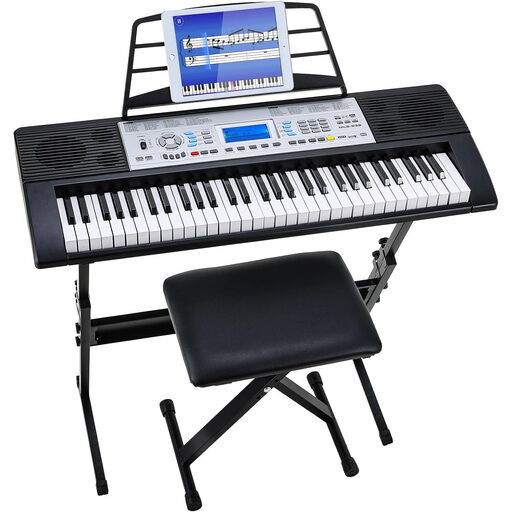
This set is designed for home practice and includes a stand, stool and music stand, according to the product name.
 No image available
A home-focused set with speakers and a learning mode, for anyone considering practising on a compact keyboard.
It depends on the model. According to Roland, the RD-88 EX has built-in stereo speakers; the Korg D1 and Yamaha CP88 don’t. You’ll need external audio equipment to hear a model without speakers in the room. Alternatively, you can practise using suitable headphones without playing through room speakers.
Headphones keep sound from speakers out of the room. If noise is causing a disturbance, the Dutch government advises talking things through and agreeing on arrangements, such as suitable times. This isn’t nationwide permission to play at any time.
Measure the available space with the music stand in place, and check which pedal and stand are included with your chosen version. Yamaha gives different depth measurements for the P-225 with and without the music stand; Korg lists a pedal included with the D1 and a stand available separately.
For a typical online consumer purchase, you’ll generally have a statutory cooling-off period of up to 14 days after delivery; legal exceptions may apply. Your statutory rights are separate from a manufacturer’s warranty: if a product is faulty, the retailer is responsible for providing an appropriate solution.