Who is this suitable for?

Beginner pianist

Would you like to learn a melody, perhaps with left-hand accompaniment, while improving your piano playing? Start by comparing the key range and touch response. Yamaha, Roland and Korg list different keyboards and numbers of keys for each model.

Quiet home practice

If you share the spare room with others, practising with headphones may be important. Check the headphone connection and how you can listen when you want to play without headphones; Roland and Korg offer different options on different models.

Player short on space

Does the instrument need to fit in a small room or one that’s only used temporarily? Measure not just the keyboard, but also its depth with the music rest, plus the space needed for the stand and playing area. Yamaha and Korg publish dimensions for the models mentioned here.

What should you look for when choosing?

Stage piano without built-in speakers

A good fit if: you want a weighted keyboard and line outputs for external audio equipment, and already have suitable headphones or a sound system.

Bear in mind: Korg says the D1 has 88 RH3 keys and LINE OUT, but no built-in speakers.

Stage keyboard with speakers

A good fit if: you want to use organ or synth sounds as well as piano sounds, and listen through the instrument itself. Yamaha lists these sounds and built-in speakers for the CK series.

Bear in mind: the CK61 has 61 FSB keys, while the CK88 has 88 GHS keys. Compare the range and keyboard type that suit your music and lessons.

Portable digital piano for home

A good fit if: you want to focus on piano practice and be able to listen without external speakers. Roland lists built-in speakers and headphone use for the FP-10.

Bear in mind: the Yamaha P-145 has 88 GHC keys and is 1,326 mm wide, so a compact casing doesn’t necessarily mean a shorter keyboard.

What to consider What should you check? Who is this important for?
Piano touch and key range Compare the number of keys, keyboard type and pedal function of the exact model with your piece of music and any lessons. If I want to learn a melody with accompaniment and keep practising, I look at touch response and range. Around 36% of consumers say piano playing is their top buying priority.
Practising quietly Check the headphone connection and whether the instrument has built-in speakers or needs external audio equipment. In a shared home, I want to practise without the instrument playing through speakers. Around 29% of consumers give quiet practice their top priority.
Space for your setup Measure the available width and depth, then compare them with the dimensions, including the music rest and stand if needed. If the piano will be in the spare room temporarily, I want to know in advance whether the instrument and playing area will fit. Around 21% of consumers put the space needed for the setup first.
Extra sounds and practice features Decide which sounds you want to use and check the metronome, pedal options and connections for each model. If I want to try the piece with other sounds too, I compare those features with the keyboard I need. Around 14% of consumers make sound variety or practice features their top priority.

Key buying points not to miss

  • Don’t assume every stage piano has speakers

    Korg says the D1 has no built-in speakers, while Yamaha lists speakers for the CK series. How you can listen at home therefore varies by model.

    Check how you want to listen to the instrument before choosing accessories.

    To play the D1 out loud without headphones, you’ll need external audio equipment.

  • Don’t confuse a slim casing with a short instrument

    The Yamaha P-145 is 1,326 mm wide and the Korg D1 is 1,327 mm wide. You’ll also need space for the music rest, stand and playing area.

    Measure the available width and depth, and allow for your chosen setup.

  • Don’t compare only the number of sounds

    The Yamaha CK61 has 61 FSB keys. That’s a different combination of key count and keyboard type from the 88 keys on models such as the Korg D1.

    Start with the range and touch response your music or lessons require, then consider which extra sounds you’ll actually use.

Brands to compare

Korg

The D1 is a stage piano worth comparing if you’re looking for a weighted keyboard and connections for external audio equipment.

  • Korg lists 88 RH3 keys, LINE OUT and a supplied damper pedal for the D1.
  • The D1 has no built-in speakers, so bear this in mind if you want to play out loud in the room.

Yamaha

The CK series is worth comparing if you want a wider choice of sounds; the P-145 is a portable digital piano for piano-focused practice.

  • Yamaha lists built-in speakers and 61 FSB keys for the CK61; the P-145 has 88 GHC keys.
  • The P-145 is 1,326 mm wide. The model specifications alone won’t tell you which touch response will feel most comfortable to play.

Roland

The FP-10 is a portable digital piano worth comparing for piano-focused practice at home.

  • Roland lists 88 PHA-4 Standard keys, built-in speakers, headphone use and a metronome.
  • The optional DP-10 pedal is required for the half-pedalling described by Roland.

Casio

The CDP-S110 is another portable model worth comparing if piano-focused controls and app-based practice are important to you.

  • Casio describes a scaled hammer-action keyboard, a supplied SP-3 sustain pedal and settings such as the metronome available through CASIO Music Space.
  • Check that the version and app connection suit the way you want to practise; these are product specifications described by Casio.

Joybuy products

This Joybuy selection includes digital pianos and 61-key keyboards for practising at home. Check that the range suits your piece of music and any lessons.

MLS-931 digital piano with 61 keys

MLS-931 digital piano, 61 keys

The title mentions a weighted keyboard and built-in speakers for practising without separate speakers.

According to the product name: 300 sounds, 300 rhythms, a metronome, a headphone socket and USB-MIDI.

View at Joybuy

Electronic keyboard piano with 61 keys

Electronic keyboard piano, 61 keys

With 61 keys, this model is designed for anyone looking for a keyboard piano with a more limited range.

The product name lists a MIDI controller, recording function, speakers, metronome and music rest.

View at Joybuy
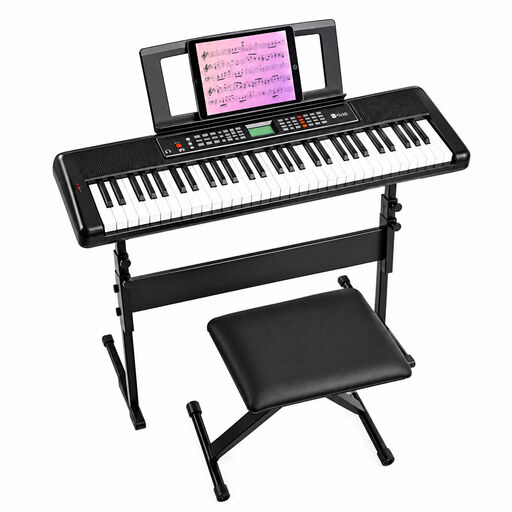
Digital keyboard piano set with 61 keys

Digital keyboard piano set, 61 keys

The product name lists a set with a stand, bench and music rest for your setup.

According to the product name: 300 tones, 300 rhythms, a three-level learning function, LCD screen and USB-MIDI.

View at Joybuy

Frequently asked questions

Can you play the Korg D1 out loud in the spare room without extra equipment?

No, the Korg D1 has no built-in speakers. Use suitable headphones or connect external audio equipment to LINE OUT if you want to listen without headphones.

Do you need a more advanced pedal straight away?

That depends on the piece and the pedalling technique you want to practise. Korg says the D1 comes with a damper pedal; for half-pedalling on the Roland FP-10, Roland lists the optional DP-10 pedal. Check what’s included with the version you choose.

What should you consider when placing a piano in a spare room?

Allow for the depth of the music rest, and leave space for the stand and seat. Yamaha gives the P-145’s depth as 268 mm without the music rest and 320 mm with it.

Who should you contact if a product develops a fault after purchase in the Netherlands?

Report a fault to the seller. According to the Dutch government, you’re entitled to a product that works properly, and there is no fixed statutory warranty period in the Netherlands; what you can expect depends, among other things, on the product and how it’s used. A manufacturer’s warranty does not replace your statutory rights.

Do you have a cooling-off period when buying a piano online from a business?

In many cases, distance purchases come with a 14-day cooling-off period, according to the Dutch government. Check the terms of the specific purchase; these rules on distance selling do not apply in the same way when buying from a private individual.
