
For small, neatly presented bites
Want to serve lots of small toasts where the topping takes centre stage? Melba toast is one option to consider; ALDI and Jumbo, among others, have plain varieties in their ranges.


For small bites at the St Nicholas parade, Melba toast is an obvious choice; opt for party toast if you want more room for toppings. A seasoned variety works best when its flavour complements the topping. If you have allergies or questions about ingredients or salt, always check the current packaging.
Want to serve lots of small toasts where the topping takes centre stage? Melba toast is one option to consider; ALDI and Jumbo, among others, have plain varieties in their ranges.
If you want to add spreads, cheese or other generous toppings, compare the size of party toast or luxury toast with that of Melba toast. Lidl and ALDI list these product types separately.
If you have allergies or specific questions about ingredients or salt, the packaging of the variety you choose is the definitive source. The Netherlands Nutrition Centre highlights the importance of checking labels for allergens, while Albert Heijn notes that product information can change.
First decide how you want to top and serve the toast; then compare the flavour, label and pack contents.
| What to consider | What to check when buying | Who it matters to |
|---|---|---|
| Size and shape | Compare Melba toast, party toast and toast cups; check that each piece is large enough for your topping. | For small bites, I want a compact base, while generous toppings need more room. Around 31% of consumers would consider the right product shape their most important selection criterion. |
| Flavour | Compare plain and seasoned varieties, and match the flavour to your topping. | If I’m serving simple toppings, the toast itself can have more flavour; with strongly flavoured toppings, I’d choose a more neutral base. Around 31% of consumers would put this flavour pairing first. |
| Ingredients and allergens | Read the current ingredients list and allergen information; compare the salt content per 100 g in the nutritional information. | If I have an allergy or a question about baker’s salt, I want to know what’s in this particular variety. Checking ingredients and labels would be the main priority for around 23% of consumers. |
| Quantity | Check the net weight and, if stated, the number of toasts in the pack. | When catering for a group, I want to have enough toast ready without buying more varieties than I can serve. Quantity and ease of serving would determine the choice for around 15% of consumers. |
A toast with truffle, garlic or herbs, for example, has its own flavour, which won’t suit every topping. Albert Heijn and Jumbo list a range of flavoured varieties, but choosing a topping that goes with yours is still a separate decision.
Choose plain toast if you want the topping to provide the flavour. Consider a seasoned variety if you’d like the toast itself to add more flavour to a simple topping.
Melba toast, party toast and toast cups all have different shapes. So a size that works for a small bite won’t necessarily be suitable for a generous topping or a filling.
Before you buy, decide whether you want to serve small topped toasts, larger bites or filled cups, then check the shape of the pack you choose.
Ingredients and allergen information can change. The Netherlands Nutrition Centre says that checking the label is important if you have food allergies; Albert Heijn also warns that online product information may change.
Just before serving, check the allergen information and ingredients on the current packaging. If anything is unclear, ask the manufacturer for clarification.
The Netherlands Food and Consumer Product Safety Authority explains the conditions under which iodine compounds may be present in bakery products through baker’s salt. This doesn’t mean that an individual toast product contains baker’s salt.
If baker’s salt matters to your choice, check the ingredients list on the specific pack and contact the manufacturer for product information if necessary.
Bolletje is particularly relevant here as an example of a different type of snack: its ciabatta crackers aren’t classic Melba toast.
Albert Heijn’s toast range includes both Melba toast and varieties with a more pronounced flavour.
At Jumbo, you can compare different toast shapes and flavours side by side.
Lidl has separate product pages for Melba toast and party toast.
ALDI’s toast range includes Melba, luxury and party toast, as well as toast cups.
For small bites where the topping takes centre stage, you can explore this Melba toast at Joybuy. If you’re planning generous or moist toppings, check for yourself that the size and texture are suitable.
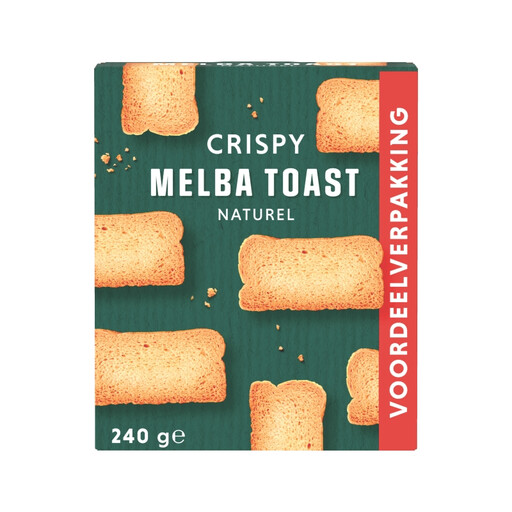 Image unavailable
Melba toast to consider for small topped bites.
Pack contents: 240 g.
The allergen information for this product is contradictory. If you have allergies, check the current packaging and ask the manufacturer for clarification if in doubt.
Check the size and firmness if you want to add generous or moist toppings.
Melba toast is well suited to small bites; party toast is worth considering when you need more room for toppings. It’s a choice based on how you want to serve the toast, not a general ranking of quality. If you’re planning generous or moist toppings, check beforehand that the toast is suitable.
Read the allergen information and ingredients list on the current packaging. The Netherlands Nutrition Centre stresses that checking the label is important if you have food allergies; don’t rely solely on the product name or an online description, which may change.
No, the Dutch rules don’t confirm that every toast product contains iodine. According to the Netherlands Food and Consumer Product Safety Authority, iodine compounds may be present in bread, bread substitutes and other bakery products only through baker’s salt, with a maximum of 65 mg of iodine per kg of salt. Check the ingredients list on the packaging of the toast you choose.
Compare the amount of salt per 100 g in the nutritional information, even if the packs are different sizes. The Netherlands Nutrition Centre says that the nutritional values of these products are listed per 100 g; also check the ingredients of the specific variety.