
Manager of large animation projects
You want to keep project files and source material together on one portable working drive. So, before choosing a capacity, work out the size of your complete projects and how much they’re likely to grow.


Start by working out how much space you need for complete project folders and source files. Then check that your workstation’s port and cable support the SSD’s speed. A USB 3.2 Gen 2x2 or Thunderbolt model is only really worthwhile with a compatible host. An external SSD is not a back-up in itself, nor does it enable simultaneous collaboration.
You want to keep project files and source material together on one portable working drive. So, before choosing a capacity, work out the size of your complete projects and how much they’re likely to grow.
If you move or use large media files directly from the external drive, the host connection and achievable speed matter more than the stated maximum alone.
You need to keep files accessible to different users and systems, while also agreeing how to manage project dependencies, access and back-ups.
First, work out how much space your complete projects will need. Then check the connections and systems, and arrange a separate back-up for any files you want to keep.
| What to consider | What should you look for? | Who is this most important for? |
|---|---|---|
| Space for complete projects | Compare the drive’s capacity with the size of complete project folders, including collected source files and expected growth. | If I want to keep several projects and their source files together, I first want to work out how much space I need. Around 26% of consumers put space for complete projects first. |
| Compatibility between users and systems | Check which computers need access, which ports are available and whether the file system works on those systems. | If different users need to open the drive on their own computers, I want to check in advance that the files will be accessible there. Around 21% of consumers prioritise compatibility between users and systems. |
| Speed when working and transferring files | Check the host port and cable specifications. A USB-C connector alone doesn’t confirm support for USB 3.2 Gen 2x2. | If I often transfer large media files or work from the SSD, I want to know what my workstation actually supports. Around 21% of consumers prioritise transfer speed. |
| Data protection and access | Decide who will have access, where the independent back-up will be stored and how you’ll test recovery. | If lost project files would be difficult to replace, I want to arrange a separate copy and clear access rules. Around 21% of consumers put data protection and access first. |
| Moving between workstations | Consider whether the SSD will be moved often, and check the included cable and any protection claims for the specific model. | If the drive will regularly move between workstations, I also want to consider its size, connection options and physical protection. Around 11% of consumers prioritise portability. |
Stated maximum speeds apply to specific interfaces and conditions. So, a port with the right connector shape doesn’t automatically provide the connection needed to achieve them.
Before you buy, check the host port and cable specifications, as well as the conditions attached to the SSD’s stated speed.
An After Effects project may refer to media files stored outside the project file. This means the project could be incomplete if you transfer only that one file.
Adobe describes Collect Files as a feature that copies relevant project files into one folder. Check that folder before deleting the original files.
If the SSD contains the only copy and it’s lost, there won’t be a separate project copy to fall back on.
Keep an independent copy and test that you can open a project from it.
Apple warns that formatting erases all files on the relevant drive or volume.
Check which systems need access and copy any existing data elsewhere before formatting the drive.
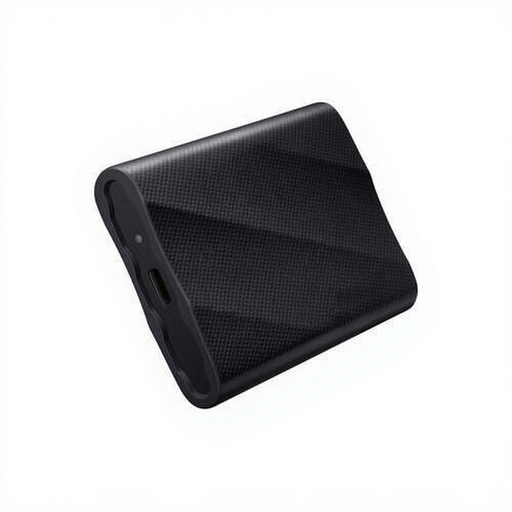
The Portable SSD T9 is available in a 4 TB version for large project folders, with a USB 3.2 Gen 2x2 connection.
The X10 Pro is available in a 4 TB version, among others, for large media projects, and offers a USB 3.2 Gen 2x2 connection.
The Rugged SSD Pro is designed for a compatible Thunderbolt workflow and also offers a USB-C connection.
The XS1000 is a compact USB 3.2 Gen 2 option, available in 1 TB and 2 TB versions.
These models are portable SSDs for external project storage. Check that the capacity and connection of each version are right for your workstation.
 No image available
A portable 1 TB SSD to consider if that capacity suits your project inventory and your host supports USB 3.2 Gen 2x2.
The product description quotes read speeds of up to 2.000 MB/s and notes that write speeds are lower. It also lists AES 256-bit encryption, IP65 protection, Windows and macOS compatibility, a USB-C cable and a USB-A adapter.
 No image available
A 2 TB version for external project storage, if that capacity suits your inventory and USB 3.2 Gen 2 is sufficient for your host.
The product description quotes maximum read speeds of 1.050 MB/s and write speeds of 1.000 MB/s, AES 256-bit encryption, drop protection from heights of up to 2 metres, and compatibility with Windows and macOS. It lists USB-C to USB-C and USB-C to USB-A cables.
 No image available
A 2 TB version for external project storage, if your project inventory suits this capacity and your workstation supports USB 3.2 Gen 2x2.
The product description quotes maximum read speeds of 2.000 MB/s and write speeds of 1.950 MB/s, hardware encryption and drop resistance from heights of up to 3 metres. It also lists Windows and macOS compatibility, and USB-C to USB-C and USB-C to USB-A cables.
 No image available
This version offers 4 TB for large project folders, if that capacity suits your inventory and your host supports USB 3.2 Gen 2x2.
The product description quotes read and write speeds of up to 2.000 MB/s, AES 256-bit hardware encryption and drop resistance from heights of up to 3 metres. It also lists Windows and macOS compatibility, and USB-C to USB-C and USB-C to USB-A cables.
 No image available
A 1 TB version for external project storage, if your project inventory fits within that capacity and your host supports USB 3.2 Gen 2x2.
The product description quotes read speeds of up to 2.000 MB/s, hardware encryption and drop resistance from heights of up to 3 metres. It also lists Windows and macOS compatibility, and USB-C to USB-C and USB-C to USB-A cables.
Yes, if both computers support the file system and connection. Apple lists exFAT as a Windows-compatible option for drives larger than 32 GB. First, make a copy of any existing files: formatting erases the files on the drive.
No. The connector shape alone doesn’t tell you which interface the host supports. Check the SSD, host port and cable: the stated USB 3.2 Gen 2x2 speeds require a compatible host, while LaCie links the Rugged SSD Pro’s higher maximum to Thunderbolt.
Make sure you include the files the project refers to. Adobe describes Collect Files as a feature that copies relevant project files into one folder. Check that collected folder before deleting the original files.
No. The Dutch government says there is no fixed statutory warranty period in the Netherlands. A product must be fit for purpose, and if there’s a problem, the seller must provide a solution; a manufacturer’s warranty is separate.
Not as a general product requirement for every buyer. If an organisation processes personal data, the Dutch Data Protection Authority says it must choose appropriate security measures based on the risks of that processing. The required combination of measures can’t be determined by SSD type alone.